
What this course is built on
This course follows the Texas Essential Knowledge and Skills for Grade 5 science, 19 TAC §112.7. The standard has thirteen strands. Four cover how scientists work. One covers the big ideas that repeat all through science, like patterns and cause and effect. Eight cover the science itself. Every strand is taught this year.
The units are named for what the child learns, in plain words. They follow the order of the strands. A textbook is one company’s sequence. The standards are the requirement. We write the lessons to the standards.
The state asks that at least 50 percent of science time be spent investigating. That means asking questions, planning, and doing safe work with real things. That is why every lesson has a hands-on investigation and why the lessons are short on reading.
What your scientist will be able to do
- Design a simple experiment with a question, a variable and controls.
- Show that matter is made of particles and that mass is conserved when things dissolve.
- Explain equal and unequal forces and test them on a ramp or with a balloon rocket.
- Trace energy as it changes form in a circuit and follow light as it reflects, bends and is absorbed.
- Explain day and night, and the changing shadow, from the spin of Earth.
- Describe a healthy ecosystem and how people can help or harm it.
The year
41 lessons in nine units. Weeks are intent, not contract.
| Unit | Title | TEKS strand | Lessons | Window |
|---|---|---|---|---|
| 1 | The Scientist’s Toolkit | 1 to 4 | 7 | Weeks 1 to 6 |
| 2 | Matter and Particles | 6 | 6 | Weeks 7 to 11 |
| 3 | Forces and Motion | 7 | 4 | Weeks 12 to 15 |
| 4 | Energy, Circuits and Light | 8 | 5 | Weeks 15 to 19 |
| 5 | Earth Spins | 9 | 3 | Weeks 20 to 22 |
| 6 | Water, Rock and Landforms | 10 | 6 | Weeks 22 to 27 |
| 7 | Using Resources Wisely | 11 | 3 | Weeks 28 to 29 |
| 8 | Ecosystems | 12 | 4 | Weeks 30 to 33 |
| 9 | Structures and Behaviors | 13 | 3 | Weeks 34 to 36 |
How a lesson works
- Try this first. A small puzzle you can tap through. It gets the thinking started.
- Today’s story. Three short paragraphs. A button reads it aloud.
- Five steps. The idea, one piece at a time.
- Hands on. A real investigation with a list of what you need.
- Three rules. The big ideas, short enough to remember.
- Poppy’s quiz. Six questions with the reason behind each answer.
- Talk about it. Two questions to say out loud or write down.
Safety
Hands-on work happens with an adult nearby. No open flame. No mixing of store-bought chemicals. No tasting of lab materials. Wear eye protection when a lesson says to. Wash hands after. Tell an adult about every spill, cut or surprise right away, however small.
Nothing is saved about your child
These pages do not ask for a name, an email or a login. Scores and answers stay on the screen and disappear when the page closes.
What to keep on the shelf
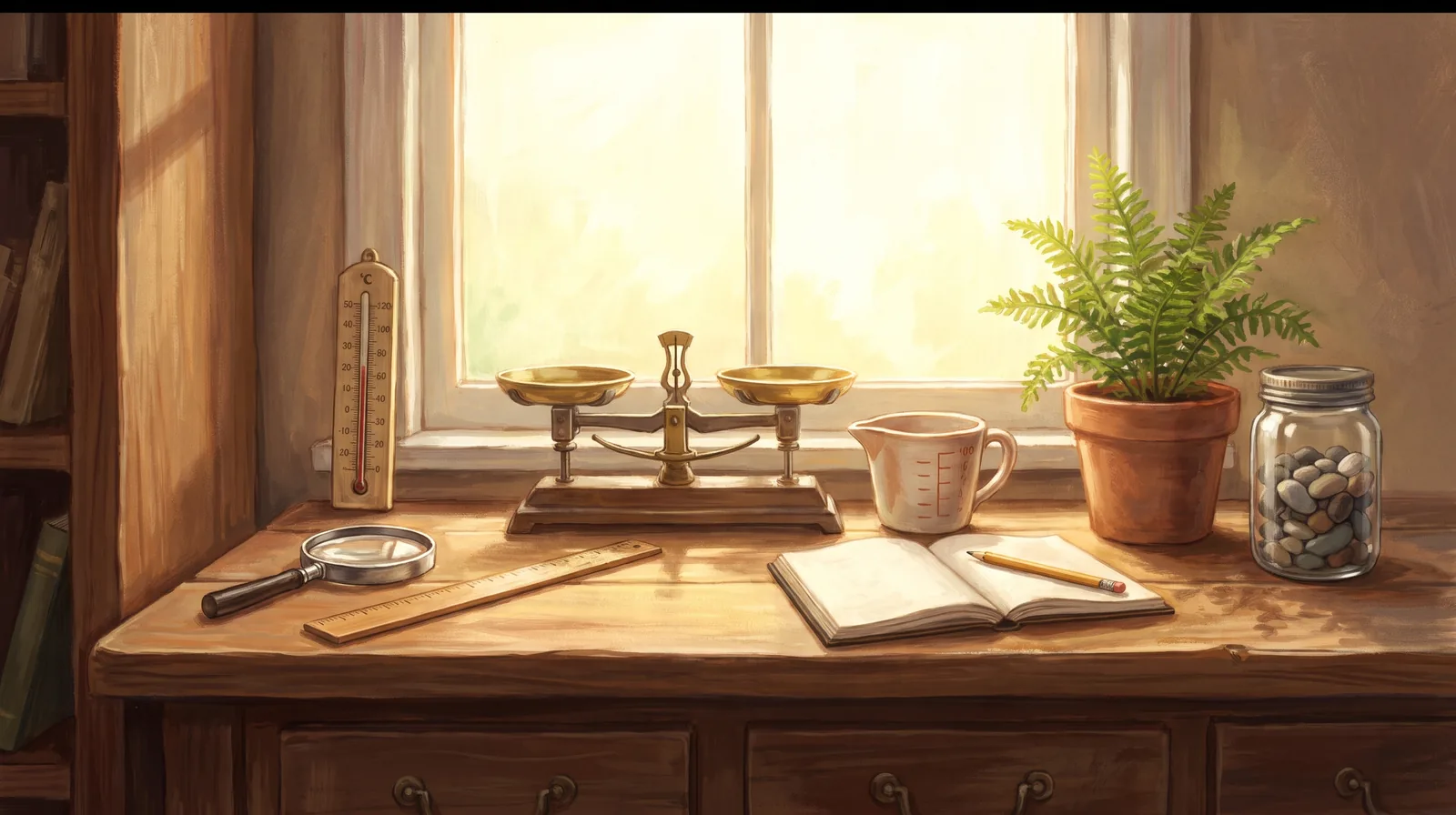
Most of the year runs on kitchen and classroom things. This is every item named in the Grade 5 investigations.
- a bag of clean household waste from a week
- a baking pan
- a baking pan or plastic tub
- a ball or orange
- a book to tilt the pan
- A classroom or a kitchen
- a clear glass jar
- a clear jar with a lid
- a clear jar with lid
- a clear plastic cup
- a clear zip bag
- a clipboard
- a clock
- a compass or a phone compass
- a cup
- a dark room
- a drip tray
- a flashlight
- a group of 6 to 8
- a hair dryer on low or a paper fan
- a hand lens
- a handful of soil
- a heavy book
- a hula hoop or string square
- a kitchen scale
- a lamp with no shade, or a flashlight
- a marker
- a measuring cup
- a notebook
- a paper plate
- a paper towel
- A parent or neighbor with a job
- A parent or teacher
- A partner
- a pencil
- a plastic cutting board
- a plate
- A result from an earlier test
- a ruler
- a ruler or tape measure
- a ruler to prop pans
- a safe window or yard spot
- a shallow box or tray
- a shoebox
- a small ball
- a small balloon
- a small block or rock
- a small bottle with a pinhole
- a small jar
- a small paper cup with a pinhole
- a spoon
- a stick or ruler
- a sticker
- a sunny window
- a timer
- a tub or sink of water
- a watering can
- Balloons of two sizes
- Battery
- Battery, bulb and wires
- Black cloth
- blue food coloring
- Books
- Buzzer
- chalk
- clay or a cup of dirt to hold it up
- Clay or tape
- Clear cup
- clear cups
- Clear glass of water
- Clock
- Clock or timer
- clothespin
- Coffee filter
- cooking oil
- cotton balls
- Cup
- Cup of warm tap water
- Cup of water
- damp sand
- Dark room
- Drinking straw
- dry beans
- dry sand or fine salt
- Five question starters
- Five small objects such as a cork, nail, coin, rubber band and eraser
- Flashlight
- Flat board
- Flat mirror
- four boxes labeled
- Four clear cups
- Four marbles
- gloves
- Graph paper
- grass clumps or sod
- Hand lens
- Hand-crank radio or toy
- ice cubes
- Index cards
- Iron filings or steel wool bits
- Kitchen scale
- Kitchen scale or balance
- Magnet
- Magnet in a plastic bag
- markers
- Measuring cup
- Metal spoon
- Mirror
- modeling clay in several colors
- Notebook
- One D or AA battery
- paper
- Paper and pencil
- Paper clip, eraser, coin, pencil
- paper for tally marks
- Paper towel
- paper towels
- Pencil
- Pennies or washers
- Penny, leaf and a pencil
- Pepper
- Plastic spoon
- Room-temperature water
- Ruler
- safety glasses
- Safety goggles if you have them
- Salt
- Sand
- Scissors
- Second cup
- Shallow pan
- Sheets of paper
- Small bulb
- Small cup
- Small flashlight bulb
- small gravel
- Small motor
- small plants or moss
- small toy or paper turtle
- soil
- Spoon
- Spring scale or a small kitchen scale
- Straw
- String
- String about 4 meters
- Sugar
- Switch from a clothespin and foil
- Tablespoon for stirring
- Tape
- Tape measure
- Teaspoon
- Thermometer
- Thermometer or a dab of butter on each handle
- Three brands of paper towel
- Three index cards
- Toy car
- Tray
- Tub of water
- tweezers
- two baking pans
- two buckets or jugs
- Two grooved ruler tracks or a folded paper channel
- Two spring scales
- Two stacks of books
- Two thermometers
- Two wires with bare ends
- Warm tap water
- Water
- wax paper
- White cloth
- Wires
- Wooden spoon
- yarn