
Teacher cards / Activity 34
For teachers and helpers. Adult supervised. Not for student screens.Water Cycle in a Bag
Can a little water in a sealed bag make its own rain?

★The card
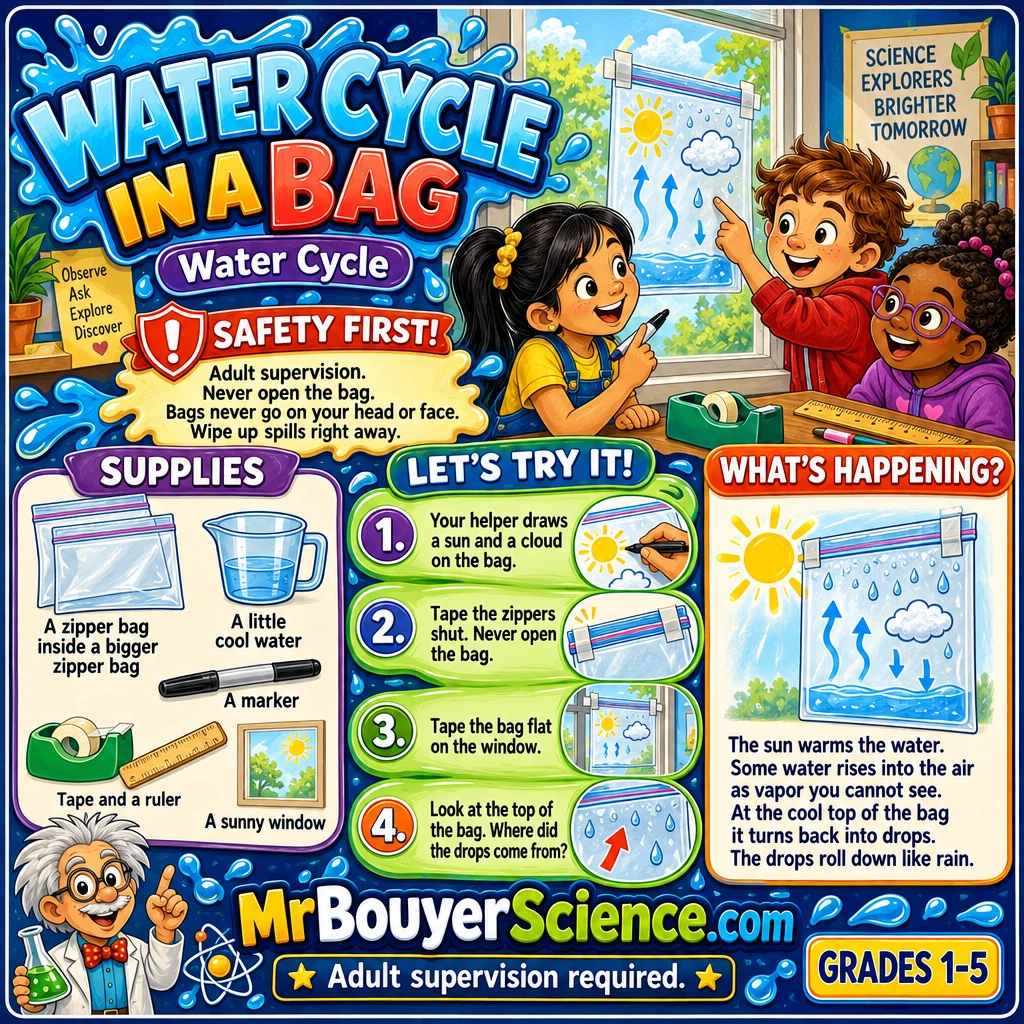
Put this card on the board for the class, or print it. Save the card
1Before class
The day before
- Make one bag yourself the day before. Tape it to your sunny window and see how long drops take to show.
- Find the sunniest window in the room. Direct sun for several hours works best.
- Pick a shady spot for two groups. A wall or shelf away from the window is fine.
- Plan a time later the same day to check the bags. Drops often show after a few hours on a sunny day. A cloudy day may need until tomorrow.
- Give your helpers the helper guide on this page. Let them seal one bag first.
- Check the window area. Move blind cords out of reach of small children.
Ten minutes before kids arrive
- Measure one quarter cup of cool tap water into each of five small cups. Set one cup on each tray.
- Lay out one quart zipper bag and one gallon zipper bag on every tray.
- Tear eight strips of masking tape and stick them to the edge of every tray.
- Put a ruler, a permanent marker, paper towels, pencils and paper at every group.
- Clear a space on the window sill. Wipe the glass dry so tape will stick.
- Keep one spare set of bags in your kit in case of a leak.
- Put this card up on the board.
Safety and care
- An adult stays with every group for the whole activity.
- The K to 5 teacher is the responsible adult in the room. Helpers are teenagers and work with the teacher.
- Only the helper uses the permanent marker. Draw the sun and cloud before any water goes in. Keep the cap on when not drawing.
- Plastic bags are never put over a head or face. Keep bags flat on the tray or taped to the window.
- Water on the floor is a slip risk. Pour only over the tray and wipe up spills at once with paper towels.
- The bags are double sealed and taped shut. They are never opened. Opening a bag lets the water out and ends the experiment.
- Use cool tap water only. Nothing is tasted. Nothing goes in mouths.
- Children stay at the window with an adult. Nobody climbs on chairs or the sill. The teacher or a helper tapes up anything high.
- Wash hands after the activity.
2Materials for 15 students
| Item | Per group | Whole class | Notes |
|---|---|---|---|
| Quart zipper bags, freezer type | 1 | 5 | Freezer bags are thicker and leak less. Keep a few spares. |
| Gallon zipper bags, freezer type | 1 | 5 | The outer bag. The quart bag goes inside it. |
| Cool tap water, one quarter cup in a small cup | 1 | 5 | Measure it ahead. Cool water only. |
| Permanent marker, low odor | 1 | 5 | Helper only. Draws the sun, the cloud and the water line. |
| Masking tape strips | 8 | 1 roll | Tear the strips ahead and stick them on the tray edge. |
| Trays | 1 | 5 | A baking sheet or lunch tray catches spills. |
| Rulers in centimeters | 1 | 5 | For measuring how tall the water is. |
| Paper towels | 3 | 15 | For spills and for drying the outer bag. |
| Pencils | 3 | 15 | |
| Plain paper, folded in half | 3 | 15 | Each child records their own bag. |
| Trash bag | 1 | The sealed bags go in whole when the activity ends. |
How to set up the room
- Put the five trays on tables or the floor a few steps from the window.
- Keep one clear path to the window. Seat the groups so each can see the board.
- Groups 1 to 3 hang their bags on the sunny window. Groups 4 and 5 hang theirs on the shady wall.
- Tape each bag flat at the top and bottom so it hangs without sagging.
3Run it in 30 minutes
Groups sit with their trays. Show the board. Ask where the water will go after hours in the sun.
The helper draws a sun and a cloud with the marker. The helper pours in the water. Seal the quart bag. Slide it into the gallon bag and seal that too. Tape the zipper shut.
A child marks the water line on the bag. Another child measures how tall the water is in centimeters. The third child writes it down.
Tape the bags flat. Groups 1 to 3 go on the sunny window. Groups 4 and 5 go on the shady wall.
Talk about the water journey. Wipe the trays. Wash hands. The teacher checks the bags later the same day.
4What the kids do
- Your helper draws a sun and a cloud on the quart bag with a marker.
- Your helper pours in the water. Seal the bag. Slide it into the big bag and seal that too.
- Tape the zippers shut. This bag will never be opened.
- Mark the water line on the bag. Measure how tall the water is. Write it down.
- Tape the bag flat on the window or the shady wall.
- Draw what you think will happen. Come back later and draw what you see.
- Look at the top of the bag. Where did the drops come from?
Match it to the grade
Watch for drops on the bag. Draw the sun, the cloud and the rain. Say the words sun, water, rain together. Talk about the water going up and coming down.
Measure the water line. Draw the bag at the start and later in the day. Use the words evaporation and rain. Say which bag had more drops.
Compare the sunny bags to the shady bags. Record where drops form and how big they get. Name evaporation, condensation and precipitation. Explain why the bag stays sealed.
5Helper guide for older students
Your job
- Lead one group of three. Seal one bag the day before so you know the steps.
- Draw the sun and cloud before any water goes in. Keep the marker with you.
- Pour the water over the tray. Seal both bags and tape the zippers.
- Give each child a job. One marks the line. One measures. One records.
- Ask questions and let the children guess before you explain.
Say things like this
- What do you think will happen to the water?
- Where do you think the water will go?
- Let us look again later and see.
- That is a good guess. How could we test it?
Please do not
- Do not open a sealed bag.
- Do not let a bag go near a child's face.
- Do not leave water on the floor.
- Do not give away the answer before the children look.
- Do not say a guess is wrong. Say let us look and see.
6Talk it over
Questions to ask
- Where did the drops on the top of the bag come from?
- What did the sun do to the water? How do you know?
- Why did the bag on the sunny window look different from the one in the shade?
- What did we change and what stayed the same?
- Where have you seen drops on a cold glass or a window?
- Grades 4 and 5. The bag is sealed. Where did the water go and why did it not leave the bag?
The science, in plain words
The water cycle is water moving between liquid and gas and back again. In the bag the sun warms the window and the water. Some of the water evaporates, which means it becomes invisible water vapor. The vapor rises and meets the cooler plastic near the top of the bag. There it condenses into tiny drops. When the drops grow heavy they run down the plastic. That is the bag version of rain, which scientists call precipitation. The bag is sealed, so no water leaves. The total amount stays the same. It only changes place and form. A bag in strong sun should show drops sooner than a bag in the shade because more warmth means faster evaporation. The cloud drawn on the bag is only a picture. Real clouds form when rising vapor cools high in the air.
Where you see it
- Puddles shrink and disappear on a sunny day.
- Dew appears on grass in the morning after a cool night.
- A cold glass of water gets drops on the outside on a warm day.
7If it goes wrong
| What you see | What to do |
|---|---|
| No drops show up | Give it more time. Move the bag to the sunniest spot. A cloudy day can need until tomorrow. |
| The bag slides down the glass | Add tape at the top and the bottom. Tape the corners flat. |
| The bag leaks or the outer bag gets wet | Do not open it. Wipe it dry. Put it in the spare gallon bag and seal it. If it keeps leaking, put the whole thing in the trash bag. |
| The marker smears | Let the drawing dry first. Draw on the dry outside of the bag before any water goes in. |
| Drops form on both sides of the bag | This is normal. The water vapor reaches the cool plastic everywhere. Look for the biggest drops near the top. |
| The sunny bag and the shady bag look the same | Wait longer. Check again later. The sunny bag usually shows drops first. |
Clean up
- Wipe up every drop of water on trays, tables and the floor
- Check that the bags are taped flat and sealed
- Return markers, rulers and tape to the kit
- Throw away paper towels
- Wash hands
- Later, the teacher puts each sealed bag in the trash whole without opening it
Go further
- Put one bag in the sun and one in a cool shady spot. Which shows more drops?
- Try more water in one bag and less in another. Does it change how many drops form?
- Check the bags every hour for a day. Draw each check.
- Put a bag in the refrigerator for the night. What do you see in the morning?
Built by Science Fenns for teachers and student helpers. Keep supervising every group the whole time.