

Teacher cards / Activity 18
For teachers and helpers. Adult supervised. Not for student screens.String Telephone
How can a whisper travel along a string?

★The card
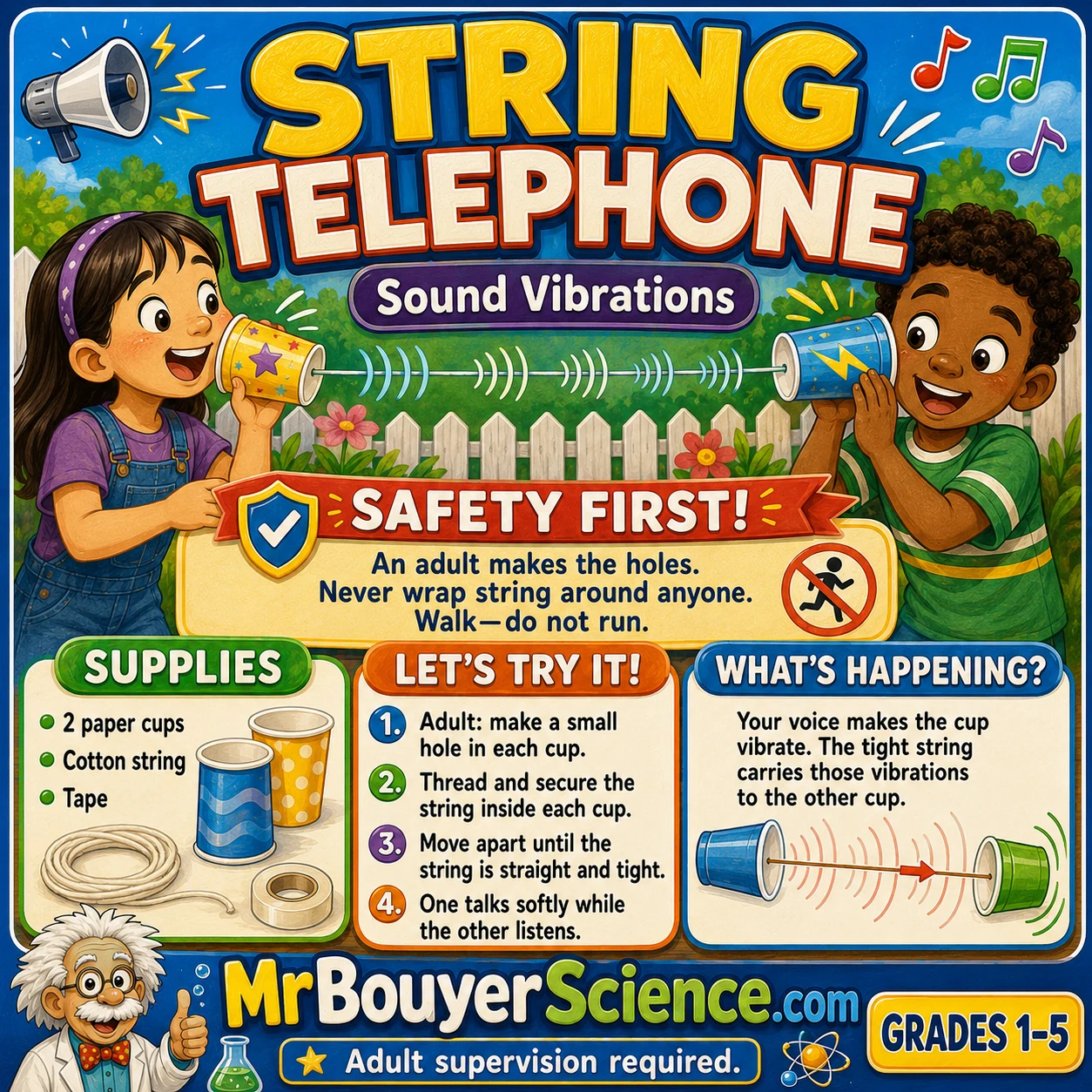
Put this card on the board for the class, or print it. Save the card
1Before class
The day before
- Poke the hole in the bottom of every cup yourself before class. Use a sharpened pencil or a skewer and push through the center of the bottom. Children and helpers never use sharp tools.
- Test one telephone yourself. It takes three minutes and saves ten in class.
- Cut five pieces of cotton string, about 3 meters each.
- Check the room for a place to spread five pairs apart. A hallway or gym also works.
- Give your helpers the helper guide on this page. Let them try one telephone first.
- Tell the K to 5 teacher that this activity is a little noisy and children will use soft voices.
Ten minutes before kids arrive
- Poke one hole in the center of the bottom of each of fifteen paper cups. Check that no rough edge points out.
- Cut five pieces of cotton string, 3 meters each.
- Put a strip of tape on the floor in pairs, 3 meters apart. Leave at least 2 meters between pairs so strings do not cross.
- At each group spot set three cups, one string, six tape strips and a trash bag or box for scraps.
- Set pencils and folded paper at every group spot.
- Put this card up on the board.
Safety and care
- An adult stays with every group for the whole activity. The K to 5 teacher is the responsible adult in the room. Helpers are teenagers and need that adult nearby.
- The teacher pokes every cup hole before class. No child or helper uses a pencil point, skewer or scissors.
- Never wrap string around anyone. Never loop it around a neck, wrist or arm.
- Walk and never run. Never swing the cups or the string.
- Groups spread out so strings do not cross. A string across a walkway is a trip risk. Never leave the string across a path.
- Soft voices only. No shouting into a cup. Do not hold a cup hard against an ear.
- Nothing goes in a mouth. Keep cups away from the mouth except for speaking into the open end.
- Wash hands before and after.
2Materials for 15 students
| Item | Per group | Whole class | Notes |
|---|---|---|---|
| Paper cups with a hole poked in the bottom | 3 | 15 | Two to use and one spare. The adult pokes the holes before class. |
| Cotton string, about 3 meters | 1 | 5 | Cotton works better than thin fishing line. Dry string is best. |
| Masking tape | 6 strips | 1 roll | Tear the strips ahead. Use some on the floor for the standing marks. |
| Pencils | 3 | 15 | |
| Plain paper, folded in half | 3 | 15 | Each child records their own tries. |
| Tape measure or meter stick | 1 | 5 | Used to set the standing marks. Two can be shared. |
| Trash bag or box | 1 | For scraps and torn cups. |
How to set up the room
- Make five pair spots with tape on the floor. Each pair of marks is 3 meters apart.
- Leave at least 2 meters between pairs so strings do not cross.
- Keep walking space clear so helpers move beside the lines, not across them.
- A hallway, gym or open classroom works. Keep the third child of each group by the string, not in front of it.
3Run it in 30 minutes
Groups sit at their spots. Show the board. Ask for a guess. Can a whisper travel along a string?
Helpers show one telephone. Each group threads the string through the cup holes. A helper ties a big knot inside each cup. Tape over the knot.
Two children stand on the marks and pull the string tight. One whispers into a cup. The other listens with a cup at the ear. The third child checks the string and records. Switch jobs each try. Then try a loose string. Then pinch the string and listen.
Bring the class together. Ask what changed with a loose string. Ask what happened when the string was pinched.
Coil the string. Return cups, tape and pencils. Wash hands.
4What the kids do
- Look at your cups and your string. The holes are already made.
- Push one string end through a hole from the outside. Your helper ties a big knot inside.
- Do the same with the other cup. Tape over each knot.
- Two friends stand on the marks. Walk apart slowly until the string is straight and tight.
- One whispers into the cup. The other holds a cup to the ear and listens.
- Make the string loose. Can you still hear? Pinch the string. What happens?
Match it to the grade
Whisper a short word and listen. Touch the cup lightly while someone speaks. Talk about the shiver you feel.
Compare a tight string with a loose string. Count how many words you can hear. Say what changed.
Test three distances. Record what you hear at each. Find where it stops working. Name what you changed and what stayed the same.
5Helper guide for older students
Your job
- Lead one group of three. Make a telephone the day before so you know the steps.
- Tie every knot yourself so the string cannot pull out.
- Give each child a job. One whispers. One listens. One checks the string.
- Ask questions and let the children try before you explain.
- Keep the pair on their marks and the string off the walkway.
Say things like this
- What do you think will happen? Why?
- Can you feel the cup shiver?
- Let us change one thing and try again.
- That is a good guess. How could we test it?
Please do not
- Do not use a pencil or any sharp tool. The adult made the holes.
- Do not wrap string around anyone.
- Do not let anyone run with a string in hand.
- Do not shout into a cup.
- Do not say a guess is wrong. Say let us test it.
6Talk it over
Questions to ask
- What did you hear when the string was tight?
- What happened when the string went loose? Why do you think so?
- What happened when someone pinched the string?
- Did the cup feel any different when someone spoke into it?
- Where do you hear sound travel through something besides air?
- Grades 4 and 5. Why does a tight string carry sound better than a loose one?
The science, in plain words
Sound is a vibration. When a child speaks into the cup, the bottom of the cup vibrates. The vibration moves into the string. A tight string carries it along as a wave and shakes the second cup. The second cup then makes the air near the listener's ear vibrate, and the listener hears the sound. A loose string cannot pass the vibration well. Pinching the string with a finger damps the vibration and the sound fades.
Where you see it
- A doctor's stethoscope carries sound through a tube.
- Fish and whales hear sounds through water.
- You can hear a train coming by pressing an ear to the rail.
7If it goes wrong
| What you see | What to do |
|---|---|
| I cannot hear anything | Pull the string tight. Make sure it does not touch a table, a chair or a person. |
| The string pulls out of the cup | Tie a bigger knot. Tape over it. |
| The sound is faint | Whisper straight into the cup. Hold the other cup right over the ear. Reduce the distance a little. |
| Two strings cross | Move the pairs apart. Stop and walk the strings back into line. |
| A cup tears | Use a spare cup. Ask an adult to poke a new hole. |
| It gets too loud | Remind everyone that whispers work best. Loud voices do not help. |
Clean up
- Coil each string and tie it loosely
- Put cups, tape and pencils in the kit
- Pick up any scraps and torn tape
- Count cups back in
- Wash hands
Go further
- Try a longer string. Does the sound still come through?
- Try thin yarn or fishing line against cotton string.
- Make a three cup telephone with a joined string. What happens?
- Try a plastic cup against a paper cup.
Built by Science Fenns for teachers and student helpers. Keep supervising every group the whole time.