

Teacher cards / Activity 17
For teachers and helpers. Adult supervised. Not for student screens.Static Butterfly
How can a charged balloon lift a tissue paper butterfly without touching it?

★The card
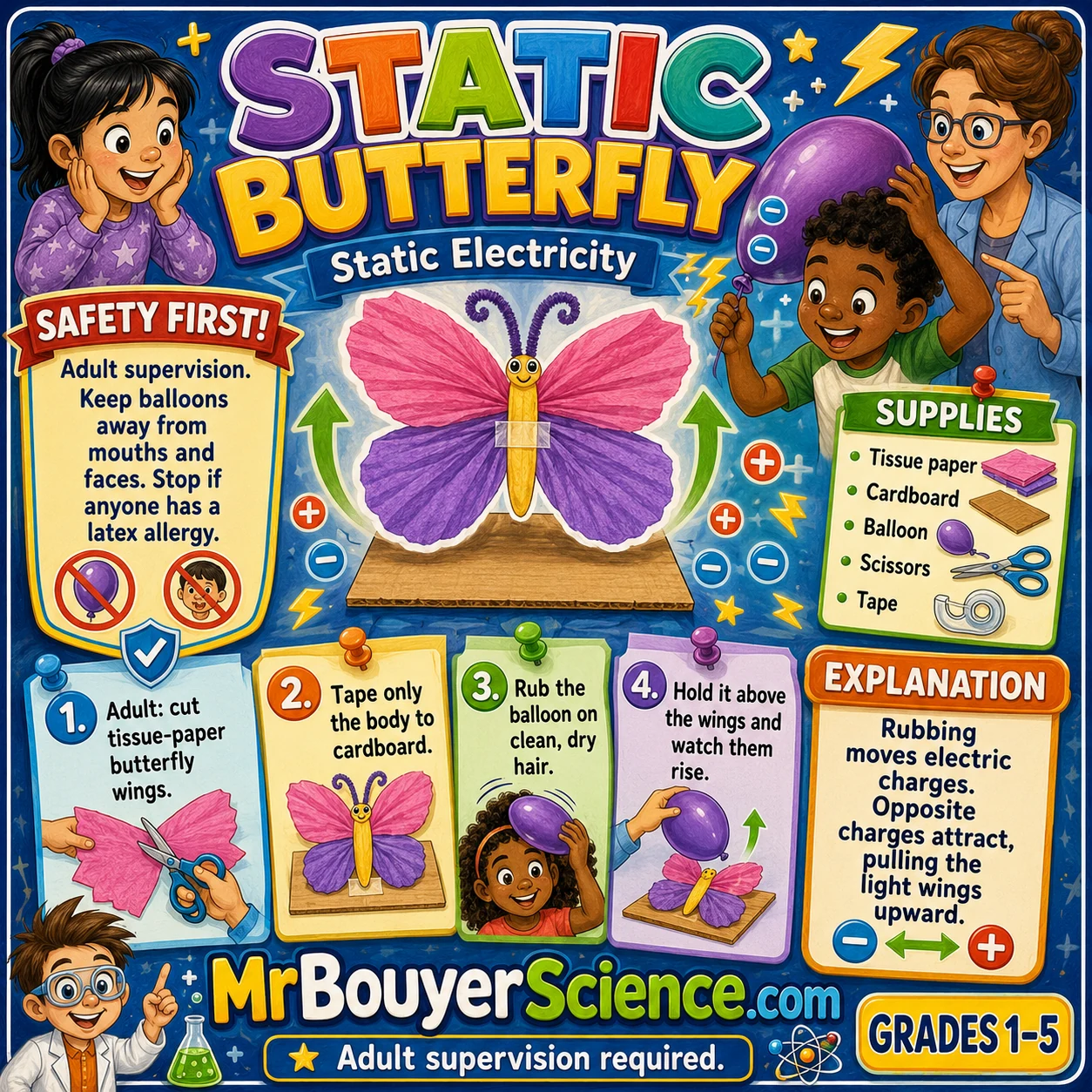
Put this card on the board for the class, or print it. Save the card
1Before class
The day before
- Ask about latex allergies. If any child has one, use no latex balloons at all and use the plastic comb or ruler plan on this page.
- Test one butterfly yourself. Rub the balloon on wool and hold it over the wings. It takes three minutes.
- Pick a dry day if you can. Damp air makes static weak. A dry room works best.
- Cut the tissue paper wings yourself or with a helper before class. Children never use scissors.
- Give your helpers the helper guide on this page. Let them make one butterfly first.
- Tell the K to 5 teacher that children with long or loose hair should not rub a balloon on their own head. The wool cloth does the same job.
Ten minutes before kids arrive
- Cut cardboard into fifteen squares about 15 centimeters wide.
- Cut twenty wing shapes from two layers of tissue paper. Each shape is one pair of wings joined in the middle. Make five extra.
- Fold over the ends of every pipe cleaner so no wire end sticks out.
- Tear six strips of tape for each group and stick them on a table edge.
- At each group spot set three cardboard squares, four wing shapes, three craft sticks, three pipe cleaners, six tape strips, one wool cloth and two balloons.
- Keep the balloons in the bag until a helper needs one. Keep one plastic comb or ruler at each group as the latex free plan.
- Set a trash bag near the door of the room.
- Put this card up on the board.
Safety and care
- An adult stays with every group for the whole activity. The K to 5 teacher is the responsible adult in the room. Helpers are teenagers and need that adult nearby.
- Check for latex allergies before you open the bag. If any child has one, use the plastic comb or ruler plan for the whole class. Do not open latex balloons in the room.
- The older student or an adult blows up every balloon. Children never inflate balloons.
- No balloons in mouths. No chewing the neck. No holding a balloon on the face.
- Pick up every popped piece at once and put it in the trash bag. Pieces are a choking risk.
- Children do not use scissors. The teacher or helper pre cuts all the tissue paper.
- Rub the balloon on a wool cloth or on your own clean dry hair. Never on another person. Never pull anyone by the hair.
- Pipe cleaner ends are folded over so no wire end can poke an eye. Nothing goes in a mouth.
- Wash hands before and after.
- Popping balloons are loud. Tell the class before you start.
2Materials for 15 students
| Item | Per group | Whole class | Notes |
|---|---|---|---|
| Tissue paper wing shapes, pre cut | 4 | 20 | Three to use and one spare. Two layers of different colors look best. |
| Cardboard squares, about 15 centimeters | 3 | 15 | Thin cardboard from a box works. |
| Craft sticks for the body | 3 | 15 | Wide ones are easiest to tape. |
| Pipe cleaners for antennae | 3 | 15 | Optional. Fold the ends over. |
| Balloons, 9 inch round | 2 | 10 | One to use and one spare. Latex free if anyone needs them. |
| Wool cloth, felt or fleece | 1 | 5 | Wool rubs best. A fleece scrap works well too. |
| Plastic comb or plastic ruler | 1 | 5 | The latex free plan. Rub it on the wool cloth. |
| Clear tape | 6 strips | 2 rolls | Tear the strips ahead and stick them on a table edge. |
| Pencils | 3 | 15 | |
| Plain paper, folded in half | 3 | 15 | Each child records their own tries. |
| Trash bag | 1 | For broken balloon pieces and scraps. |
How to set up the room
- Seat each group of three at a table or on the floor with a clear flat surface.
- Spread the groups so helpers can walk between them.
- Keep the groups away from open windows and fans. Moving air blows the wings around.
- Put the trash bag by the door where the teacher can reach it.
3Run it in 30 minutes
Groups sit at their spots. Show the board. Ask for a guess. Can a balloon lift paper without touching it?
Helpers show one butterfly. Each child tapes a craft stick body to the cardboard. The wing shape goes under the stick. Tape only the body. The wings stay free.
A helper blows up the balloon and ties it. Rub it on the wool cloth for about 15 strokes. Hold it a few centimeters above the wings and move it up slowly. Each child takes a turn. Try the comb or ruler too.
Bring the class together. Ask what the wings did. Ask what changed when the balloon was not rubbed.
Pick up every piece. Put the wings and cardboard in the kit. Count balloons back in. Wash hands.
4What the kids do
- Look at your wing shape. It is already cut for you.
- Tape the craft stick body to the cardboard. Tape only the body.
- Lay the wings under the stick so they can move. Add antennae if you like.
- Your helper blows up the balloon. Rub it on the wool cloth. Rub, rub, rub.
- Hold the balloon a few centimeters above the wings. Move it up slowly.
- Watch the wings rise. Try the balloon without rubbing it first. What changes?
Match it to the grade
Rub the balloon and watch the wings. Say lift together. Try it on small paper bits too. Talk about the invisible pull.
Compare a rubbed balloon with one that was not rubbed. Move the balloon closer and farther. Say where the wings lift best.
Count the strokes before each try. Test five, ten and fifteen strokes. Record the height the wings reach. Name what you changed and what stayed the same.
5Helper guide for older students
Your job
- Lead one group of three. Make a butterfly the day before so you know the steps.
- Blow up every balloon and tie it before a child holds it.
- Give each child a turn with the rubbed balloon.
- Ask questions and let the children try before you explain.
- Pick up every piece of a popped balloon at once.
Say things like this
- What do you think will happen? Why?
- What changed when you rubbed it?
- Let us change one thing and try again.
- That is a good guess. How could we test it?
Please do not
- Do not use scissors with the children. The tissue is already cut.
- Do not let a child blow up a balloon.
- Do not rub a balloon on another person's hair.
- Do not put a balloon near any face.
- Do not say a guess is wrong. Say let us test it.
6Talk it over
Questions to ask
- What did the wings do when the balloon came near?
- What happened when we did not rub the balloon first? Why do you think so?
- What happened when we moved the balloon farther away?
- What other things could the balloon pick up?
- Where have you felt or seen static before?
- Grades 4 and 5. The balloon never touched the wings. How can it still pull on them?
The science, in plain words
Rubbing a balloon on wool moves tiny charged particles called electrons from the wool onto the balloon. The balloon ends up with extra negative charge. The tissue paper has no net charge. When the charged balloon comes close, the charges inside the paper shift a little. The side of the paper nearest the balloon ends up slightly positive. That side is closer, so the pull is stronger than the push on the far side. Tissue paper is so light that this pull can lift it. Dry air helps because damp air lets charge leak away.
Where you see it
- Clothes stick together when they come out of a dryer.
- Dust clings to a screen or a TV.
- Lightning is a huge spark of static electricity in a storm cloud.
7If it goes wrong
| What you see | What to do |
|---|---|
| The wings do not move | Rub the balloon longer on the wool. Hold it closer. Try on a drier day or in a drier room. |
| The wings stick to the balloon | Tap the wings gently back down. Rub the balloon again. Hold it a little farther away. |
| The balloon does not seem charged | Use the wool cloth, not a cotton shirt. Rub in one direction with firm strokes. |
| The wings are too heavy | Use thinner tissue paper or cut the wing shape smaller. One layer works too. |
| A balloon pops | Pick up every piece. Put it in the trash bag. Use a spare. |
| A child has a latex allergy | Use the plastic comb or ruler. Rub it on the wool cloth and hold it over the wings. Remove all latex balloons from the room. |
Clean up
- Pick up every balloon piece and bag it
- Put the wings, cardboard and craft sticks in the kit
- Return tape, pencils and wool cloths
- Count balloons back in
- Wash hands
Go further
- Try bits of paper, foil scraps or foam pieces. Which ones does the balloon lift?
- Try a plastic comb after rubbing it on the wool. Compare it to the balloon.
- Try thicker paper for the wings. Does the balloon still lift it?
- Hold the balloon against a wall after rubbing. Does it stick?
Built by Science Fenns for teachers and student helpers. Keep supervising every group the whole time.