
Teacher cards / Activity 16
For teachers and helpers. Adult supervised. Not for student screens.Sink or Float?
Why do some things float and other things sink?

★The card
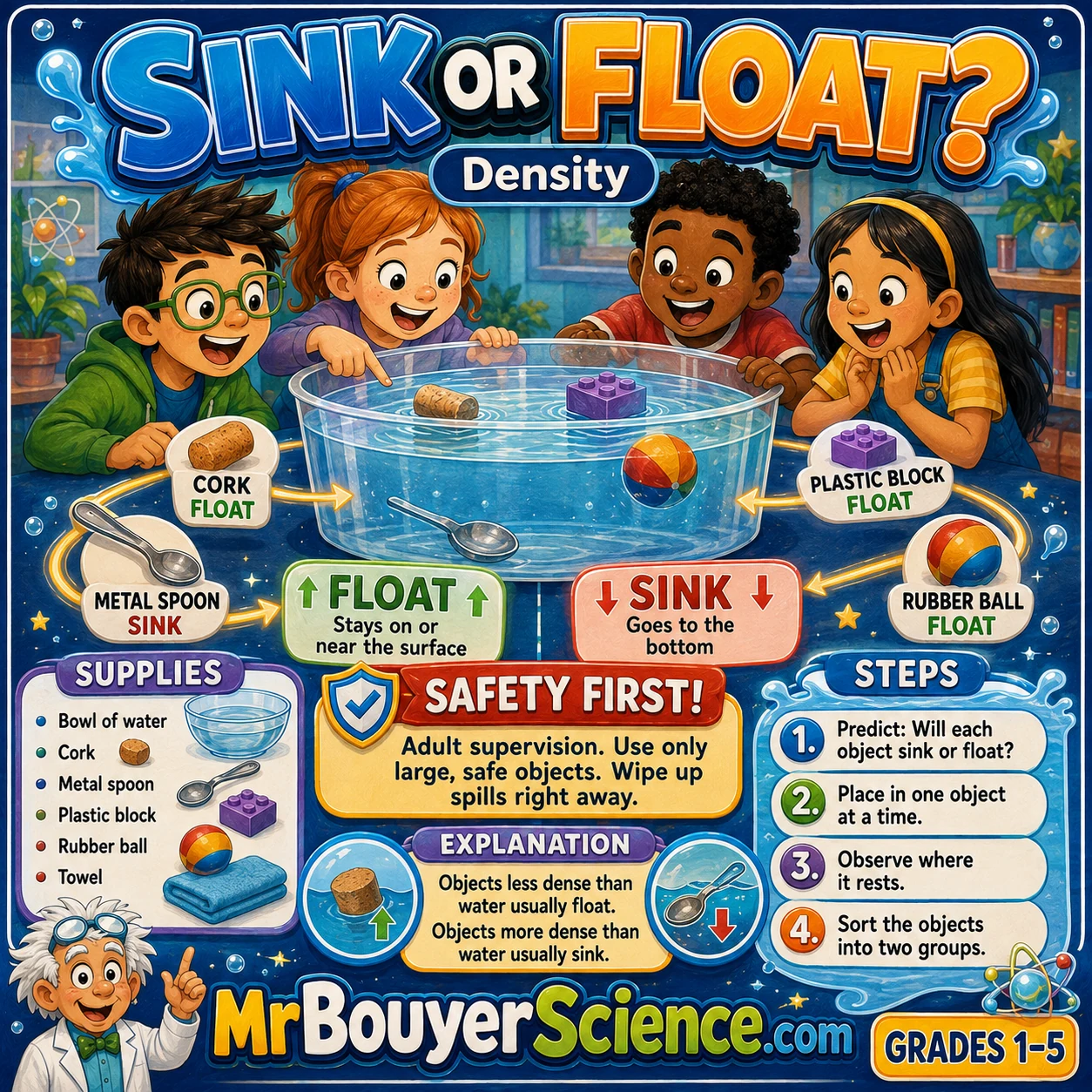
Put this card on the board for the class, or print it. Save the card
1Before class
The day before
- Test every object in a tub yourself the day before. Note which ones float and which ones sink. A large solid plastic block usually sinks. A hollow one may float. A hollow rubber ball floats. A solid rubber ball may sink.
- Use only large objects. Nothing small enough to swallow. If it fits in a toilet paper tube, leave it out.
- Check that the metal spoon has no sharp edges and that the cork has no crumbling pieces.
- No food is used. Nothing is tasted or eaten. Ask about any allergy to cork or rubber products anyway.
- Make sure the tap water is cool to the touch. Lukewarm tap water is fine. Never heat the water.
- Give your helpers the helper guide on this page. Let them test each object first.
- Plan where to dump the water at the end. Have a sink or large bucket ready.
Ten minutes before kids arrive
- Put five tables or desks in a row with room to walk behind them. Keep the tubs off the floor.
- Lay a plastic tablecloth or tray at every station and put a tub on it.
- Fill each tub about halfway using a pitcher. Fill it at the station so nobody carries a full tub.
- Set the four objects in a dry bin beside each tub. Set a towel by every tub.
- Put two big towels and a mop near the door for floor spills.
- Fold a paper in half at each seat. Label one side Float and one side Sink.
- Put this card up on the board.
Safety and care
- The K to 5 teacher is the responsible adult. An adult stays with every group for the whole activity. Helpers are teenagers and lead the activity only.
- Use large safe objects only. Nothing small enough to swallow. Nothing goes in mouths.
- Wipe up spills right away. Wet floors are a slip hazard. Keep a towel at every station and a mop by the door.
- Keep tubs on tables with a tray under them. Nobody carries a full tub.
- Children lower objects gently. No throwing, no splashing.
- Use cool tap water only.
- Wash hands before and after. Dry hands on the towel.
- Metal spoons have no sharp edges. Check them before class.
2Materials for 15 students
| Item | Per group | Whole class | Notes |
|---|---|---|---|
| Wide plastic tub, about 4 liters | 1 | 5 | Clear is best. Fill it halfway with cool tap water. |
| Large cork piece | 1 | 5 | A cork square or big cork stopper. Larger than a wine cork. |
| Large metal spoon | 1 | 5 | A serving spoon with a smooth edge. |
| Large solid plastic block | 1 | 5 | Test it first. Most solid ones sink. |
| Hollow rubber ball | 1 | 5 | A tennis ball size or larger. Test it first. |
| Towel | 1 | 5 | For hands and spills. |
| Plastic tablecloth or tray | 1 | 5 | Goes under the tub. |
| Dry bin for objects | 1 | 5 | Keeps the objects together before the test. |
| Pitcher | 2 | Fill the tubs at the stations. | |
| Big towels and a mop | 2 towels and 1 mop | For floor spills. | |
| Pencils | 3 | 15 | |
| Plain paper, folded in half | 3 | 15 | Label one side Float and one side Sink. |
How to set up the room
- Five tubs on five tables, each on a tray or plastic tablecloth.
- Children stand or sit on the sides of the table. The helper stands with the group.
- Keep floors dry. Keep towels at every station.
- Keep the doorway and walking paths clear of bags and chairs.
3Run it in 30 minutes
Groups stand at their tubs. Show the board. Hold up the four objects. Ask for a guess. Which ones will sink?
Each child marks a sheet. For each object write float or sink. Say why in one short sentence.
A child lowers one object gently into the water. The group watches where it rests. The helper asks what they see. Take it out, dry it and set it on the sorting sheet.
Sort the objects into two groups. Compare with the guesses. Which one surprised you? Why?
Wipe spills. Dry the objects. Empty tubs with the helper at the sink or bucket. Wash hands.
4What the kids do
- Look at the four objects. Do not put them in yet.
- Predict. Will each one sink or float? Mark your sheet.
- Lower one object gently into the water.
- Watch. Does it stay on top, hover or go to the bottom?
- Take it out. Dry it on the towel.
- Sort the objects into two groups. Float and sink.
- Check your guesses. Which one surprised you?
Match it to the grade
Test the objects and sort them into two piles. Say float or sink. Say the one that surprised you.
Predict, test and record. Sort objects by float and sink. Say one thing the floaters have in common.
Use the word density. Explain that floaters are less dense than water. Record predictions and results in a table and count how many guesses were right.
5Helper guide for older students
Your job
- Lead one group of three. Test every object the day before so you know what to expect.
- Give each child a turn to lower an object gently.
- Ask what they think before they test.
- Wipe spills right away.
- Keep nothing small or swallowable near the tub.
Say things like this
- What do you think will happen? Why?
- Where did it stop?
- What do the floaters have in common?
- That is a good guess. How could we test it?
Please do not
- Do not give away the answer before they test it.
- Do not let anyone put an object in their mouth.
- Do not let anyone splash or throw things in.
- Do not leave water on the floor.
- Do not say a guess is wrong. Say let us test it.
6Talk it over
Questions to ask
- Which objects floated? Which sank?
- Which one surprised you? Why?
- Is the heavy one always the one that sinks?
- What do the floating objects have in common?
- Where have you seen something float that you thought would sink?
- Grades 4 and 5. Why does the cork float but the spoon sink when the spoon is smaller?
The science, in plain words
Density tells how much stuff is packed into a space. Water pushes up on any object put in it. If the object is less dense than water, the push is enough to hold it up and it floats. If it is more dense, it sinks. A cork has many tiny pockets of air, so it floats. A hollow rubber ball is full of air, so it floats. A metal spoon is packed tight, so it sinks. A large solid plastic block is a little denser than water, so it usually sinks, but this depends on the block. Heavy does not mean sink. Size matters too. A huge log floats and a small steel washer sinks.
Where you see it
- A steel ship floats because it is shaped to hold a lot of air.
- A life jacket is filled with a light foam that floats.
- A rock sinks to the bottom of a pond.
7If it goes wrong
| What you see | What to do |
|---|---|
| An object does what nobody expected | Good. Talk about it. Test again. Check whether it is hollow or full of air. |
| The ball keeps bobbing and will not sit still | Wait a moment. It will settle. Push it down gently and watch it come back up. |
| Water has splashed on the floor | Stop the activity. Wipe it up at once with a towel. Keep children away until it is dry. |
| The plastic block floats when it should sink or the other way round | Fine. Record what happened. The result depends on the block. Ask why it did that. |
| Children splash | Remind them to lower objects with their fingers. Remove the object for a moment if needed. |
| The cork is crumbling | Swap it for a fresh piece. Do not let children pick at it. |
Clean up
- Take the objects out and dry them
- Wipe the tables and the trays
- Empty tubs with the helper at a sink or bucket
- Count the objects and towels back in
- Wash hands
Go further
- Add a new large safe object. Predict and test.
- Shape a ball of modeling clay and drop it in. Then shape the same clay into a boat. What happens?
- Press the floating ball down gently and let go. What happens? How hard does the water push back?
- Compare a tub of cool tap water with a tub of salty water. Does the cork float higher?
Built by Science Fenns for teachers and student helpers. Keep supervising every group the whole time.