

Teacher cards / Activity 15
For teachers and helpers. Adult supervised. Not for student screens.Singing Hanger
How can a metal hanger send sound through a string to your ears?

★The card
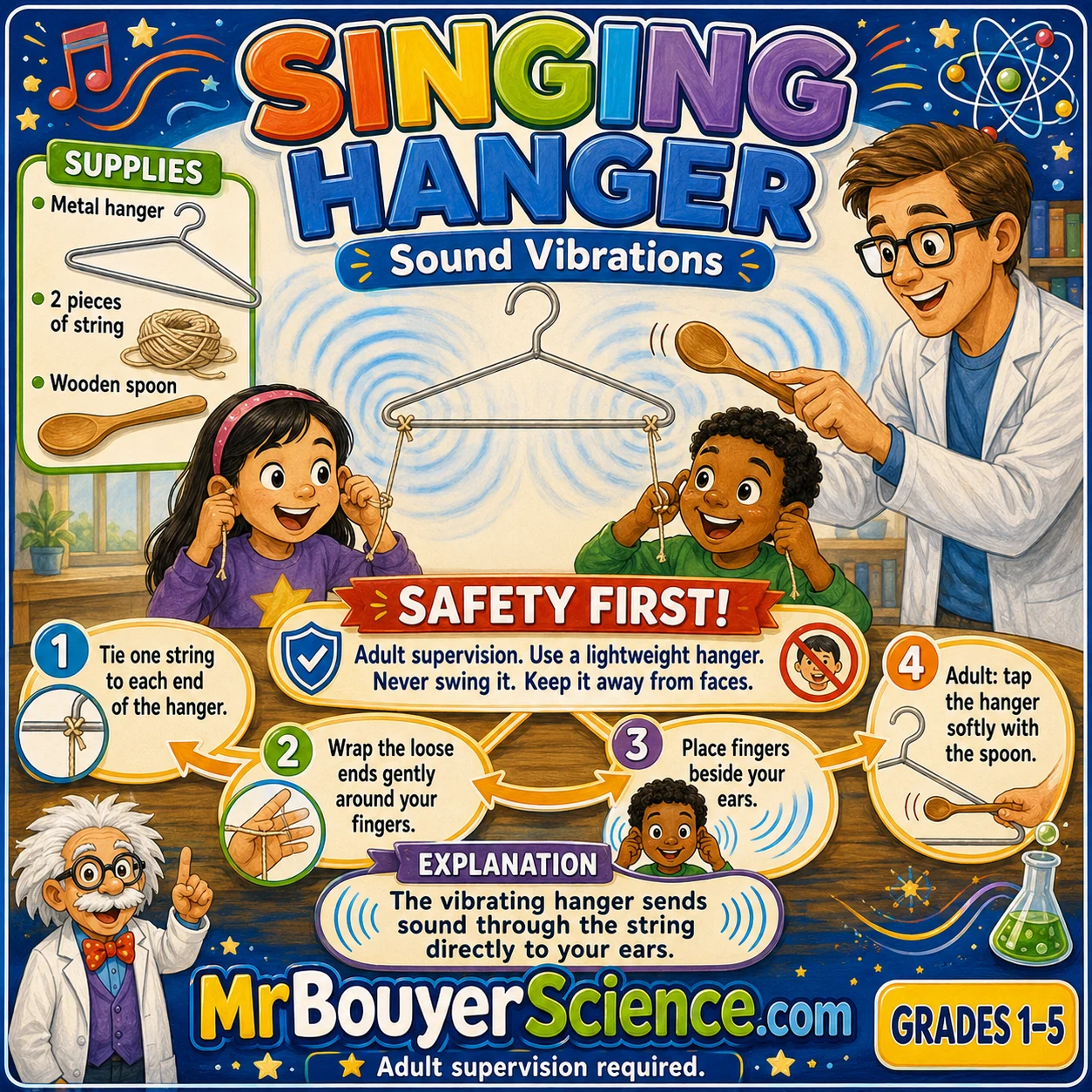
Put this card on the board for the class, or print it. Save the card
1Before class
The day before
- Test one hanger yourself. It takes two minutes. You will hear why the children laugh.
- Use lightweight wire hangers only. Check each one for sharp ends and rough spots. Wrap any rough spot and the hook in tape.
- Cut ten strings about 60 centimeters long. Adult scissors only. Cut a few spares.
- Tie one string to each lower corner of every hanger. Use a firm knot and add a strip of tape over each knot.
- Practice a soft tap. Start gentle. Learn how loud it gets.
- Ask the K to 5 teacher about any child who is sensitive to loud sounds. That child can count taps and watch.
- Give your helpers the helper guide on this page. Let them try the hanger first.
Ten minutes before kids arrive
- Make five stations with a clear floor circle about two meters across. Keep them away from walls and furniture.
- Put a tape strip on the floor where the listener stands. Put another strip to the side where the helper stands.
- Set one prepared hanger, one wooden spoon, pencils and paper at each station.
- Keep spare strings, tape and a spare hanger on a side table.
- Put this card up on the board.
Safety and care
- The K to 5 teacher is the responsible adult. An adult stays with every group for the whole activity. Helpers are teenagers and lead the activity only.
- Use a lightweight wire hanger only. Cover the hook and any rough spot with tape.
- Never swing the hanger. It hangs still. Keep it away from faces and bodies.
- Strings never go around a neck, a wrist or a head. Children only hold the string ends in their fingers.
- The helper taps softly with the wooden spoon from the side. Tap the metal bar only. Never tap near a face.
- Ask if it is too loud. Any child can drop their hands at any time.
- Scissors are used only by an adult.
- Wash hands after.
2Materials for 15 students
| Item | Per group | Whole class | Notes |
|---|---|---|---|
| Lightweight wire hanger | 1 | 5 | Thin wire. Cover the hook with tape. One spare helps. |
| String, 60 centimeters each | 2 | 10 | Cut by an adult. Soft cotton string is best. |
| Wooden spoon | 1 | 5 | For soft taps only. |
| Masking tape | 4 strips | 1 roll | Covers the hook and the knots. Marks the floor. |
| Pencils | 3 | 15 | |
| Plain paper | 3 | 15 | Each child records their own listening. |
| Spare hanger and string | 1 set | Keep on the side table. |
How to set up the room
- Five stations spread around the room with two meters of clear floor around each.
- The listener stands on the tape mark. The helper stands to the side on the second mark.
- The other two children in the group sit close and watch. They count the taps.
- Keep walking space clear for helpers.
3Run it in 30 minutes
Groups sit at their stations. Show the board. Hold up the hanger. Ask for a guess. What will it sound like if we tap it?
The helper taps the hanger softly while it hangs. The group listens. Ask what they hear. Keep it quiet.
One child at a time stands on the mark. The child holds the string ends and presses fingertips to the ears. The helper taps softly from the side. The child says what they hear. The others count taps. Switch until all three have a turn.
Each child tries once with fingertips away from the ears. Compare. Which was louder? Which was deeper?
Gather the class. Share what you heard. Count hangers, spoons and strings back in. Wash hands.
4What the kids do
- Look at the hanger. It is metal and light.
- Tap it softly while it hangs. Listen.
- One at a time. Hold the string ends between your thumb and finger.
- Press your fingertips gently against your ears. Stand tall and still.
- The helper taps the hanger softly. Do not swing it.
- Listen. Tell your group what you heard.
- Take turns. Then try again with your fingers away from your ears.
Match it to the grade
Listen and say what you hear. Say loud or soft. Say bell or gong. Feel the hanger with a fingertip right after a tap to feel it shake.
Draw the hanger with the sound waves. Compare the sound with fingers at the ears and away from the ears. Say which was louder.
Name the vibration. Explain why a solid string carries the sound to the ear. Try a different length of string and record the sound for each.
5Helper guide for older students
Your job
- Lead one group of three. Try the hanger the day before so you know the sound.
- Tap softly from the side. Start with the softest tap you can.
- Ask the listener if it is too loud before you tap again.
- Give each child a turn. The others count taps and watch.
- Keep the hanger hanging still. Never let it swing.
Say things like this
- What do you hear?
- Is it louder or softer than before?
- Let us try with your fingers away from your ears.
- That is a good guess. How could we test it?
Please do not
- Do not tap hard.
- Do not tap near a face.
- Do not let a string go around a neck or wrist.
- Do not give away the answer before they listen.
- Do not say a guess is wrong. Say let us test it.
6Talk it over
Questions to ask
- What did the hanger sound like in the air? What did it sound like through the strings?
- Which was louder? Why do you think so?
- What did you feel in your fingers?
- What could we change to make the sound different?
- Where have you heard a ringing sound like this one?
- Grades 4 and 5. Why do you think the string carries the sound better than the air does?
The science, in plain words
Sound is made by something vibrating. A tap makes the hanger vibrate, which means it shakes back and forth very fast. In air, the vibration spreads out in all directions and gets weaker. A string is a solid and holds the vibration together as it travels. The vibration moves up the strings, into your fingers and through the bones of your head to the inner ear. Your fingers also block much of the noise from the room. So the sound seems to come from inside your head, loud and deep, like a church bell.
Where you see it
- A bell rings because it vibrates after it is struck.
- A stethoscope carries the sound of a heartbeat through a tube to the ears.
- A string telephone sends voice vibrations along a string.
7If it goes wrong
| What you see | What to do |
|---|---|
| The sound is too quiet | Tap the bottom metal bar, not the string. Check that the strings are snug and the hanger hangs still. |
| The sound is too loud | Use a softer tap. Let the child lower their hands for a moment. |
| The hanger swings | Stop. Let it hang still. Ask the child to hold their hands steady. The helper taps only when it is still. |
| A string slides off the hanger | Retie it at the lower corner and put tape over the knot. |
| The hanger hits the child's legs | Have the child stand tall with the hands up. Use a shorter hanger if needed. |
| The child hears nothing | Press the fingertips a little more firmly on the ears. Keep the hands very still. |
Clean up
- Hand the hangers and spoons to the helpers
- Check every string for damage and set them aside
- Count hangers, spoons and strings back in
- Put tape strips in the trash bag
- Wash hands
Go further
- Try a metal spoon on the hanger. Does it sound different?
- Try a longer string and a shorter string. What changes?
- Try a different hanger or a different metal object tied to the strings.
- Touch the hanger with a fingertip right after a tap. What do you feel?
Built by Science Fenns for teachers and student helpers. Keep supervising every group the whole time.