
Teacher cards / Activity 14
For teachers and helpers. Adult supervised. Not for student screens.Shadow Tracker
How does a shadow change as the Sun seems to move across the sky?

★The card
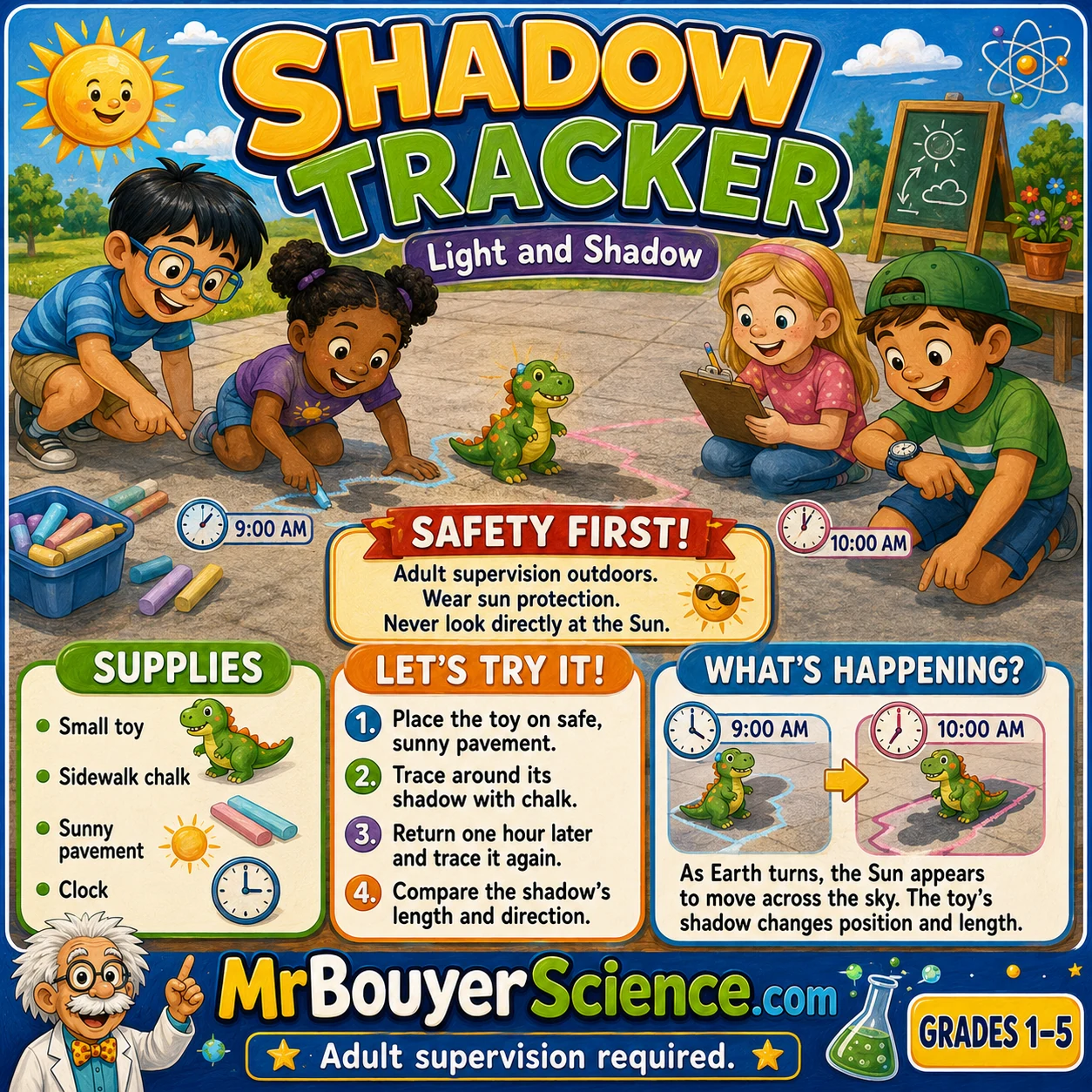
Put this card on the board for the class, or print it. Save the card
1Before class
The day before
- Check the weather. Pick a sunny window in the middle of the morning or early afternoon.
- Walk the pavement yourself. Pick flat, dry ground away from parking lots, driveways and roads.
- Ask families to send sun hats. Ask them to put on sunscreen at home before class.
- Plan the second trace. A trace one hour apart does not fit in 30 minutes. Do the first trace at the start of class. Do a quick second trace near the end. Then the K to 5 teacher returns later the same day, or repeats it back in the K to 5 room, for a trace an hour or more later.
- Ask the K to 5 teacher about any child who reacts to chalk dust. That child can be the note taker.
- Choose toys with a flat base and no loose small parts.
- Read the cloudy day plan under trouble shooting. Have the flashlights ready as a backup.
- Give your helpers the helper guide on this page. Let them trace one toy shadow first.
Ten minutes before kids arrive
- Pick five spots on the pavement about three meters apart. Each spot needs full sun with no tree or building shade.
- Check that each spot stays sunny for the whole lesson and, if you can, for the later trace.
- Mark each spot with a chalk X so groups find it fast.
- Set a toy, three chalk sticks, a clipboard with paper, pencils and a tape measure in a tote at each spot.
- Set one clock or watch at each spot. Make sure they all show the same time.
- Set a shaded rest spot nearby with water bottles and a bucket of water for rinsing chalk off hands.
- Put this card up on the board and walk the class out together.
Safety and care
- The K to 5 teacher is the responsible adult. An adult stays with every group for the whole activity. Helpers are teenagers and lead the activity only.
- Everyone wears sun protection. Hats on. Sunscreen put on at home. Water bottles wait in the shade.
- Never look at the Sun. Not for a second. Not with sunglasses. Say it before you go outside and say it again at the spots.
- Work only on safe pavement. Stay away from roads, parking lots and driveways. Touch the pavement with your hand first. If it is hot, move to a cooler spot.
- Chalk goes on the ground only. Nothing goes in mouths. No blowing chalk dust and no clapping it off hands. Use thick low dust chalk.
- Wash hands with soap and water after chalk. The rinse bucket is only for a first rinse.
- Watch for trip hazards. Children kneel or crouch beside the traces. Toys are placed, never thrown.
- Pencils are sharpened ahead by an adult. Children use them only to write and draw.
- Watch for heat. Anyone who feels hot, dizzy or tired goes to the shade and gets water. Tell the K to 5 teacher.
2Materials for 15 students
| Item | Per group | Whole class | Notes |
|---|---|---|---|
| Small toy with a flat base | 1 | 5 | About the height of a child's hand. No loose small parts. |
| Thick sidewalk chalk sticks | 3 | 15 | Two different colors plus a spare. Low dust chalk is best. |
| Clock or watch | 1 | 5 | A helper's watch works. All should show the same time. |
| Tape measure | 1 | 5 | For the shadow length. K and 1 can use hand spans. |
| Clipboard | 1 | 5 | Paper blows away without one. |
| Plain paper | 3 | 15 | Each child draws and records their own. |
| Pencils, sharpened ahead | 3 | 15 | An adult sharpens them before class. |
| Sun hats | 3 | 15 | From home. Keep a few spares. |
| Water bottles | 3 | 15 | Kept in the shade. |
| Tote or bucket for each station | 1 | 5 | Holds the kit and the toy. |
| Bucket of water and paper towels | 1 | For a first rinse of chalk hands. | |
| Cloudy day only. LED flashlight | 1 | 5 | LED only. It stays cool. |
| Cloudy day only. Large sheets of paper | 1 | 5 | Butcher paper or taped newspaper. |
| Cloudy day only. Masking tape | 4 strips | 1 roll | To tape the paper to the floor. |
| Trash bag | 1 | For chalk bits and tape. |
How to set up the room
- Five spots on safe pavement, three meters apart, all in full sun.
- Children kneel or crouch beside their spot. They stay to the side so their own shadows do not fall on the toy shadow.
- Keep the whole class on one side of the area, away from roads, doors and driveways.
- Keep one clear walking path for helpers and a shaded rest spot with water nearby.
3Run it in 30 minutes
Meet in the shade outside. Give the sun rules. Ask for a guess. What will a toy shadow do if we wait a little while?
Each group puts the toy on its X. A child traces around the feet. Another traces the whole shadow in one color and puts a chalk dot at the tip. The third writes the time.
Measure the shadow with the tape or hand spans. Put the toy away. Play shadow games. Make a tall shadow, a short shadow and a wide shadow. Never look up at the Sun.
Put the toy back on its feet outline. Trace the new shadow in a second color. Put a dot at the tip. Write the time. Compare. The shift is small after a short wait.
Gather in the shade. Look at both traces. Ask what changed. Plan the later trace with the K to 5 teacher.
Pick up toys, chalk and clipboards. Count them back in. Leave the traces. Walk in together and wash hands with soap.
4What the kids do
- Place the toy on your X. Trace around its feet so you can put it back.
- Look at the shadow. Which way does it point? How long is it?
- Trace around the shadow with one color. Put a dot at the tip. Write the time.
- Measure the shadow from the toy's feet to the dot.
- Put the toy away. Play shadow games. Make your shadow tall, short and wide.
- Put the toy back on its feet. Trace the new shadow with a new color. Write the time.
- Compare the two shadows. What changed? What stayed the same?
Match it to the grade
Trace the shadow and look at it. Say long and short. Measure with hand spans. Point to the way the shadow goes.
Trace twice and measure each shadow with a tape in centimeters. Say which is longer. Draw both on paper and say which way each points.
Record the time and the shadow length at every trace. Find how much the length changed. Make a simple graph of length against time. Explain the change with the turning Earth.
5Helper guide for older students
Your job
- Lead one group of three. Trace one toy shadow the day before so you know the steps.
- Give each child a job. One traces. One dots the tip and measures. One writes the time.
- Ask what they see and let them try before you explain.
- Keep the group on safe pavement. Watch the hats and the water.
- Remind the group never to look at the Sun.
Say things like this
- Which way is the shadow pointing?
- What do you think will happen in a little while?
- Let us make a mark so we can check.
- That is a good guess. How could we test it?
Please do not
- Do not tell children to look up at the Sun to show them where it is. Point at the sky from the side.
- Do not let chalk go near faces or mouths.
- Do not let anyone run on the pavement.
- Do not give away the answer before they trace again.
- Do not say a guess is wrong. Say let us test it.
6Talk it over
Questions to ask
- Which way did the shadow point? Where was the Sun?
- What changed between the first trace and the second?
- What stayed the same?
- When do you think the shadow will be shortest today?
- Where else have you seen a shadow change during the day?
- Grades 4 and 5. What is really moving, the Sun or the Earth? How do you know?
The science, in plain words
The Sun is a bright light far away. Light travels in straight lines. The toy blocks some of it and leaves a dark shape on the ground on the side away from the Sun. The Sun does not really travel across the sky. The Earth turns once a day, so the Sun seems to rise, climb, cross and set. As it seems to move, the shadow turns. When the Sun is low, shadows are long. Near the middle of the day the Sun is highest and shadows are shortest. The change in 20 minutes is small. About an hour or more gives a clear shift in direction and length.
Where you see it
- A sundial uses a shadow to show the time of day.
- Shadows are long in the early morning and late afternoon and short near the middle of the day.
- People long ago used a stick in the ground to tell time by its shadow.
7If it goes wrong
| What you see | What to do |
|---|---|
| It is cloudy | Go indoors. Tape paper to the floor. Put the toy on its feet outline in the middle. A helper holds an LED flashlight low and to one side, never pointed at anyone's face. Trace the shadow. Move the flashlight a quarter of the way around the toy. Trace again in a new color. This shows how a moving light moves a shadow. |
| The shadow is faint | Move to brighter, flatter pavement. Check that nothing is shading the spot. A taller toy gives a clearer shadow. |
| The toy keeps falling over | Use a toy with a wide flat base. A helper steadies the base only. Keep hands out of the shadow when you trace. |
| The children's own shadows cover the toy shadow | Have children kneel to the side so their shadows fall away from the toy shadow. |
| The shadow barely moved | That is normal after a short wait. Look at the dots. Come back an hour later and trace again. |
| A child is hot, flushed or tired | Go to the shade at once. Give water. Tell the K to 5 teacher. |
Clean up
- Pick up every piece of chalk and put it in the tote
- Put toys, clipboards, pencils and tape measures back in the kit
- Count the toys and clipboards back in
- Leave the chalk traces and tell the K to 5 teacher when to return
- Walk back together and wash hands with soap and water
Go further
- Trace the shadow an hour or more later and compare all three traces.
- Trace around a child's shadow in the morning and again near noon. Who is taller in the shadow?
- Make a shadow puppet with a flashlight and cardboard shapes.
- Place a tall object and a short object side by side. Compare their shadows.
Built by Science Fenns for teachers and student helpers. Keep supervising every group the whole time.