

Teacher cards / Activity 23
For teachers and helpers. Adult supervised. Not for student screens.Rubber Band Guitar
Why do thick bands and thin bands sound different?

★The card
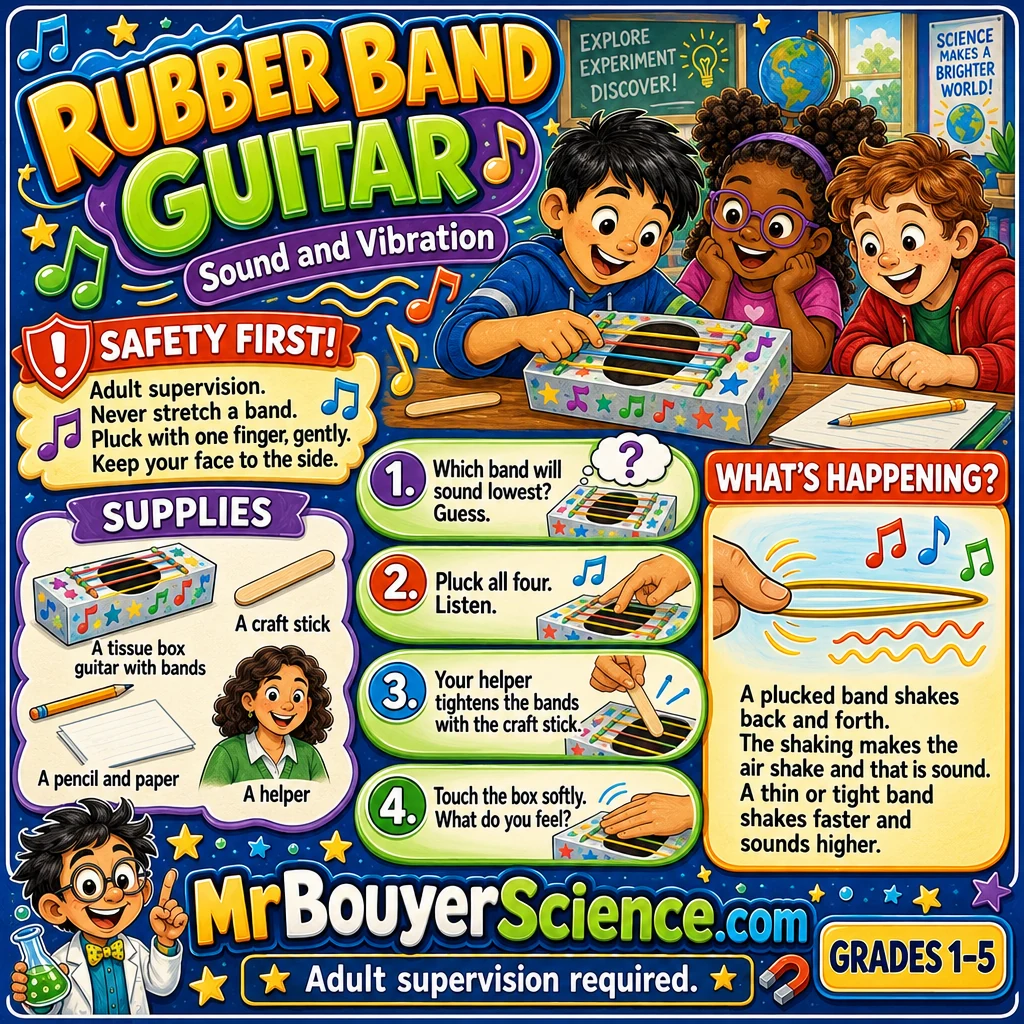
Put this card on the board for the class, or print it. Save the card
1Before class
The day before
- Build one guitar yourself and pluck every band. It takes five minutes.
- Ask about latex allergies. Use only latex free bands. Buy a bag marked latex free.
- Check every band. Throw away any that are cracked, sticky or stretched out and floppy.
- Put the bands on the boxes before class. Do not let children stretch bands onto boxes.
- Give your helpers the helper guide on this page. Let them pluck a guitar first.
Ten minutes before kids arrive
- Take every tissue out of five empty tissue boxes. Check that no staples or sharp edges stick out.
- Stretch four bands lengthwise across the opening of each box. Put the two thick bands side by side on one half and the two thin bands on the other.
- Check that each band sits flat and is not twisted.
- At each station set one guitar, one craft stick, two spare bands, pencils and paper.
- Keep the spare bands in a bag so none go missing.
- Put this card up on the board.
Safety and care
- An adult stays with every group for the whole activity. The K to 5 teacher is the responsible adult. Helpers are teenagers and lead the activity.
- Latex free bands only. Ask about allergies before you open the bag.
- A band that slips or snaps can sting an eye. Bands stay on the box. Children never stretch a band, pull it away from the box or let it go.
- Never point a stretched band toward a face. Pluck by pulling the band up only a finger's width.
- Safety glasses for helpers and the teacher if your school has them. Children keep their faces to the side of the box and not over it.
- Count the bands in and out. None go in mouths. None are worn on fingers or wrists.
- Wash hands after the activity.
2Materials for 15 students
| Item | Per group | Whole class | Notes |
|---|---|---|---|
| Empty tissue boxes, tissues removed | 1 | 5 | Or a plastic tub with a smooth rim and no lid. |
| Thick latex free rubber bands | 2 | 10 | All the same size and thickness. |
| Thin latex free rubber bands | 2 | 10 | About the same length as the thick ones. |
| Spare latex free bands, any size | 2 | 10 | For when a band loosens or cracks. |
| Flat craft sticks | 1 | 5 | Used to tighten the bands. Not sharp. |
| Pencils | 3 | 15 | Sharpened by the teacher only. |
| Plain paper, folded in half | 3 | 15 | Each child records their own results. |
| Bag for spare bands | 1 | 5 | To keep them counted. |
| Trash bag | 1 | For any broken band. |
How to set up the room
- Seat each group of three on the floor or at a table around one guitar.
- Keep five stations spread out so the sounds do not blend into one noise.
- Keep the spare bands and craft sticks with the teacher or helper.
- Keep walking space clear so helpers can move between stations.
3Run it in 30 minutes
Sit around the guitars. Show the board. Ask for a guess. Will a thick band sound higher or lower than a thin band?
Helpers show how to pluck gently with one finger. Children touch the box softly while a helper plucks, so they can feel the buzz.
Pluck each band. Number the four bands from lowest to highest sound. Then slide the craft stick under all four bands to tighten them. Pluck again and rank again.
Bring the class together. Compare the rankings. Ask why a thick band sounds lower.
Take off the craft stick. Count the bands back in. Wash hands.
4What the kids do
- Look at your guitar. Which band do you think sounds lowest?
- Pluck one band gently with one finger. Listen.
- Pluck each of the four bands. Listen to each one.
- Number the bands from lowest to highest sound.
- Your helper slides the craft stick under all four bands. Now they are tighter.
- Pluck again. Did the sounds go higher or lower?
- Touch the box softly while a helper plucks. What do you feel?
Match it to the grade
Pluck the bands and say high or low. Feel the box buzz. Draw a loud band and a quiet band.
Rank the four bands from lowest to highest. Pluck again after tightening. Say what changed.
Record the ranking before and after tightening. Name what you changed and what stayed the same. Explain how thickness and tightness change the sound.
5Helper guide for older students
Your job
- Lead one group of three. Make a guitar the day before and play it first.
- Check the bands before class and put them on the box yourself.
- Give each child a turn to pluck. One plucks. One listens. One writes.
- Ask questions and let the children try before you explain.
- Watch the bands and the faces. Keep faces to the side of the box.
Say things like this
- What do you think will happen? Why?
- Is that sound high or low?
- Put your fingertip on the box. What do you feel?
- Let us change one thing and try again.
Please do not
- Do not let a child stretch a band or pull it off the box.
- Do not point a stretched band at anyone.
- Do not give away the answer before they test it.
- Do not let bands go into mouths or onto wrists.
- Do not say a guess is wrong. Say let us test it.
6Talk it over
Questions to ask
- Which band sounded lowest? Which sounded highest?
- What did you feel when you touched the box?
- What happened to the sound when the bands got tighter?
- What did we change? What stayed the same?
- Where have you seen strings on an instrument?
- Grades 4 and 5. Why would a thick string sound lower than a thin one if both are stretched the same?
The science, in plain words
A plucked rubber band vibrates. It moves quickly back and forth and pushes the air around it. The air carries those pushes to your ear and you hear sound. The number of vibrations in a second is the pitch. More vibrations a second sounds higher. A thick band has more mass, so it moves back and forth more slowly and sounds lower. A thin band is lighter and sounds higher. A tighter band snaps back faster and also sounds higher. The craft stick raises the bands and tightens them a little, so each pitch rises. The hollow box rings with the band and makes the sound louder.
Where you see it
- A guitar has thick strings for low notes and thin strings for high notes.
- A piano has long thick wires for low notes and short thin wires for high notes.
- A violin player turns pegs to tighten the strings and raise the pitch.
7If it goes wrong
| What you see | What to do |
|---|---|
| The bands make almost no sound | Pluck a little harder, still gently. Check that the band is tight and sits flat. |
| The bands sound alike | Use bands that are clearly different in thickness. Pluck slowly and listen to one at a time. |
| A band slips off the box | Helper puts it back on. Swap in a spare band if it keeps slipping. |
| The craft stick slides away | Place it flat under all four bands near the end of the opening. |
| The sound is dull | Hold the box still on the table. Do not squeeze it. |
| A band cracks | Put it in the trash bag at once. Use a spare. Count the bands. |
Clean up
- Take off the craft sticks
- Take the bands off the boxes with a helper and count them
- Put the boxes away
- Put any broken band in the trash bag
- Return pencils and paper
- Wash hands
Go further
- Try a longer box and a shorter box. Which sounds lower?
- Pluck a band while a helper holds a finger on its middle. What changes?
- Make a short tune with the four bands.
- Try a plastic tub in place of the tissue box. Is the sound louder or softer?
Built by Science Fenns for teachers and student helpers. Keep supervising every group the whole time.