
Teacher cards / Activity 20
For teachers and helpers. Adult supervised. Not for student screens.Ramp Racers
Does a taller ramp make a car roll farther?

★The card
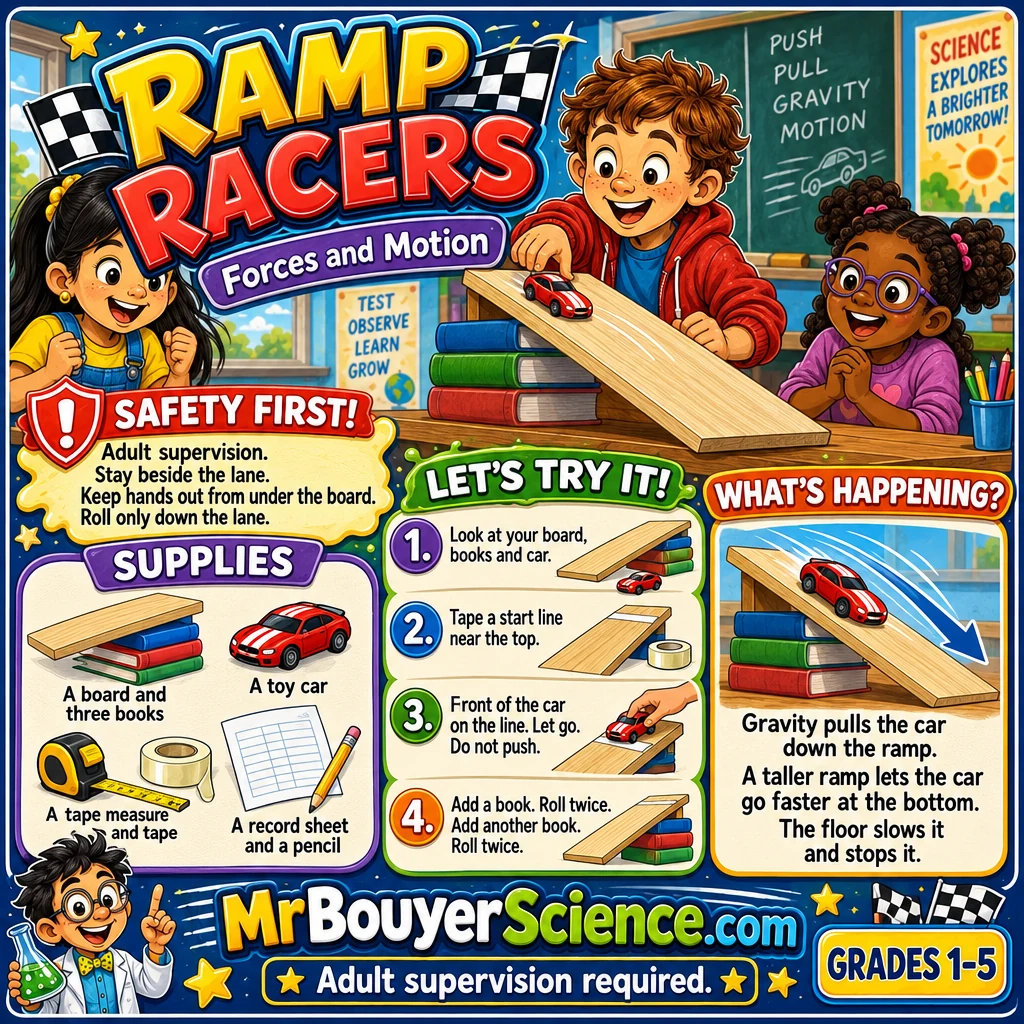
Put this card on the board for the class, or print it. Save the card
1Before class
The day before
- Build one ramp yourself and roll the car at one, two and three books. Check that the car rolls straight and stops on the floor you plan to use.
- Use a hard smooth floor. Carpet stops cars too soon.
- Check that every book is the same thickness. Three books of the same kind per group is best.
- Check every toy car for loose wheels and small parts. Use a car with wheels that spin freely.
- Give your helpers the helper guide on this page. Let them build a ramp first.
Ten minutes before kids arrive
- Lay one tape strip on the floor for each group as the ramp end line. Space the lines two meters apart.
- Lay a tape measure along the floor from each ramp end line, straight down the lane. Tape the end.
- Place the books and board at each ramp end line so the board can run down toward the tape measure.
- Set the toy car, pencils, paper and tape strips at each station.
- Keep walkways clear. Rolling cars need a clear lane of at least three meters.
- Put this card up on the board.
Safety and care
- An adult stays with every group for the whole activity. The K to 5 teacher is the responsible adult in the room. Helpers are teenagers.
- Heavy books can drop on feet. Stack them flat on the floor and keep hands out from under the board.
- Rolling cars are a trip risk. Children stay beside the lane, not in front of the ramp.
- Only roll the car down the lane. Never aim it at another group.
- Pick up any loose wheel or small part right away. Small parts are a choking risk.
- Nothing goes in mouths.
- Wash hands after the activity.
2Materials for 15 students
| Item | Per group | Whole class | Notes |
|---|---|---|---|
| Smooth ramp board, about 1 meter long | 1 | 5 | A shelf board, foam board or stiff cardboard works. |
| Hardcover books of the same thickness | 3 | 15 | Use books of one kind so each added book raises the ramp the same amount. |
| Toy car with free spinning wheels | 1 | 5 | Use the same car for the whole test. |
| Tape measure, 3 meters or more | 1 | 5 | Meter sticks work if you tape two end to end. |
| Masking tape | 6 strips | 1 roll | Tear the strips ahead and stick them on a table edge. |
| Pencils | 3 | 15 | |
| Record sheets, plain paper folded in half | 3 | 15 | Each child records their own rolls. |
How to set up the room
- Set five lanes side by side across the room. Keep the lanes two meters apart.
- Put the ramp end line at the start of each tape measure.
- Leave at least three meters of clear floor at the end of each lane.
- Seat each group beside its lane on the floor or on low chairs.
3Run it in 30 minutes
Groups sit beside their lanes. Show the board. Ask for a guess. Will a taller ramp make the car roll farther?
Each group builds the ramp with one book. The board rests on the book and the end touches the ramp end line.
Two rolls at one book. Add a book and roll twice. Add one more and roll twice. One child releases the car. Another marks where the front wheels stop. The third reads the tape measure.
Bring the class together. Compare which height went farthest. Ask why.
Pick up the books and boards. Roll up the tape measures. Wash hands.
4What the kids do
- Look at your board, books and car. This is your ramp.
- Build the ramp with one book. Rest the top end of the board on the book.
- Put a tape strip a hand width from the top. This is your start line.
- Predict. How far will the car roll past the ramp end?
- Put the front of the car on the start line. Let go. Do not push.
- Mark where the front wheels stop. Read the tape measure. Roll again and write both numbers.
- Add a book. Same car and same start line. Roll twice again. Add one more book and roll twice.
Match it to the grade
Roll the car and watch it go. Measure with big steps or a long strip of paper. Say which ramp was taller.
Roll at one, two and three books. Measure in centimeters. Say which height went farthest.
Record two rolls at each height. Find the typical distance for each. Make a bar graph. Name what you changed and what you kept the same.
5Helper guide for older students
Your job
- Lead one group of three. Build a ramp the day before so you know the steps.
- Give each child a job. One releases the car. One marks the stop. One reads the tape measure.
- Keep the group beside the lane and out of the way of the car.
- Ask what they think before they roll.
- Change only one thing. Add one book at a time.
Say things like this
- What do you think will happen? Why?
- Where did the car stop?
- Let us change one thing and try again.
- That is a good guess. How could we test it?
Please do not
- Do not give away the answer before they test it.
- Do not push the car for the child.
- Do not let anyone stand in front of the ramp.
- Do not let a book stack get higher than three.
- Do not say a guess is wrong. Say let us test it.
6Talk it over
Questions to ask
- Which ramp made the car roll the farthest?
- What did we change each time? What stayed the same?
- Did the car roll the same distance both times at the same height? Why might it not?
- What could make the car go even farther?
- Where do you see ramps at the park or at school?
- Grades 4 and 5. Why did the car stop even though nothing was touching it?
The science, in plain words
Gravity pulls the car down the ramp. A taller ramp is steeper, so the car speeds up more and leaves the bottom faster. A faster car rolls farther before friction slows it to a stop. Friction acts between the wheels and the floor and inside the wheels. It is the force that stops the car. Small bumps and small differences in release cause small changes in distance, so we roll twice and compare.
Where you see it
- A playground slide uses gravity to pull a child down.
- A roller coaster starts with a tall climb so it can roll through the whole ride.
- A skateboard ramp lets a rider build speed.
7If it goes wrong
| What you see | What to do |
|---|---|
| The car does not roll straight | Check that the board is flat and the car starts straight on the line. Try a different lane. |
| The car stops at the ramp end | Use a harder floor. Make sure the wheels spin freely. |
| The board slides | Tape the top of the board to the book. Keep the bottom end on the line. |
| The numbers are all different | Release the car from the same line and do not push. Roll twice and compare. |
| A wheel comes off | Pick it up right away. Use the spare car. |
| The car hits the wall or a table | Move the group to a clear lane. Use a lower ramp. |
Clean up
- Stack the books flat
- Lay the boards flat
- Roll up the tape measures
- Return the cars and tape to the kit
- Wash hands
Go further
- Roll a ball instead of a car. Which goes farther?
- Add a sheet of felt or carpet on the lane. What changes?
- Try a heavier car with the same ramp.
- Make a graph with ramp height on the bottom and distance on the side.
Built by Science Fenns for teachers and student helpers. Keep supervising every group the whole time.