
Teacher cards / Activity 28
For teachers and helpers. Adult supervised. Not for student screens.Rainbow Walking Water
How can water climb out of one cup and walk into another?

★The card
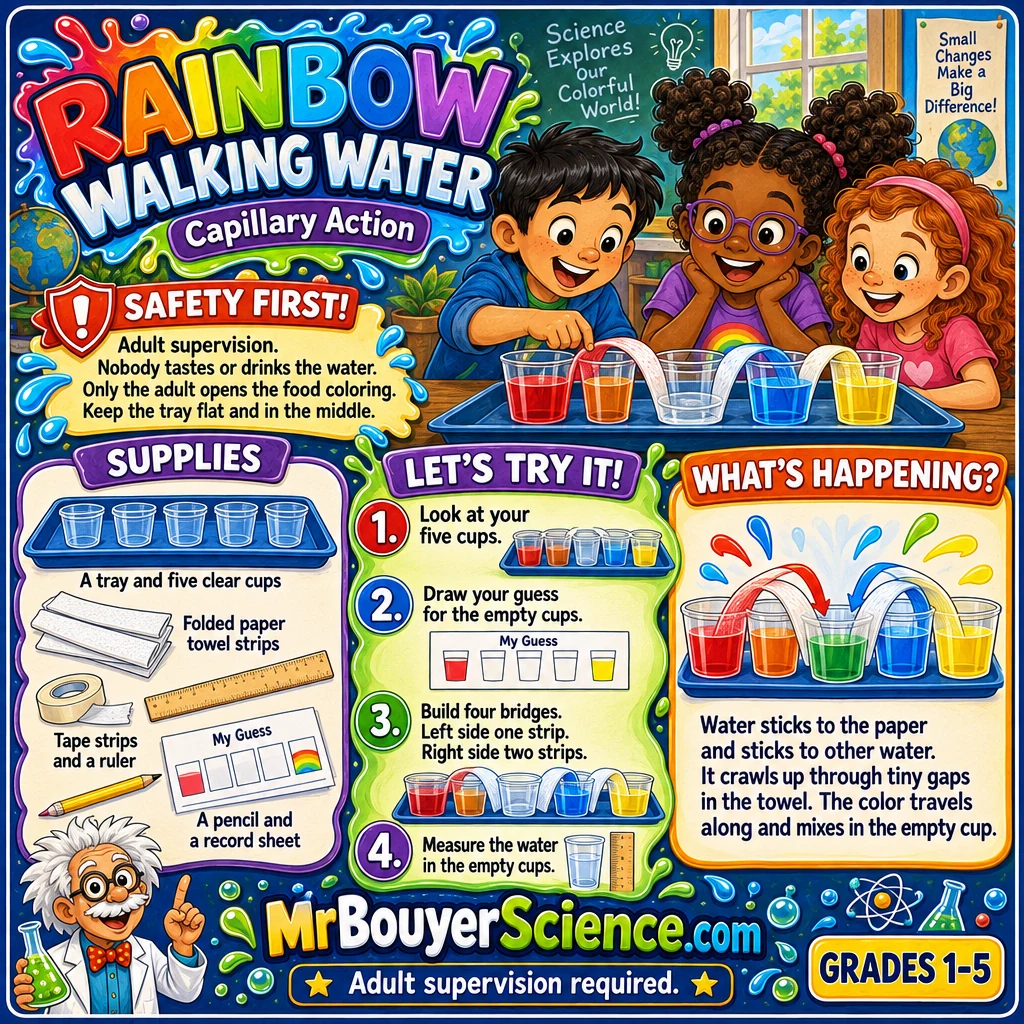
Put this card on the board for the class, or print it. Save the card
1Before class
The day before
- Test one tray yourself the day before. Note how long it takes for color to show on the towels and in the empty cups.
- Walking water is slow. Start the bridges in the first minutes of class. Check again at the end of class and again later in the day or the next morning.
- Food coloring is a food product. Ask the K to 5 teacher about dye allergies or sensitivities before you open the bottles.
- Food coloring stains skin, clothes and tables. Ask children to wear old shirts or bring smocks. Gloves are optional.
- Find a shelf or low table where the five trays can sit undisturbed for a day.
- Give your helpers the helper guide on this page. Let them build one tray first.
Ten minutes before kids arrive
- Set one tray in the middle of each table. Five tables, five trays.
- Line up five cups on each tray in this order. Red, empty, yellow, empty, blue. Leave about the width of a hand between cups.
- An adult fills the three colored cups about three quarters full with room temperature tap water.
- An adult adds food coloring until the color is bold. Red, yellow and blue. Stir each with a plastic spoon.
- Fold six paper towel strips for every tray. Fold each sheet in half the long way, then in half again.
- Set a ruler, three pencils, three record sheets, three tape strips and a few spare paper towels at every tray.
- Put this card up on the board.
Safety and care
- The K to 5 teacher is the responsible adult in the room. The high school helpers lead the activity but they are not adults.
- Nothing is tasted or drunk. The water in the cups is not for drinking. Keep water bottles away from the trays.
- An adult opens the food coloring and mixes the colors. Children never handle the bottles.
- Check for dye allergies or sensitivities first. Wash any colored skin with soap and water.
- Water on the floor is a slip risk. Keep trays flat in the middle of the table. Children do not carry cups. Wipe spills at once.
- Cups tip easily. Keep elbows and papers off the trays.
- Wash hands before and after. No sharp tools are needed.
2Materials for 15 students
| Item | Per group | Whole class | Notes |
|---|---|---|---|
| Clear plastic cups, 8 to 9 ounce | 5 | 25 | Three hold colored water. Two stay empty. Clear cups let children see the water move. |
| Food coloring in red, yellow and blue | Mixed by an adult | 1 small bottle of each | Adult only. Stains skin and clothes. |
| Room temperature tap water | About 600 ml | About 3 liters | Plain water from the tap. Let it sit in the room first. |
| Paper towel strips, folded | 6 | 30 | Fold each sheet in half the long way twice. White towels show color best. Keep a few spares. |
| Trays with a rim | 1 | 5 | Cookie sheets or lunch trays work. They catch spills and drips. |
| Rulers in centimeters | 1 | 5 | |
| Masking tape strips | 3 | 15 | Stuck on the outside of each colored cup at the water line. |
| Pencils | 3 | 15 | |
| Plain paper record sheets | 3 | 15 | Each child draws and records their own tray. |
| Old shirts or smocks | 3 | 15 | Food coloring stains. |
| Latex free gloves, optional | 3 pairs | 15 pairs | Only if the class is worried about stains. |
| Plastic spoons | 1 | 5 | For the adult who stirs the colors. |
| Extra paper towels | 1 roll | For spills. | |
| Trash bag | 1 | For used strips. |
How to set up the room
- Use five tables with one tray in the middle of each. Seat three children around each tray with one helper.
- Keep the floor clear so the K to 5 teacher and helpers can walk between tables.
- Pick a shelf or low table nearby where the trays can stay after class.
- Keep the sink or a wipe station close for hands.
3Run it in 30 minutes
Groups sit at their trays. Show the board. Ask for a guess. Can water climb out of a cup by itself?
Mark the start lines with tape. Fold, bend and set the four paper towel bridges. Left side gets single strips. Right side gets doubled strips.
Every few minutes children look, draw and name where the color is. Helpers ask questions. Measure with a ruler near the end.
Compare the two empty cups. Ask what changed and what stayed the same.
Wipe the tables. Wash hands. Leave the trays where they are. The K to 5 teacher checks again later today or tomorrow.
4What the kids do
- Look at your row of cups. Red, empty, yellow, empty, blue.
- Press a tape strip on each colored cup at the top of the water. This is the start line.
- Draw what you think the empty cups will hold at the end.
- Fold a paper towel strip into a bridge. One end goes in a colored cup. The other end goes in the next empty cup. Both ends touch the bottom.
- Build all four bridges. The two bridges on the left use one strip each. The two on the right use a doubled strip each.
- Watch and draw. Look at the strips every few minutes. Where is the color now?
- Near the end, measure the water in each empty cup with a ruler. Check the start lines on the colored cups.
Match it to the grade
Watch the color crawl up the towel. Name the colors in the empty cups. Guess what red and yellow will make. Say wet, wet, wet as the color moves.
Measure the water in the empty cups with a ruler in centimeters. Say which side gained more. Draw the cups at the start and the end.
Measure the empty cups at the start of the watch, in the middle and at the end. Make a simple line graph. Name what you changed and what you kept the same. List what makes the left and right test less than fair.
5Helper guide for older students
Your job
- Lead one group of three. Build one tray the day before so you know the steps.
- Give each child a job. One folds. One places the strips. One measures.
- Ask questions and let the children try before you explain.
- Check the strips every few minutes with the group. Point to where the color has reached.
- Keep the tray flat and in the middle of the table.
Say things like this
- What do you think will happen? Why?
- Where is the color now?
- Let us change one thing and watch.
- That is a good guess. How could we test it?
Please do not
- Do not give away the answer before they watch.
- Do not let anyone taste or drink the water.
- Do not let children open the food coloring.
- Do not hurry it. Say it takes time.
- Do not say a guess is wrong. Say let us test it.
6Talk it over
Questions to ask
- What did you see on the paper towel first?
- Which empty cup gained more water? Why do you think so?
- What colors did the empty cups turn? Where did that color come from?
- What did we change on the left and right? What stayed the same?
- Where have you seen water climb up a towel, a cloth or a sponge?
- Grades 4 and 5. Why does the water finally stop moving? What else should we test before we say the doubled strip caused the difference?
The science, in plain words
Paper towel is made of tiny fibers with small gaps between them. Water is attracted to the fibers and to other water. That pulls water up into the gaps and along the strip. Scientists call this capillary action. The strip stays wet all the way across the arch. Once water reaches the top of the bridge, gravity helps it run down the other side into the empty cup. Water keeps moving until the levels even out or the towel is full. The colors ride along with the water. Red and yellow make orange. Yellow and blue make green. The mixed colors often look lighter than the cups because the paper holds back some of the dye. A doubled strip has more fibers and more room for water, so it may carry water faster. Treat the left and right comparison as a first look. The dyes are different too, so it is not a perfect test.
Where you see it
- A paper towel soaks up a spill by pulling water into its fibers.
- Plants pull water up through tiny tubes in their roots and stems.
- A paintbrush pulls paint up between its bristles.
7If it goes wrong
| What you see | What to do |
|---|---|
| Nothing seems to move | Check that both ends touch the bottom of the cups and the whole strip is wet. Give it more time. Walking water is slow. |
| The strip is dry in the middle | Move the cups a little closer so the arch is not stretched tight. Press the strip down into the cup so it stays wet. |
| Colors look muddy brown | Make sure each empty cup gets only its own two bridges. Use fresh strips and keep the cups apart. |
| Water drips on the tray or table | A strip is touching the tray or table edge. Lift it back to a clean arch. Dry the tray. |
| A cup tips over | Keep the trays flat in the middle of the table. An adult mops up. Refill the cup if needed. |
| Stained hands | Rinse right away with soap and water. Stains fade in a day or two. |
Clean up
- Wipe every table and tray
- Put used strips in the trash bag
- Leave the trays in place if you can for a later check
- An adult pours the colored water down the sink when the check is done
- Wash hands with soap and water
Go further
- Try a wider strip, a coffee filter or a napkin. Which one carries water best?
- Make a ring of six cups to see more mixed colors.
- Set the cups farther apart. How far can the water walk?
- Look again the next morning. Where did the water go?
Built by Science Fenns for teachers and student helpers. Keep supervising every group the whole time.