
Teacher cards / Activity 13
For teachers and helpers. Adult supervised. Not for student screens.Paper Towel Absorbency Race
Which paper towel holds the most water?

★The card
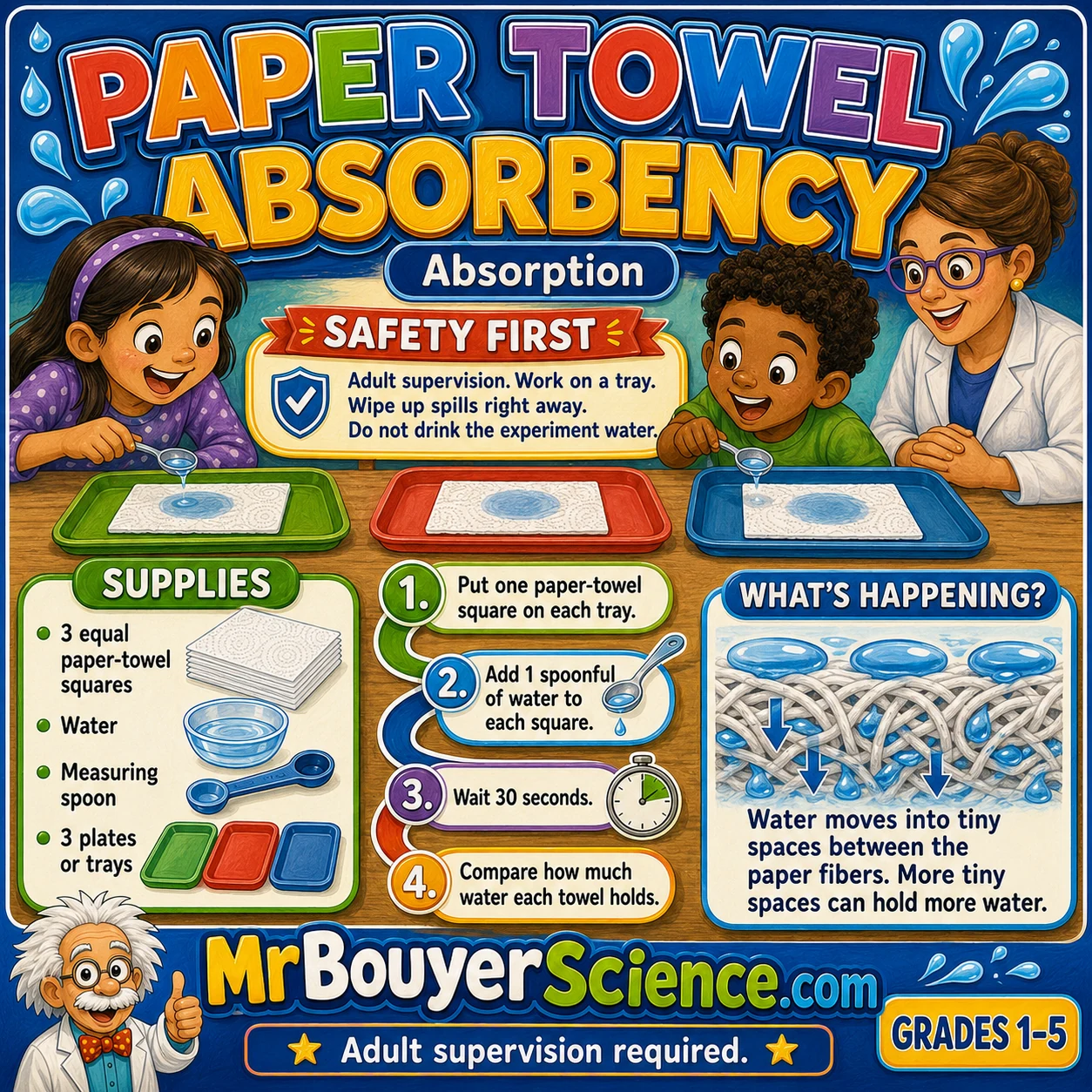
Put this card on the board for the class, or print it. Save the card
1Before class
The day before
- Choose three different paper towels. Label them A, B and C.
- Cut each towel into equal squares about 10 centimeters wide. Use scissors yourself before class. Children never use scissors.
- Cut 3 squares of each towel for each group. One is for round one, one is for round two and one is a spare. That is 9 squares per group.
- Test one round yourself. Add one spoonful to each square and watch.
- Use plain tap water only. Nothing is added to the water. The water is not for drinking.
- Check the room for allergy needs. No food is used in this activity.
- Give your helpers the helper guide on this page. Let them test one round first.
Ten minutes before kids arrive
- Set five tables, one for each group. Use tables so water stays off the floor.
- Put three trays on every table. Mark them A, B and C with tape.
- Fill one small cup about a third full of plain water for each group. Set it in a shallow tray so spills stay caught.
- Set one measuring teaspoon, a stopwatch and a stack of dry towels at every table.
- Put a roll of paper towels for wiping spills at every table.
- Set a trash bag near the door.
- Put this card up on the board.
Safety and care
- An adult stays with every group for the whole activity.
- Use plain water only. Nothing is added. The water is never for drinking.
- Work on a tray at a table. Wipe spills at once.
- Wet floors are slippery. Dry any drip on the floor right away.
- Children never use scissors. An adult cuts the squares before class.
- Nothing goes in mouths. No tasting the water or the towels.
- Wash hands before and after.
2Materials for 15 students
| Item | Per group | Whole class | Notes |
|---|---|---|---|
| Paper towel squares, A, 10 centimeters wide | 3 | 15 | Cut equal squares. Adult cuts before class. |
| Paper towel squares, B, 10 centimeters wide | 3 | 15 | A different brand or thickness. |
| Paper towel squares, C, 10 centimeters wide | 3 | 15 | A third brand or thickness. |
| Trays | 3 | 15 | Marked A, B and C. Plates with a lip work too. |
| Small cup of plain water | 1 | 5 | About a third full. Keep it in a shallow tray. |
| Measuring teaspoon | 1 | 5 | Rinse and dry between groups. |
| Stopwatch or timer | 1 | 5 | The helper reads it out. |
| Roll of paper towels for spills | 1 | 5 | Keep it away from the test squares. |
| Pencils | 3 | 15 | |
| Plain paper, folded in half | 3 | 15 | Each child records their own results. |
| Trash bag | 1 | For wet towels. |
How to set up the room
- Set five tables with three trays on each. Mark each tray A, B or C.
- Seat the group of three around the table. Each child takes one tray.
- Keep the cup of water in the middle in its own tray.
- Keep floor space clear around every table. Dry any drip right away.
3Run it in 30 minutes
Groups sit at their tables. Show the board. Ask for a guess. Which towel holds the most water? Why?
Helpers show how to place one square on each tray. Check that squares are the same size.
Add one spoonful of water to each square. Wait 30 seconds. Look at the wet spot. Look at any water left on top.
Use fresh squares. Add one spoonful at a time. Count spoonfuls until water stays on top. The towel that holds the most is the winner.
Bring the class together. Compare results. Wipe the trays. Bag the wet towels.
4What the kids do
- Put one dry paper towel square on each tray.
- Add one spoonful of plain water to each square.
- Wait 30 seconds. The helper reads the timer.
- Look at each square. Which wet spot is biggest? Is water left on top?
- Use fresh squares. Add one spoonful at a time.
- Count the spoonfuls until water stays on top.
- Which towel held the most? Was your guess right?
Match it to the grade
Add one spoonful and watch the water soak in. Say wet spot together. Point to the towel that looks wettest.
Count the spoonfuls each towel holds. Say which held the most. Compare with your guess.
Test each towel three times. Find the typical count. Make a bar graph. Name what you changed and what you kept the same.
5Helper guide for older students
Your job
- Lead one group of three. Run one round the day before so you know the steps.
- Give each child a job. One adds the spoonful. One counts. One records.
- Wipe any spill at once.
- Ask questions and let the children try before you explain.
- Keep the cup in its own tray and keep water off the floor.
Say things like this
- What do you think will happen? Why?
- Where did the water go?
- Let us change one thing and try again.
- That is a good guess. How could we test it?
Please do not
- Do not give away the answer before they test it.
- Do not let a child drink or taste the water.
- Do not let water sit on the floor.
- Do not pour for a child. Help with your hands over theirs.
- Do not say a guess is wrong. Say let us test it.
6Talk it over
Questions to ask
- Which towel held the most water? How do you know?
- What did the towels look like up close? What did you notice?
- What happened when we added more spoonfuls? Why do you think so?
- What did we change each time? What stayed the same?
- Where do we use something to soak up water?
- Grades 4 and 5. Why must the squares be the same size for a fair test?
The science, in plain words
Paper towels are made of tiny plant fibers with many small gaps between them. Water sticks to the fibers and is pulled into the gaps. This is called capillary action. A towel with more gaps or thicker fibers can often hold more water, but the only way to know is to test. Once the gaps are full, extra water cannot go in and stays on top. Equal squares and equal spoonfuls make the test fair.
Where you see it
- A sponge soaks up spills the same way.
- A plant pulls water up through tiny tubes in its stem.
- A cloth towel dries your hands by pulling water into its fibers.
7If it goes wrong
| What you see | What to do |
|---|---|
| Water runs off the square | Check that the square is flat on the tray. Add the water slowly. |
| The results are all the same | Count in half spoonfuls. Or use three very different towels. |
| Water spills on the table | Wipe it up at once. Keep the cup in its own tray. |
| The squares are different sizes | Swap them for squares of the same size. Otherwise the test is not fair. |
| Children disagree about which holds the most | Count spoonfuls together. Then repeat. Use the count, not the look. |
| A child wants to taste the water | Say no every time. The water is never for drinking. |
Clean up
- Pour any extra water down the sink
- Bag the wet towels
- Wipe every tray and table dry
- Return spoons, cups and timers to the kit
- Wash hands
Go further
- Fold a square in half. Does it hold more or less?
- Try cloth and paper side by side.
- Try a coffee filter.
- Hang a strip of towel over the side of a cup of plain water. Watch the water climb.
Built by Science Fenns for teachers and student helpers. Keep supervising every group the whole time.