

Teacher cards / Activity 12
For teachers and helpers. Adult supervised. Not for student screens.Paper Helicopter
Why does a paper helicopter spin as it falls?

★The card
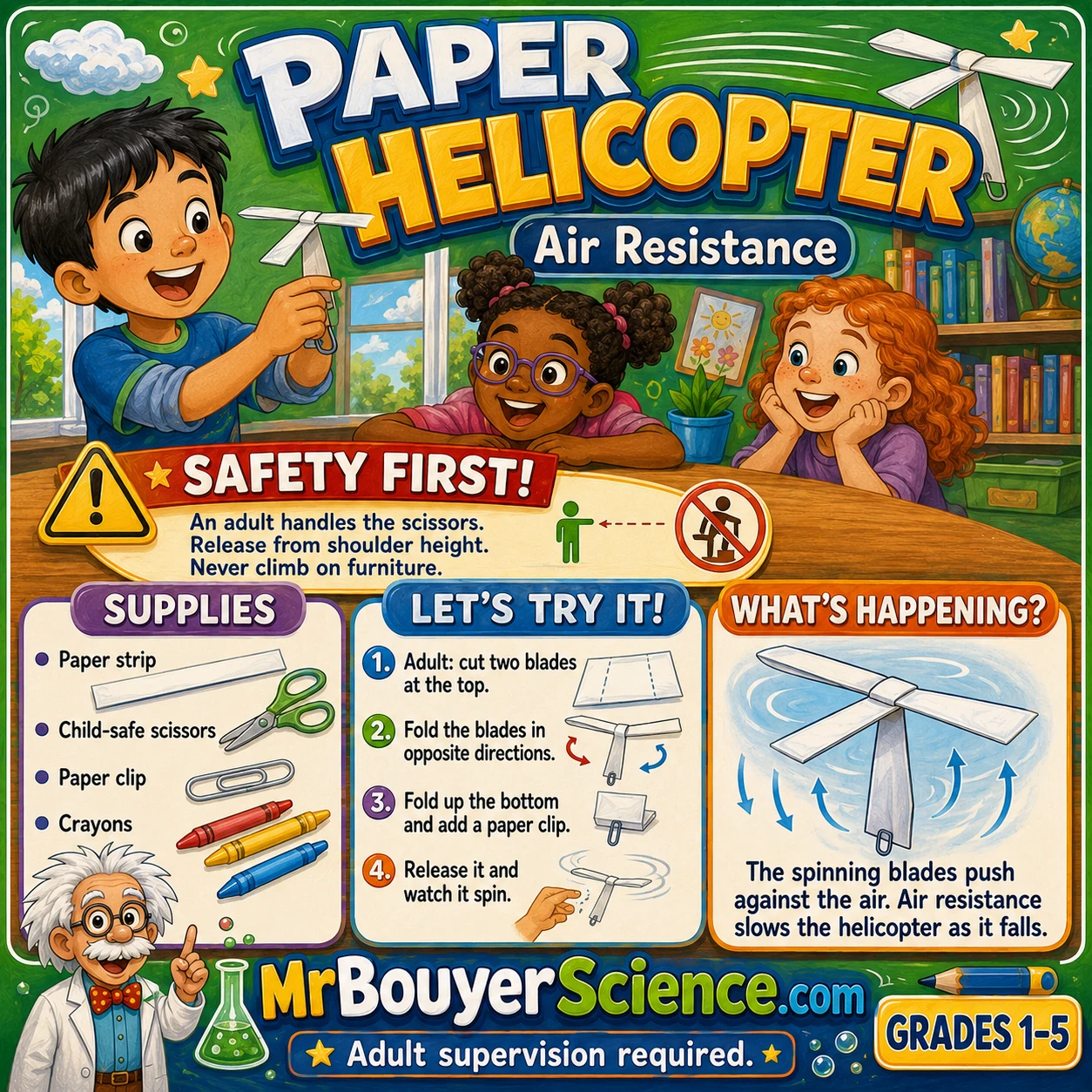
Put this card on the board for the class, or print it. Save the card
1Before class
The day before
- Cut the paper helicopters yourself before class. Children never use scissors. The K to 5 teacher makes every cut.
- Make one helicopter and test it. Drop it from shoulder height. It should spin.
- Cut 5 strips for each group. That is 25 for the class. Four get a slit and one stays flat.
- Use jumbo paper clips. Small clips are a choking risk for young children.
- Count the clips before class and count them back at the end.
- Check the room for allergy needs. No food is used in this activity.
- Give your helpers the helper guide on this page. Let them make one helicopter first.
Ten minutes before kids arrive
- Cut paper strips about 5 centimeters wide and 15 centimeters long.
- Cut a slit down the middle of the top of four strips for each group. Cut about halfway down.
- Leave one strip for each group uncut.
- Mark a drop zone for each group with tape on the floor. Each zone is a square about one meter wide.
- Set a stopwatch, 8 jumbo clips and 6 crayons at every group.
- Set a trash bag near the door.
- Put this card up on the board.
Safety and care
- An adult stays with every group for the whole activity.
- Children never use scissors. The K to 5 teacher cuts every strip before class.
- Release from shoulder height while standing on the floor. Nobody climbs on a chair, table or stool.
- Use jumbo clips only. Count them out and count them back. Nothing goes in mouths.
- Keep faces away from the drop zone. Hold the helicopter out to the side and drop it. No throwing.
- Paper edges can nick fingers. Handle strips gently.
- Wash hands before and after.
2Materials for 15 students
| Item | Per group | Whole class | Notes |
|---|---|---|---|
| Paper strips, 5 by 15 centimeters, pre cut with a slit | 4 | 20 | One for each child and one spare. Adult cuts them before class. |
| Paper strips, uncut | 1 | 5 | For the flat strip trial. |
| Jumbo paper clips | 8 | 40 | Two for each child's helicopter plus two spares. Count them back. |
| Crayons | 6 | 30 | For coloring a stripe on one blade. |
| Stopwatch or timer | 1 | 5 | The helper reads it out. Children count aloud. |
| Masking tape | 4 strips | 1 roll | For the drop zone corners. |
| Pencils | 3 | 15 | |
| Plain paper, folded in half | 3 | 15 | Each child records their own drops. |
| Trash bag | 1 | For scraps. |
How to set up the room
- Mark five drop zones on the floor. Leave one and a half meters between zones.
- Seat each group on the floor or chairs just behind its zone.
- Keep a clear path so a helper can walk to each zone.
- Keep furniture away from the zones. Nobody climbs on anything.
3Run it in 30 minutes
Groups sit behind their zones. Show the board. Ask for a guess. What will happen when a paper helicopter falls?
Helpers show how to fold the two blades in opposite directions. Fold up the bottom. Add a clip. Children color a stripe on one blade.
Each child drops their helicopter from shoulder height. Helpers count aloud. Try two clips. Then drop the flat strip.
Bring the class together. Which fell slowest. Which spun. Ask why.
Collect the clips and strips. Count the clips back in.
4What the kids do
- Look at your paper strip. An adult has already cut the top.
- Fold the two blades in opposite directions. One forward. One back.
- Fold the bottom up. Slide on a jumbo paper clip.
- Color a stripe on one blade with a crayon.
- Stand on the floor. Hold it at shoulder height. Let go.
- Count how long it takes to land. Did it spin?
- Add a second clip and try again. Then drop the flat strip.
Match it to the grade
Drop the helicopter and watch it spin. Say spin and fall together. Compare it to the flat strip.
Drop one clip and then two clips. Count how long each takes. Say which fell slower.
Time three drops for each clip count. Find the typical time. Make a bar graph. Name what you changed and what you kept the same.
5Helper guide for older students
Your job
- Lead one group of three. Make a helicopter the day before so you know the steps.
- Hand out clips and count them back at the end.
- Give each child a job. One drops. One counts. One records.
- Ask questions and let the children try before you explain.
- Keep everyone standing on the floor at shoulder height.
Say things like this
- What do you think will happen? Why?
- Which way did it spin?
- Let us change one thing and try again.
- That is a good guess. How could we test it?
Please do not
- Do not give away the answer before they test it.
- Do not let any child use scissors.
- Do not let anyone climb on a chair, table or stool.
- Do not let clips go in mouths. Count them back.
- Do not say a guess is wrong. Say let us test it.
6Talk it over
Questions to ask
- What did the helicopter do when you let go?
- What happened to the flat strip? Why do you think so?
- What happened with two clips? Why do you think so?
- What did we change each time? What stayed the same?
- Where have you seen something spin as it falls?
- Grades 4 and 5. What would happen with longer blades? Test it.
The science, in plain words
When the helicopter falls, air pushes up against it. This is air resistance. The two blades are folded in opposite directions, so the air pushes on each blade at a slant. These pushes turn the blades, and the helicopter spins as it falls. The spinning blades catch more air than a flat strip and slow the fall. A heavier helicopter with more clips falls faster because the weight pulls harder than the air pushes.
Where you see it
- Maple seeds spin as they fall and travel a long way from the tree.
- A parachute catches air to slow a fall.
- A helicopter rotor spins and pushes on the air.
7If it goes wrong
| What you see | What to do |
|---|---|
| The helicopter falls without spinning | Check that the two blades fold in opposite directions. Make the fold sharp. |
| It spins one way then wobbles | Check that both blades are the same size. Make the fold even. |
| It drops too fast to time | Remove the second clip. Try a lighter strip. |
| It lands on its side | Fold the bottom up evenly. Keep the clip at the bottom. |
| Children want to throw it | Remind them to hold it out and let go. No throwing. |
| Children want to climb up higher | Say no every time. Shoulder height only. A spin high up needs no chair. |
Clean up
- Take the clips off every helicopter
- Count clips back into the kit
- Put scraps in the trash bag
- Return crayons, timers and pencils
- Wash hands
Go further
- Try a shorter blade. A teacher or helper pre cuts it.
- Try a wider strip. Does it fall slower?
- Try a lighter clip. Does it spin faster?
- Drop two helicopters at once. Which lands first?
Built by Science Fenns for teachers and student helpers. Keep supervising every group the whole time.