

Teacher cards / Activity 11
For teachers and helpers. Adult supervised. Not for student screens.Paper Cup Tower
Why does a wide base keep a tower standing?

★The card
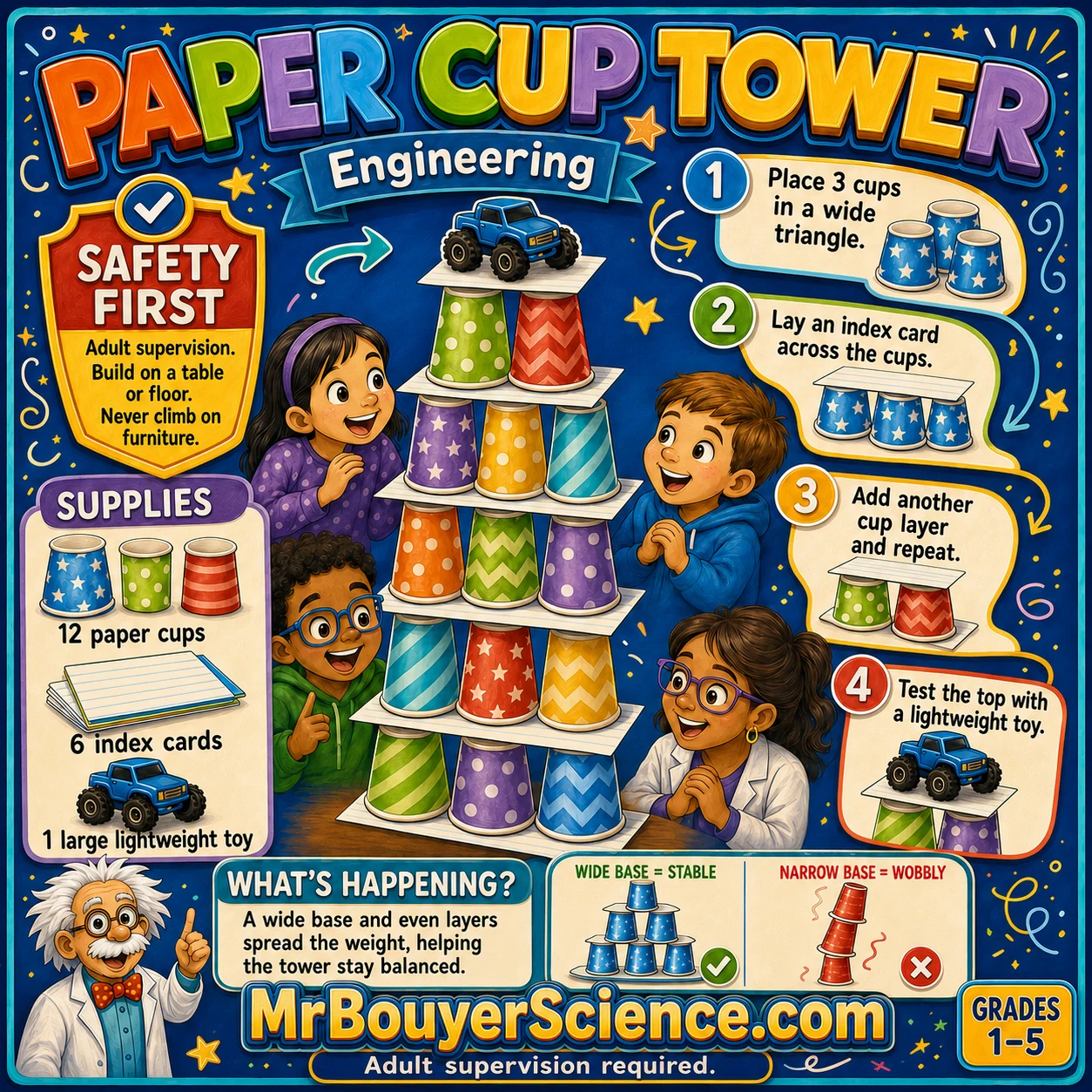
Put this card on the board for the class, or print it. Save the card
1Before class
The day before
- Build one tower yourself. It takes five minutes and shows you how close the cups must sit.
- Use 5 by 8 inch index cards. A 3 by 5 card is too small to rest on three cups.
- Choose a light toy with no loose parts. A soft toy or a foam block works well. Nothing that can come apart.
- Check the room for allergy needs. No food is used in this activity.
- Give your helpers the helper guide on this page. Let them build one tower first.
- Tell the K to 5 teacher the class will work on tables or on the floor. Nobody stands on furniture.
Ten minutes before kids arrive
- Set five work spots. Use a table or clear floor space for each group.
- Count 12 paper cups and 6 index cards for each group. Stack them on the table edge.
- Place one light toy at each spot, beside the cups.
- Put a pencil and a record sheet for each child at every spot.
- Set a trash bag near the door.
- Put this card up on the board.
Safety and care
- An adult stays with every group for the whole activity.
- Build on a table or on the floor. Nobody climbs on a chair, table or stool to build or to reach.
- Keep the tower low enough that every child can reach the top while seated or standing on the floor.
- Use a light toy with no loose parts. A falling toy should not hurt anyone.
- Cups are for building only. Nothing goes in mouths.
- Keep faces back from the tower when the toy goes on top.
- Wash hands before and after.
2Materials for 15 students
| Item | Per group | Whole class | Notes |
|---|---|---|---|
| Paper cups, 9 ounce | 12 | 60 | Plain white cups are fine. Use new cups. |
| Index cards, 5 by 8 inch | 6 | 30 | Two are spares. Stiff card works best. |
| Lightweight toy with no loose parts | 1 | 5 | A soft toy or a foam block. Keep it light. |
| Meter stick or tape measure | 1 | 5 | For the Grade 4 and 5 challenge. |
| Pencils | 3 | 15 | |
| Plain paper, folded in half | 3 | 15 | Each child records their own tower. |
| Trash bag | 1 | For any bent cups or cards. |
How to set up the room
- Set five work spots. Use tables or clear floor space.
- Put each group around one spot with the cups and cards in the middle.
- Keep the toy beside the cups until the tower is ready.
- Keep walking space clear so helpers can move between groups.
3Run it in 30 minutes
Groups sit at their spots. Show the board. Ask for a guess. How many layers can your cups hold before the toy goes on top?
Helpers build the bottom layer as a model. Three cups in a wide triangle. One card across the top. Children watch and say what comes next.
Each group builds a tower. Children take turns placing cups and cards. Helpers ask what makes it steady.
Place the light toy on top. Then build a narrow stack beside it and compare. Which one wobbles?
Bring the class together. Share what kept the towers standing. Take the towers apart. Count the cups and cards back in.
4What the kids do
- Place three cups upside down in a wide triangle. Keep the rims close.
- Lay an index card across the three cups. It should rest on all three.
- Add another layer of three cups on top of the card.
- Lay another card and keep building. Make every layer the same.
- Place the light toy on the top card. Let go slowly.
- Look at your tower. Does it wobble or stand still?
- Build a narrow stack of single cups. Compare it to the wide tower.
Match it to the grade
Build one layer and one card. Add the toy and watch. Say wide and steady. Use big words like wobble together.
Build a tower of three or four layers. Place the toy on top. Draw your tower and label the wide base.
Measure how tall your tower stands. Try two layers, three layers and four layers. Make a bar graph. Name what you changed and what stayed the same.
5Helper guide for older students
Your job
- Lead one group of three. Build a tower the day before so you know the steps.
- Give each child a job. One places cups. One lays cards. One checks that the layer is even.
- Ask questions and let the children try before you explain.
- Help with your hands over theirs when a cup is wobbling.
- Keep the tower on the table or the floor at all times.
Say things like this
- What do you think will happen? Why?
- Which layer looks steadiest?
- Let us change one thing and try again.
- That is a good idea. How could we test it?
Please do not
- Do not give away the answer before they test it.
- Do not let anyone climb on a chair, stool or table.
- Do not build above shoulder height.
- Do not knock the tower over yourself. Let it fall on its own.
- Do not say a guess is wrong. Say let us test it.
6Talk it over
Questions to ask
- What did you do to keep the tower steady?
- Which layer carried the most weight? Why do you think so?
- What happened to the wide tower and the narrow stack? Why?
- What did we change each time? What stayed the same?
- Where have you seen a wide bottom on something tall?
- Grades 4 and 5. What would happen if one layer had only two cups? Test it.
The science, in plain words
A tower stays up when its weight pushes straight down through a base wide enough to hold it. A wide base gives a large area to rest on, so the tower can lean a little and still not tip. Each cup carries weight down through its walls and rim, and the index card spreads the load from one layer onto the cups below. Even layers keep the weight balanced. A narrow stack has a small base, so a small tilt moves the weight outside the base and the tower falls.
Where you see it
- A pyramid has a wide base and is very hard to tip.
- A bridge pier has a wide footing to hold a heavy load.
- A camera tripod spreads its legs wide to stay steady.
7If it goes wrong
| What you see | What to do |
|---|---|
| The tower leans right away | Move the cups closer so the card rests on all three. Check that every cup sits flat. |
| The card slips off the cups | Use a stiffer card. Make sure the card touches the rim of every cup beneath it. |
| Cups are crushed | Replace them. A bent cup does not carry weight evenly. |
| The tower falls when the toy goes on | Set the toy on slowly and in the middle. Try a lighter toy. |
| The narrow stack will not stand | That is the point. Ask why it fell. Then widen the base. |
| Children want to keep going higher | Keep the tower to four layers. Never let a child stand or reach above shoulder height. |
Clean up
- Take every tower apart slowly
- Put bent cups in the trash bag
- Count cups and cards back in
- Return the toys and pencils to the kit
- Wash hands
Go further
- Try two cups in each layer. Is the tower still steady?
- Build the tallest tower you can with 12 cups. Keep it low enough to reach from the floor.
- Try a heavier toy. How far can you go before the tower tips?
- Tap the table gently. Which tower wobbles first?
Built by Science Fenns for teachers and student helpers. Keep supervising every group the whole time.