
Teacher cards / Activity 10
For teachers and helpers. Adult supervised. Not for student screens.Paper Bridge Challenge
How can the same sheet of paper hold more weight.

★The card
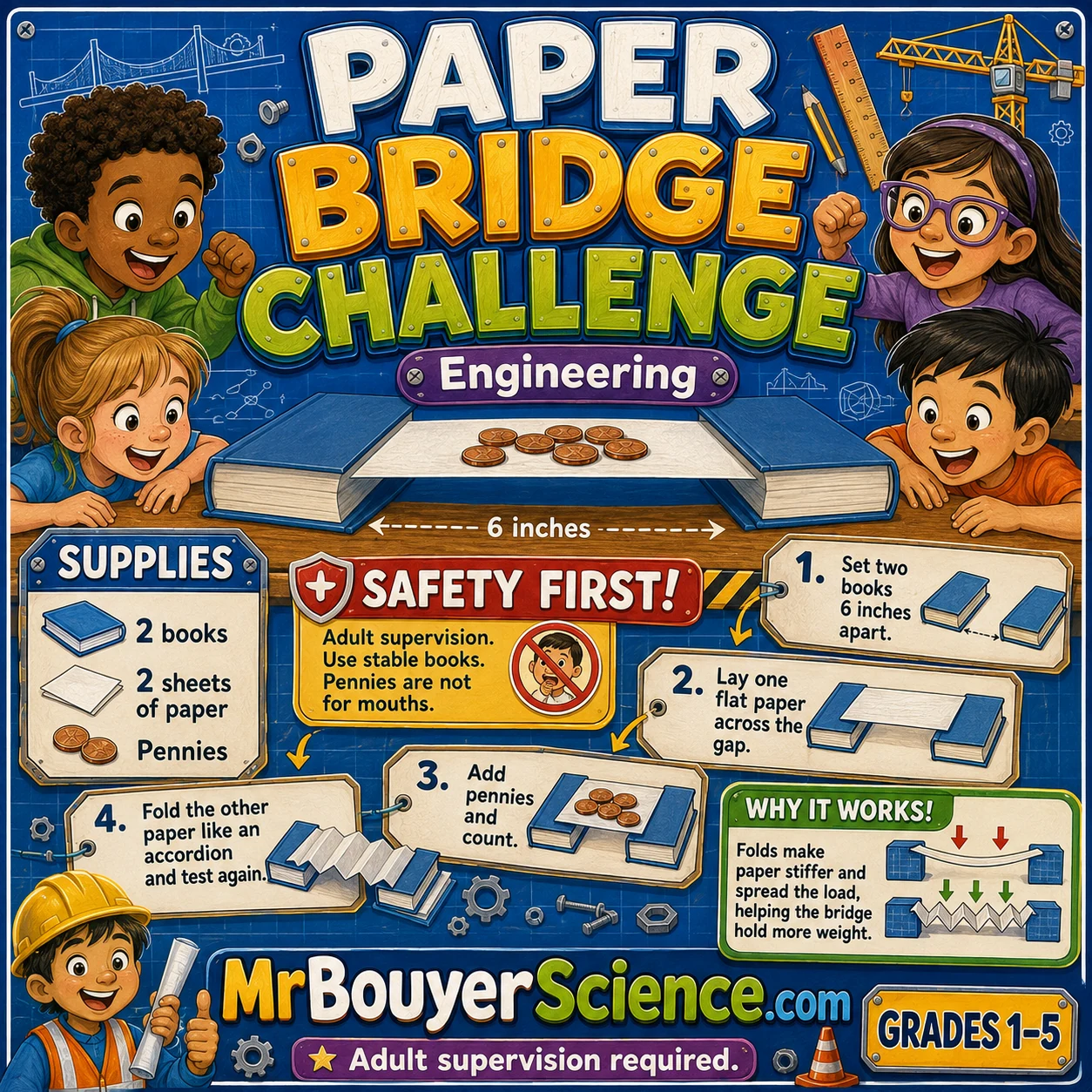
Put this card on the board for the class, or print it. Save the card
1Before class
The day before
- Build one flat bridge and one accordion bridge yourself. Count how many pennies each holds. It takes five minutes.
- Count out the pennies for each group. Keep them in small cups. Pennies are a choking risk for the youngest children.
- Plan who is in charge of the pennies. The helper hands them out and counts them back in. Children do not hold extra pennies.
- Give your helpers the helper guide on this page. Let them build both bridges first.
- Tell the K to 5 teacher to watch the youngest children closely. Nothing goes near mouths.
Ten minutes before kids arrive
- Mark a gap of 6 inches on each table or floor space with two strips of tape. Measure it with a ruler.
- Set two heavy hardcover books flat with their inner edges on the tape lines.
- Put a tray or shallow box lid under the gap to catch falling pennies.
- Set two sheets of paper and two spare sheets at each station.
- Put a cup of 40 pennies at each station. The helper keeps the cup.
- Set pencils and paper at each station.
- Put this card up on the board.
Safety and care
- An adult stays with every group for the whole activity. The K to 5 teacher is the responsible adult. Helpers are teenagers and do not replace an adult.
- Pennies are a choking risk for young children. The helper hands out the pennies and counts them. Children place them one at a time. The helper counts them back in at the end.
- Nothing goes in mouths. Pennies are never held in a hand beyond placing them.
- Use heavy hardcover books and set them flat. Never stack them. Keep them off the edge of the table.
- Books can fall and hurt feet. Keep feet back from the table edge and do not lean on the books.
- Dropped pennies on the floor are a slip hazard. Pick them up at once.
- Wash hands after handling coins.
2Materials for 15 students
| Item | Per group | Whole class | Notes |
|---|---|---|---|
| Heavy hardcover books | 2 | 10 | Same size, same weight. Never stacked. |
| Sheets of copy paper | 4 | 20 | Two to test. Two spares. |
| Pennies, counted | 40 | 200 | The helper hands them out and counts them back in. |
| Small cup for the pennies | 1 | 5 | The helper keeps this cup. |
| Ruler or tape measure | 1 | 5 | Sets the 6 inch gap. |
| Masking tape | 2 strips | 1 roll | Marks the gap. |
| Tray or shallow box lid | 1 | 5 | Sits under the gap to catch pennies. |
| Pencils | 3 | 15 | |
| Plain paper, folded in half | 3 | 15 | Each child records their own tests. |
| Trash bag | 1 | For torn paper. |
How to set up the room
- Use five sturdy tables or five clear floor spaces with room between them.
- Put the books so every group can see the gap from the side.
- Seat each group of three around its bridge with feet back from the books.
- Keep walking space clear so helpers can move between stations.
3Run it in 30 minutes
Groups sit at their books. Show the board. Ask for a guess. How many pennies can one sheet of paper hold.
Lay one sheet flat across the gap. The helper hands out pennies. Children add them one at a time and count out loud until the paper sags or falls.
Fold the second sheet like an accordion. Lay it across the gap and test again.
Count how many pennies each held. Draw both bridges. Compare.
The helper counts pennies back in. Put the paper in the bag. Return the books. Wash hands.
4What the kids do
- Set two books 6 inches apart. Check the gap with the ruler.
- Lay one flat sheet across the gap.
- The helper hands out pennies. Place them one at a time. Count out loud.
- Stop when the paper sags or falls. Write the count.
- Fold the second sheet like an accordion the long way. Lay it across the gap.
- Add pennies and count again. Write the count.
- Compare. Which bridge held more. The helper counts the pennies back in.
Match it to the grade
Place pennies one at a time and count. Say which bridge held more. Say flat and folded.
Record how many pennies each bridge held. Write which was more and how many more.
Test the flat sheet and the folded sheet three times. Record every trial. Find the typical count for each. Make a bar graph. Try two different fold sizes.
5Helper guide for older students
Your job
- Lead one group of three. Build both bridges the day before.
- Keep the pennies in your cup. Hand them out and count them back in.
- Give each child a job. One places the pennies. One counts. One records.
- Ask questions and let the children try before you explain.
- Keep feet and hands away from the books.
Say things like this
- What do you think will happen. Why.
- Where does the paper bend first.
- Let us change one thing and try again.
- That is a good guess. How could we test it.
Please do not
- Do not give a child more than one penny at a time.
- Do not leave pennies on the table when you step away.
- Do not let anyone put a penny near a mouth.
- Do not give away the answer before they test it.
- Do not say a guess is wrong. Say let us test it.
6Talk it over
Questions to ask
- How many pennies did the flat paper hold. How many did the folded paper hold.
- What did we change. What stayed the same.
- Where did the paper bend first.
- What could make the bridge even stronger.
- Where have you seen folded or ridged shapes used to make something strong.
- Grades 4 and 5. Why would the folds that run along the span help more than folds across it.
The science, in plain words
A flat sheet of paper has very little depth, so it bends easily under a load and sags. When you fold it into an accordion, the paper makes ridges that stand up above and below the middle. That depth makes the sheet much harder to bend. Engineers use the same idea in beams and in corrugated metal. The paper has the same mass, but its shape is stronger. Folds that run along the gap from one book to the other do the most good. A bridge usually fails at the middle, where the bend is greatest.
Where you see it
- Cardboard boxes have a folded paper layer inside that makes them stiff.
- Corrugated metal roofs are folded to hold their shape over long spans.
- Steel beams have an I shape because depth resists bending.
7If it goes wrong
| What you see | What to do |
|---|---|
| The flat paper falls at the first penny | The paper may be too short. Make sure it rests on both books by an inch. Try again. |
| The accordion bridge does not hold more | Check the folds run along the gap and are about as wide as a thumb. Fold crisp creases. |
| The paper slides off the books | Tape a small tab at each end or move the books closer together. Keep the gap at 6 inches. |
| Pennies roll off the bridge | Place them in the middle one at a time and flat. Stack them in a short pile. |
| The books slide apart | Set the books on a table and tape the lines. Add a bit of tape to the bottom of each book. |
| A penny is missing | Stop the activity. Check the floor, the tray and the tables. Count all pennies before anyone leaves. |
Clean up
- The helper counts the pennies back into the cup
- Check the floor and tray for strays
- Put torn paper in the trash bag
- Return books, tape and rulers to the kit
- Count the cups back in
- Wash hands
Go further
- Fold the paper into a tube. Does it hold more than the accordion.
- Make the folds wider or narrower. Which is stronger.
- Make the gap bigger. How many pennies now.
- Use two sheets together. Is it twice as strong.
Built by Science Fenns for teachers and student helpers. Keep supervising every group the whole time.