
Teacher cards / Activity 21
For teachers and helpers. Adult supervised. Not for student screens.Paper Airplane Test Flight
Can one small change make a paper airplane fly farther?

★The card
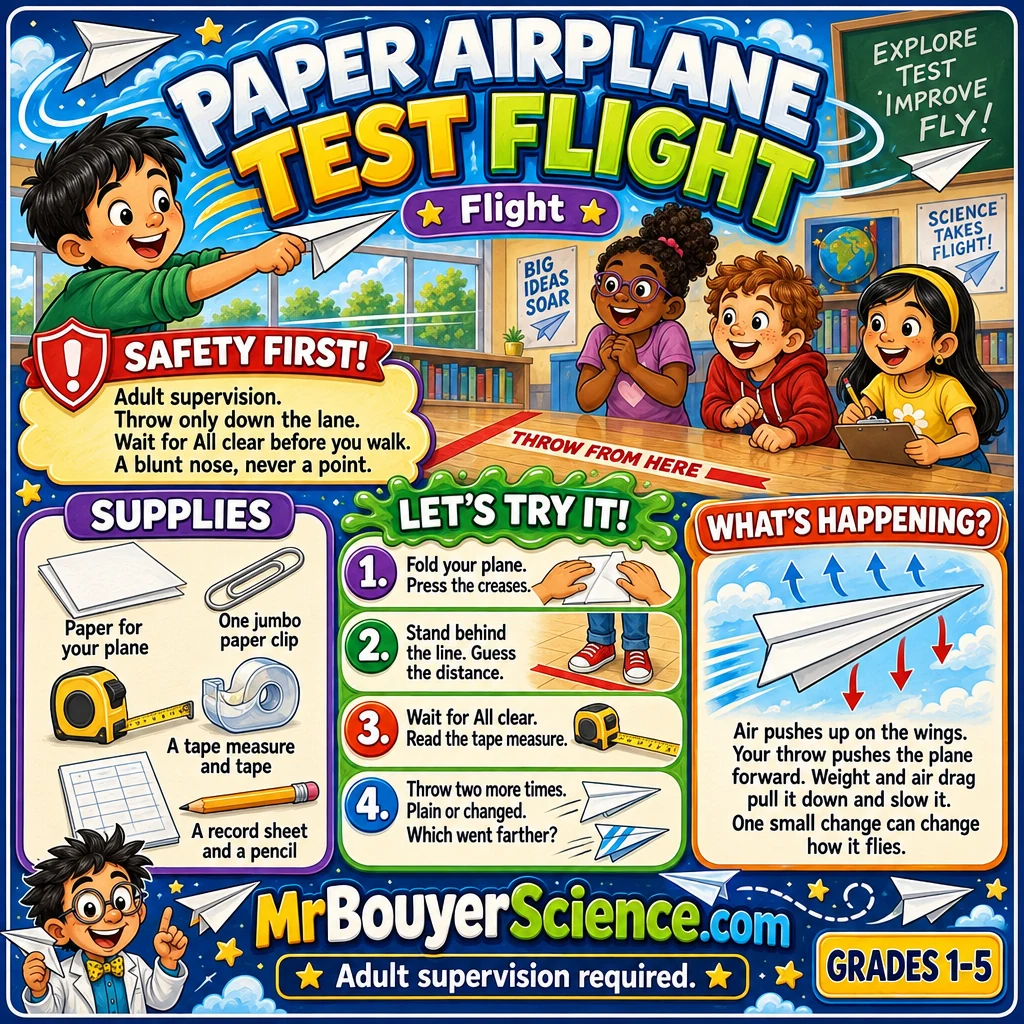
Put this card on the board for the class, or print it. Save the card
1Before class
The day before
- Fold and fly one plane yourself. Fly it down the lane before class so you know a normal distance.
- Pick a long clear lane. A hallway, gym or covered outdoor space on a calm day works. Close doors and windows if you stay inside.
- Plan the call words with the K to 5 teacher. Use Ready. Fly. All clear. Children only walk after All clear.
- Count the jumbo paper clips into each kit. Count them out again at the end.
- Give your helpers the helper guide on this page. Let them fold the plane first.
Ten minutes before kids arrive
- Lay one long tape strip across the floor as the throw line.
- Lay five lanes side by side down the room, two meters apart. Start a tape measure at the throw line in each lane. Tape the end down.
- Count eight sheets of paper, four jumbo paper clips, six tape strips and a pencil into each kit.
- Set the kits at the throw line.
- Clear all chairs, bags and people from the lanes. Nothing is on the floor in front of the line.
- Put this card up on the board.
Safety and care
- An adult stays with every group for the whole activity. The K to 5 teacher is the responsible adult in the room. Helpers are teenagers.
- Fold the nose of every plane back so it is blunt. No pointed noses.
- Throw only down the lane and always the same direction. Never throw toward people, windows or the ceiling lights.
- Only the thrower is at the line when the teacher calls Fly. Everyone else stands behind.
- Nobody walks into the lanes until the teacher calls All clear.
- Count paper clips in and out. They are small parts. Never put them in mouths.
- Pencils are for writing only. Keep the points down.
- Wash hands after the activity.
2Materials for 15 students
| Item | Per group | Whole class | Notes |
|---|---|---|---|
| Sheets of copy paper | 8 | 40 | All the same size and kind. Three planes plus five spares. |
| Jumbo paper clips | 4 | 20 | Count in and out. Used only if the group picks nose weight. |
| Tape measure, 5 meters or more | 1 | 5 | Or a string with tape flags every meter. |
| Masking tape | 6 strips | 1 roll | One long strip is also the throw line. |
| Pencils | 3 | 15 | |
| Record sheets, plain paper folded in half | 3 | 15 | Each child records their own flights. |
How to set up the room
- Mark the throw line across one end of the room. Run five lanes away from it.
- Space the lanes two meters apart. Lay a tape measure down each lane.
- Seat each group behind the throw line.
- Keep all walking space off the lanes.
3Run it in 30 minutes
Groups sit behind the throw line. Show the board. Ask for a guess. How far will a paper airplane fly?
Helpers show one fold. Each child folds a plane. Fold the nose tip back to make it blunt.
Each child flies two times. The group picks one change. Each child flies two more times. One thrower per group at a time. Teacher calls Ready. Fly. All clear.
Bring the class together. Compare the plain flights with the changed flights.
Collect planes, clips and tape. Count the clips back in.
4What the kids do
- Fold your plane the same way as your helper. Press every crease flat.
- Fold the nose tip back so the nose is blunt, not pointy.
- Stand behind the throw line. Guess how far it will fly.
- Throw your plane down the lane two times. Use the same push each time.
- Wait for All clear. Walk to your plane. Read the tape measure at the nose. Write it down.
- Change one thing. Fold the back edge of both wings up a little, or clip one jumbo paper clip to the nose.
- Throw two more times with the same push. Which went farther, plain or changed?
Match it to the grade
Fold a simple plane and fly it. Say fast and far. Measure with big steps along the lane.
Fly two plain and two changed flights. Measure in meters and half meters. Say which was farther.
Record every flight. Find the typical distance for plain and changed. Make a bar graph. Explain what you changed and what you kept the same.
5Helper guide for older students
Your job
- Lead one group of three. Fold and fly a plane the day before.
- Keep the group behind the throw line until the teacher calls Fly.
- Give each child a job. One throws. One watches where it lands. One reads the tape measure.
- Ask what they think before they fly.
- Change only one thing.
Say things like this
- What do you think will happen? Why?
- Where did the nose land?
- Let us change one thing and try again.
- That is a good guess. How could we test it?
Please do not
- Do not give away the answer before they test it.
- Do not let anyone walk into a lane before All clear.
- Do not let anyone throw across the room.
- Do not let a child put a paper clip near their mouth.
- Do not say a guess is wrong. Say let us test it.
6Talk it over
Questions to ask
- Which flight went the farthest? What was different?
- What did we change? What stayed the same?
- Why did we throw the same way each time?
- What happened to your plane in the air? Did it tip, dive or glide?
- Where do you see things fly or float on the air?
- Grades 4 and 5. Why could one change help in one group and hurt in another?
The science, in plain words
A thrown plane moves forward because of your push. Air flows over the wings and pushes the plane up, which is called lift. Weight pulls it down and air drag slows it. Folding the back edges of the wings up tips the nose up and changes how it glides. A paper clip on the nose moves the weight forward, which can steady the flight, but too much weight makes it dive. A fair test changes only one thing. The thrower and the push should stay the same. Results will vary, and that is a good thing to talk about.
Where you see it
- Real airplanes have flaps on the wings to change how they lift.
- Birds change the shape of their wings and tails to turn and glide.
- A kite stays up because moving air pushes on it.
7If it goes wrong
| What you see | What to do |
|---|---|
| The plane dives straight down | Fold the back edges of the wings up a little. Take the clip off. |
| The plane loops or stalls | Flatten the wing flaps. Throw with less push. |
| The plane turns left or right | Check that both wings are the same. Fold again with a flat crease. |
| The numbers are all different | Throw with the same push each time. Aim straight down the lane. |
| A plane lands out of its lane | Measure from the throw line to where the nose landed. Say the lane was not straight. |
| The tape measure moves | Tape it down at the throw line and at the far end. |
Clean up
- Collect every plane for recycling
- Count the paper clips back in
- Roll up the tape measures
- Collect the record sheets
- Wash hands
Go further
- Try a different fold. Which flies farther, a dart or a wide wing?
- Try a long strip of paper as a tail.
- Throw with a gentle push and a strong push.
- Make a bar graph of every group's results.
Built by Science Fenns for teachers and student helpers. Keep supervising every group the whole time.