

Teacher cards / Activity 09
For teachers and helpers. Adult supervised. Not for student screens.Orange: Sink or Float?
Why does an orange float in its peel and sink without it?

★The card
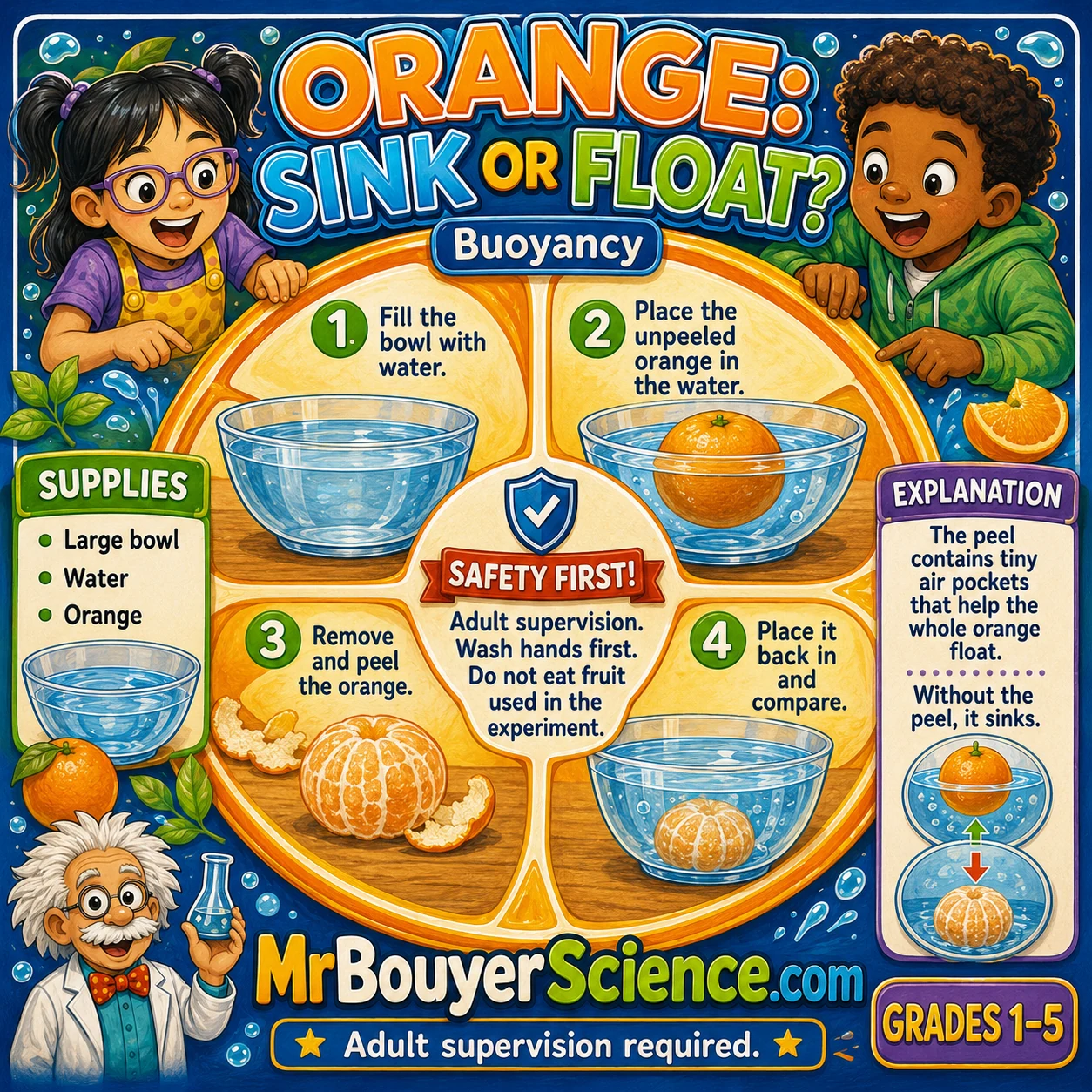
Put this card on the board for the class, or print it. Save the card
1Before class
The day before
- Ask about citrus allergies and skin sensitivity. A child with a citrus allergy does not touch the oranges and watches and records from a step back.
- Test one orange yourself. Whole oranges usually float and peeled ones usually sink, but fruit varies. Pick the type that does what the card says.
- Buy latex free gloves for the adults who peel. Check that no adult in the room has a latex or citrus allergy.
- Give your helpers the helper guide on this page. Let them peel one orange in gloves first.
- Tell the K to 5 teacher nothing is eaten. All fruit used goes in the trash.
Ten minutes before kids arrive
- Fill five large clear bowls about two thirds full of cool tap water. Carry them with two hands and set them on trays.
- Put a tray under every bowl and a towel under every tray.
- Place one whole orange beside each bowl. Keep two spares with the K to 5 teacher.
- Set a pair of gloves, a small plate and a trash bag at every station. The plate is where the peel is laid.
- Set pencils, paper and a few paper towels at every station.
- Put this card up on the board.
Safety and care
- An adult stays with every group for the whole activity. The K to 5 teacher is the responsible adult. Helpers are teenagers and do not replace an adult.
- Citrus peel oil can irritate skin and eyes. Only a teacher or helper wearing gloves peels the orange. Peel away from faces and hold the fruit low. Children do not touch the peel.
- Check for citrus allergies and skin sensitivity before you start.
- Nobody eats, tastes or licks the fruit. Throw all the fruit and peel away when the lesson ends.
- Do not rub your eyes or touch your face. If peel oil gets in an eye, rinse with clean water and tell the teacher.
- Wash hands with soap and water before and after the activity.
- Water on the floor is a slip hazard. Keep the bowls on trays and wipe spills at once.
- Carry full bowls with two hands. Fill them where they will stay.
2Materials for 15 students
| Item | Per group | Whole class | Notes |
|---|---|---|---|
| Large clear bowl | 1 | 5 | Clear sides let children see the orange sink. |
| Cool tap water | about 2 liters | about 10 liters | Fill two thirds full. |
| Orange with a thick peel | 1 | 5 | A navel orange works well. Test one ahead. |
| Spare oranges | 2 | For tests that go wrong. | |
| Latex free gloves, one pair for the peeler | 1 | 5 | Keep extra pairs in the kit. |
| Small plate | 1 | 5 | For the peel. Children do not touch it. |
| Tray | 1 | 5 | Catches spills and splashes. |
| Old towel | 1 | 5 | Goes under the tray. |
| Paper towels | 4 sheets | 20 sheets | For wiping. |
| Pencils | 3 | 15 | |
| Plain paper, folded in half | 3 | 15 | Each child records their own results. |
| Trash bag | 1 | 5 | For peel and fruit. Nothing is eaten. |
How to set up the room
- Set the five stations on a hard floor or sturdy tables with room between them.
- Put each tray and bowl where the children can look in from the side.
- Seat each group of three around its tray. Keep the peeler's elbow room clear.
- Keep walking space clear so helpers can move between stations.
3Run it in 30 minutes
Groups sit at their bowls. Show the board. Ask for a guess. Will the whole orange sink or float. What about a peeled orange.
Children set the unpeeled orange gently in the water. They watch and record. Ask what they notice.
A helper in gloves lifts the orange out and peels it away from faces. All the peel and white pith go on the plate. The helper lowers the peeled orange into the water.
Bring the class together. Compare the two. Ask why they acted differently.
Bag the peel and fruit. Wipe the trays and floor. Wash hands with soap and water.
4What the kids do
- Look at your bowl of water and your orange.
- Guess. Will it sink or float.
- Gently set the whole orange in the water. Watch.
- A helper in gloves lifts it out and peels it away from faces.
- The helper lowers the peeled orange into the water.
- Watch. Did it do the same thing. Record both.
- Peel and fruit go in the trash. Nobody eats the fruit. Wash hands.
Match it to the grade
Watch the orange float. Watch the peeled orange sink. Say float and sink. Draw both. Say which one sank.
Guess before each test. Record the guess and the result. Say what changed between the two tests.
Explain the result with the words density and air pockets. Predict what would happen to a peeled orange with a bit of peel left on. Ask how to test it.
5Helper guide for older students
Your job
- Lead one group of three. Peel an orange in gloves the day before.
- Put your gloves on before you touch the orange. Peel away from every face.
- Give each child a job. One sets the orange. One records. One watches the water.
- Ask questions and let the children guess before you explain.
- Keep the plate of peel away from the children.
Say things like this
- What do you think will happen. Why.
- Let us watch what the orange does.
- What changed between the two tests.
- That is a good guess. How could we test it.
Please do not
- Do not let a child touch the peel.
- Do not hold the orange near a face.
- Do not let anyone taste or eat the fruit.
- Do not give away the answer before they test it.
- Do not say a guess is wrong. Say let us test it.
6Talk it over
Questions to ask
- What happened to the whole orange. What happened to the peeled one.
- What changed between the two tests. What stayed the same.
- What do you think is in the peel that the fruit does not have.
- What other things have you seen float or sink.
- What could we test next.
- Grades 4 and 5. Why does taking off the peel change the result when the orange still weighs almost the same.
The science, in plain words
An object floats when it is less dense than the water, which means it has less mass for its size. A whole orange has a thick peel and a spongy white layer called pith. These are full of tiny air pockets. The air adds size without adding much mass, so the whole orange is less dense than water and floats. A peeled orange loses the air filled layers. What is left is mostly juicy fruit, which is denser than water, so it sinks. The mass of the orange hardly changes. Its size changes. That is why density matters here. Fruit varies, so test ahead.
Where you see it
- A life jacket has foam full of trapped air so it floats.
- Cork floats because it is full of tiny sealed air pockets.
- A steel ship floats because the hull holds so much air.
7If it goes wrong
| What you see | What to do |
|---|---|
| The whole orange sinks | Try a different orange. Thick skinned navel oranges float best. Test one ahead and keep the one that floats. |
| The peeled orange floats | Some pith is left. The helper peels off the white pith as well. Try a different orange if it still floats. |
| The orange bobs and tips over | Let the water settle. Drop it in gently from just above the surface. |
| Water splashes out | Fill the bowl less and lower the orange slowly. Keep the tray in place and wipe the floor. |
| A child does not want to be near the peel | That is fine. Move them to the recording job. Keep the plate at the far side. |
| Peel oil gets on a hand | The adult stops. Wipe it with a paper towel and wash with soap and water. Do not touch the face. |
Clean up
- Lift out all fruit and peel with gloves and bag them
- Throw the fruit away and do not eat it
- Carry the bowls with two hands and empty them in a sink
- Wipe trays, tables and floor spots
- Take off gloves and throw them away
- Wash hands with soap and water
Go further
- An adult in gloves peels a mandarin. Does it float with its peel and sink without it. Predict first.
- An adult in gloves peels only half of an orange. Does it float or sink.
- Try a cup of salty water. Does the orange float differently.
- Press the whole orange down and let go. What happens.
Built by Science Fenns for teachers and student helpers. Keep supervising every group the whole time.