

Teacher cards / Activity 08
For teachers and helpers. Adult supervised. Not for student screens.Oobleck: Solid or Liquid?
Can something be a solid and a liquid at the same time?

★The card
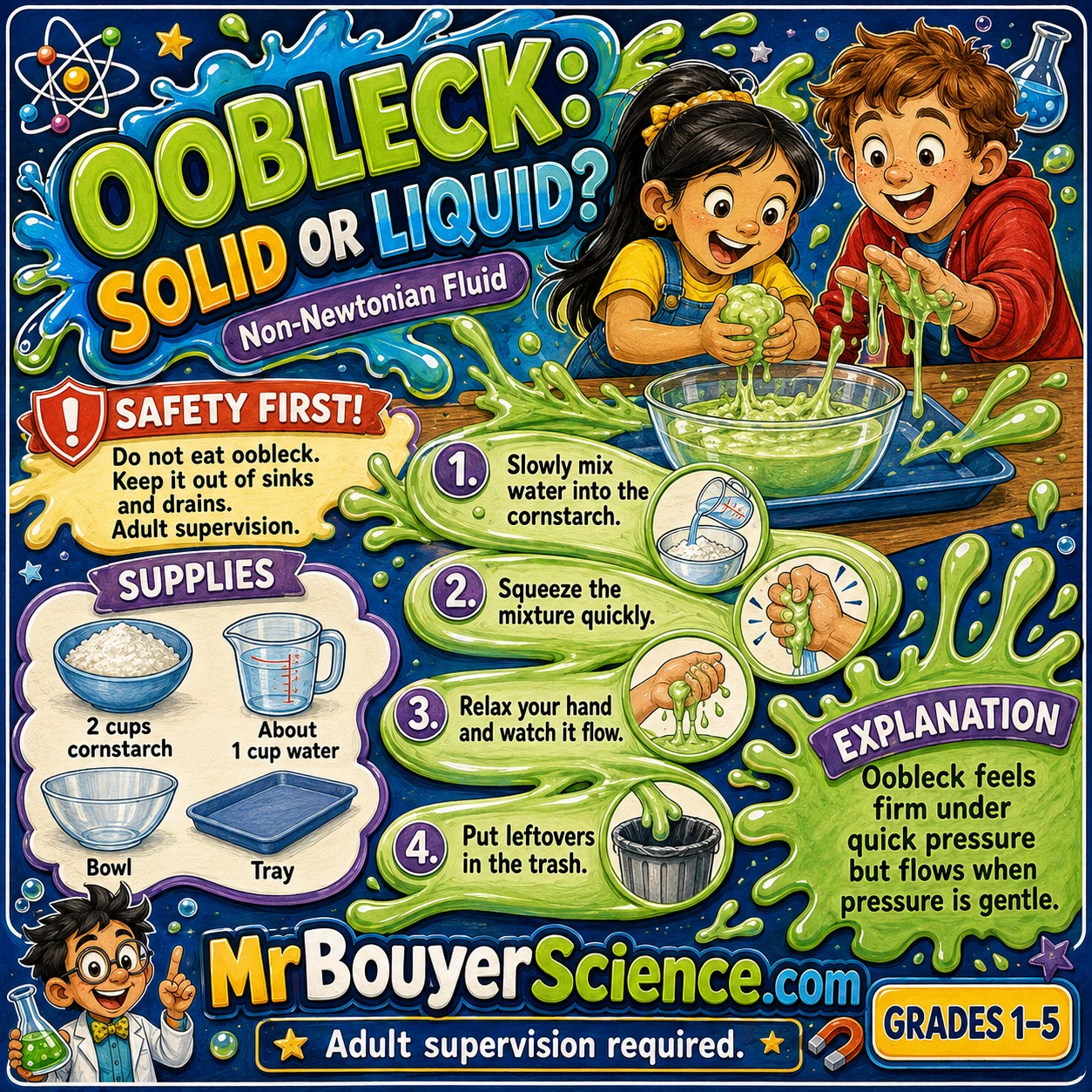
Put this card on the board for the class, or print it. Save the card
1Before class
The day before
- Ask about corn allergies and skin conditions. Any child with a corn allergy watches and records and does not touch the oobleck.
- Ask about asthma and lung conditions. Cornstarch dust can bother eyes and lungs. A child with asthma stays back while the powder is poured.
- Make one batch yourself. It takes five minutes and shows you how much water your cornstarch needs.
- Give your helpers the helper guide on this page. Let them try the batch first.
- Tell the K to 5 teacher to bring the class in clothes that can get messy. Sleeves up and no loose cuffs.
- Choose a room with a hard floor that is easy to wipe. Plan to wipe every floor spot at the end.
Ten minutes before kids arrive
- Cover each group's table or floor space with an old towel or plastic sheet.
- Set one tray on each sheet and one bowl inside each tray.
- Use the measuring cup to level two cups of cornstarch for every group. Do this slowly and low over the box. Keep each portion in a covered container until class.
- Pour one cup of cool tap water into a cup for every group. Set one at each station.
- Put six paper towels, a spoon, a trash bag and the paper and pencils at every station.
- Place a bigger pitcher of water and a spare cup of cornstarch with the K to 5 teacher.
- Put this card up on the board.
Safety and care
- An adult stays with every group for the whole activity. The K to 5 teacher is the responsible adult. Helpers are teenagers and do not replace an adult.
- Only an adult measures and pours the cornstarch. Pour slowly and low so the powder does not rise as a cloud. Do not shake or tap the container.
- Check for corn allergies before you open the box. Cornstarch comes from corn.
- Cornstarch dust can bother eyes and lungs. Children with asthma stay back during pouring. Wash eyes with clean water if powder gets in them and tell the teacher.
- Mix only in the bowl and tray. Keep all of it over the tray.
- Never pour oobleck down a sink or drain. It settles and clogs pipes. Scoop it into the trash bag.
- Oobleck on a floor is very slippery. Wipe up every drop right away. Children walk and do not run.
- Nothing is tasted and nothing goes near mouths. Do not touch your face with oobleck hands.
- Wipe hands with paper towels first. Then wash with soap and water. Do this before and after the activity.
2Materials for 15 students
| Item | Per group | Whole class | Notes |
|---|---|---|---|
| Cornstarch, 2 cups | 2 cups | 10 cups | Level it with the measuring cup ahead of time. One large box is plenty. |
| Cool tap water, about 1 cup | 1 cup | 5 cups | Add water a spoonful at a time if the mix is too stiff. |
| Mixing bowl, clear if you can | 1 | 5 | A wide bowl is easier for three pairs of hands. |
| Tray or shallow box lid | 1 | 5 | It must be bigger than the bowl and catch all drips. |
| Measuring cup | 1 | 5 | An adult uses it. One is enough per group. |
| Spoon | 1 | 5 | Helpful for the first stir. |
| Old towel or plastic sheet | 1 | 5 | Goes under the tray. |
| Paper towels | 6 sheets | 30 sheets | Keep extra in the kit. |
| Pencils | 3 | 15 | |
| Plain paper, folded in half | 3 | 15 | Each child records their own notes. |
| Trash bags | 1 | 5 | Line the tray or sit one beside each station for the leftovers. |
| Pitcher of water and floor mop or towels | 1 | For top ups and for wiping the floor. |
How to set up the room
- Spread the five stations on a hard floor or on sturdy tables with room between them.
- Keep walking space clear so helpers can move between stations.
- Put the trash bags where the helpers can reach them.
- Keep the sink area clear. Oobleck never goes in it.
- Seat each group of three around its tray. Keep powder and water in the middle.
3Run it in 35 minutes
Groups sit at their trays. Show the board. Ask for a guess. Is it a solid or a liquid when you press it hard.
An adult pours the cornstarch slowly into the bowl. Then pour the water in. Children mix slowly with their hands. Add a little water or powder until it is thick but pours slowly.
Press it. Poke it. Squeeze it fast. Let it drip. Rest a hand in it. Children take turns. Record what they feel.
Bring the class together. Compare fast and slow. Ask why.
Scoop everything into the trash bags. Wipe the trays and floor. Wipe hands. Then wash.
4What the kids do
- Look at your bowl. An adult pours cornstarch in slowly.
- The adult pours the water in. Mix with your fingers. Go slowly.
- Squeeze the mixture fast. How does it feel.
- Relax your hand. Watch it flow and drip.
- Poke it slowly. Then poke it fast. What is different.
- Record what you felt. Draw the fast squeeze and the slow drip.
- Scoop it into the trash bag. Never down a sink. Wipe and wash.
Match it to the grade
Squeeze it and let it run. Use the words hard and soft. Say what the hand feels. Draw a squeeze and a drip.
Try fast and slow. Sort what you saw into solid ways and liquid ways. Draw both. Say what happens with a little more water.
Test two mixes. Change one thing. Measure the water by spoonfuls. Record how the mix feels and flows. Explain what the tiny bits are doing.
5Helper guide for older students
Your job
- Lead one group of three. Make a batch the day before so you know how it feels.
- Stay beside the adult while the powder is poured. Keep your face back.
- Give each child a turn. One squeezes. One pokes. One records.
- Ask questions and let the children try before you explain.
- Keep everything over the tray. Wipe small spills at once.
Say things like this
- What do you think will happen when you squeeze it fast.
- Does it feel like a solid or a liquid right now.
- Let us change one thing and try again.
- That is a good guess. How could we test it.
Please do not
- Do not pour the powder or open the box. That is for an adult.
- Do not let anyone put oobleck near eyes, nose or mouth.
- Do not pour oobleck into any sink.
- Do not let children walk around with oobleck on their hands.
- Do not say a guess is wrong. Say let us test it.
6Talk it over
Questions to ask
- How did it feel when you squeezed it fast. How did it feel when you went slowly.
- Did it act like a solid or a liquid. Did it act like both.
- What did we change each time. What stayed the same.
- What would happen with more water. What would happen with less.
- Where have you seen something that flows one way and stiffens another.
- Grades 4 and 5. Why do you think quick pressure makes it harder.
The science, in plain words
Oobleck is a mix of cornstarch grains and water. The grains do not dissolve. They stay spread through the water. When you push slowly, the grains slide past each other and the mix flows like a liquid. When you push fast, the grains get pressed together and the water cannot get out of the way, so the mix resists and feels firm. Scientists call this kind of material a shear thickening fluid. It is not fully a solid and not fully a liquid. When the force stops, it flows again. The ratio of water to cornstarch matters. Too much water and it never stiffens. Too little and it is only a crumbly paste.
Where you see it
- Wet sand firms up under your foot when you walk fast and gives way when you stand still.
- Ketchup does the opposite. It flows better after you shake the bottle.
- Researchers have tested fluids that stiffen on a sudden hit for protective gear.
7If it goes wrong
| What you see | What to do |
|---|---|
| It is too runny and never gets stiff | An adult adds cornstarch a spoonful at a time. Pour slowly and keep the container low. Stir slowly. |
| It is too dry and crumbly | Add water a spoonful at a time. Mix slowly with fingers. |
| It will not stiffen when squeezed | Squeeze faster and harder. If it still stays runny, add cornstarch. |
| It sticks to hands and will not come off | Wipe it with a dry paper towel first. Let it dry on the hands for a moment and rub it off. Then wash with soap. |
| Oobleck lands on the floor | Stop the group. Scoop up the pile. Wipe the spot with damp then dry towels. Floors are slippery. |
| A child does not want to touch it | That is fine. Let them poke it with a spoon or watch and record. Do not push. |
Clean up
- Scoop all oobleck into the trash bags
- Never pour it down a sink or drain
- Wipe trays, bowls and the floor with paper towels
- Check the floor for slippery spots
- Wipe hands first and then wash with soap and water
- Count spoons and cups back in
Go further
- Make a second batch with less water. How does it change.
- Roll a ball quickly in your palms. Then stop rolling. What happens.
- Set a small toy on top. Does it sink slowly or quickly.
- Fill a spoon with oobleck and tilt it slowly. Then tap the spoon. What happens.
Built by Science Fenns for teachers and student helpers. Keep supervising every group the whole time.