

Teacher cards / Activity 26
For teachers and helpers. Adult supervised. Not for student screens.Newspaper Tower
How tall a tower can you build from newspaper and tape that stands on its own?

★The card
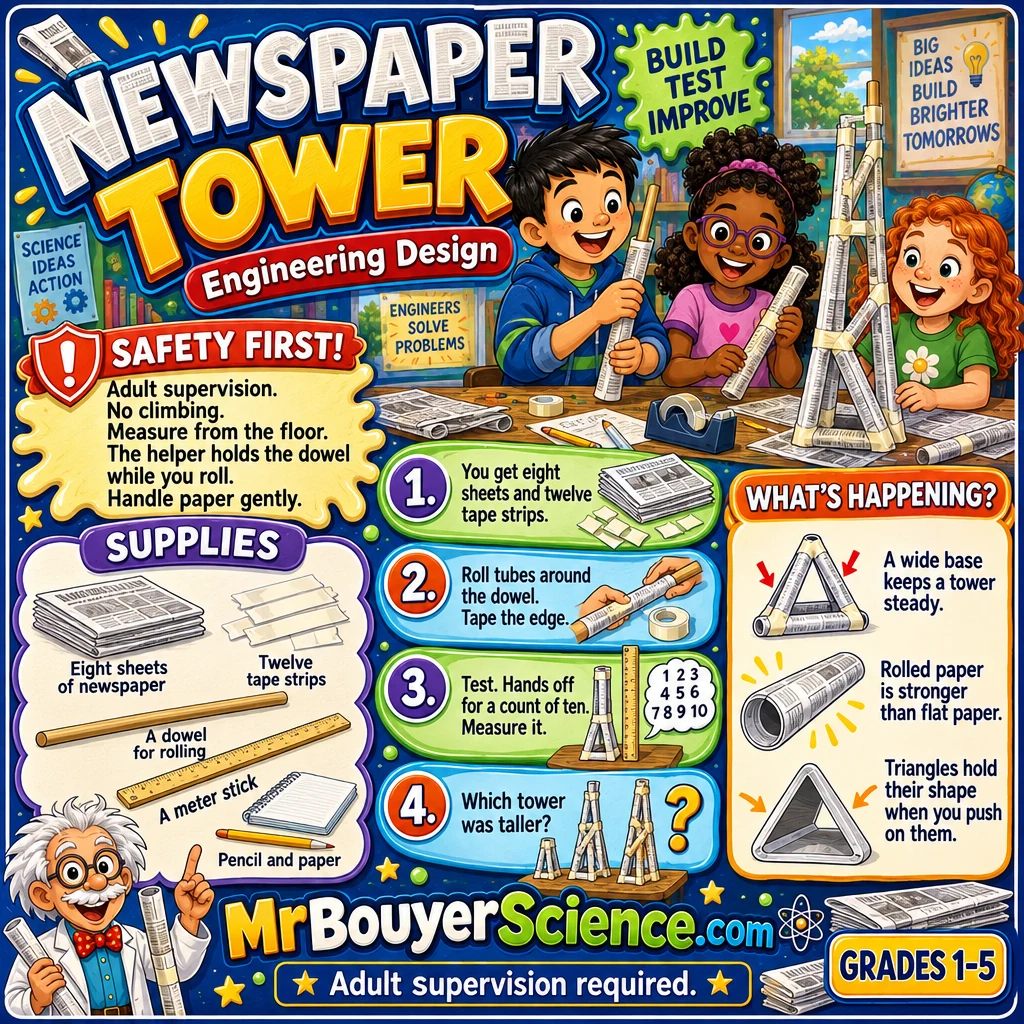
Put this card on the board for the class, or print it. Save the card
1Before class
The day before
- Build one tower yourself with the same supplies. Even a short one teaches you what is tricky.
- Gather clean newspaper. Use only plain newsprint pages. Skip glossy ads.
- Tear the tape into strips about 20 centimeters long and stick them on the edge of a table. Tape is the limited supply.
- Check that the dowels have smooth, rounded ends. Sand them if needed.
- Give your helpers the helper guide on this page. Let them build one tube first.
Ten minutes before kids arrive
- Pick five spots on a hard floor, each with one meter of open space all around.
- Fold the newspaper into piles of eight whole sheets. Make five piles.
- At every spot set a pile of eight sheets, twelve tape strips, one dowel, one meter stick and a recording sheet.
- Put six extra tape strips in a cup at every spot. These are for the second try only.
- Put a trash bag near the door for scraps.
- Put this card up on the board.
Safety and care
- The K to 5 teacher is the responsible adult in the room. A helper stays with every group the whole time.
- No climbing. No chairs, no tables and no standing on anything. Children stay on the floor and use the meter stick to measure.
- Dowels stay on the floor or in the hand while rolling. They are never waved or pointed at anyone. The helper holds the dowel while a child rolls.
- Newspaper edges can give a small paper cut. Handle paper gently.
- Tear tape by hand. No scissors in the children's hands. Any cutting is done by an adult before class.
- Newsprint rubs off on hands. Wash hands after class.
- Towers fall. Keep faces away and keep walkways clear.
2Materials for 15 students
| Item | Per group | Whole class | Notes |
|---|---|---|---|
| Whole sheets of newspaper | 8 | 40 | Plain newsprint works best. |
| Masking tape strips, 20 centimeters long | 12, plus 6 extra | 90 strips | One roll covers a class. Limited supply is the challenge. |
| Wooden dowel, 1 centimeter thick, 30 centimeters long | 1 | 5 | For rolling tubes. Ends must be smooth. A cardboard tube from paper towels also works. |
| Meter stick | 1 | 5 | Two can be shared if you are short. |
| Pencils | 3 | 15 | |
| Plain paper, folded in half | 3 | 15 | Each child draws a plan and records heights. |
| Cup for extra tape | 1 | 5 | Holds the six extra strips. |
| Trash bag | 1 | For scraps. |
How to set up the room
- Spread the five tower spots across the room with one meter of open space around each.
- Seat each group of three on the floor, kneeling around its spot.
- Keep the walkway to the door clear.
- Put the meter sticks where the helpers can reach them.
3Run it in 33 minutes
Groups sit at their spots. Show the board. Ask for a guess. How tall a tower can eight sheets of paper hold up?
Groups talk and draw their tower. Where will the base go? Where will the tape go?
Helpers show how to roll a tube around the dowel. Groups build. The tower must stand alone.
The tower stands with hands off for a count of ten. One child measures with the meter stick. One records.
Change one thing. Rebuild with the same paper and the six extra tape strips. Test and measure again.
Bring the class together. Compare first and second heights. Ask what each group changed.
Collect every scrap. Count tools back in.
4What the kids do
- Look at your supplies. You have eight sheets of newspaper and twelve strips of tape. That is all.
- Plan. Talk it over and draw your tower. Where will the wide part go?
- Make tubes. Roll a sheet tightly around the dowel and tape the edge. Slide the dowel out.
- Build. The tower must stand on its own. Do not hold it. Do not tape it to the floor.
- Test. Take your hands away and count to ten. Measure the height with the meter stick. Write it down.
- Improve. Change one thing only. Use the extra tape strips. Build again.
- Measure the second tower. Which one was taller? Why?
Match it to the grade
Build a short tower from three rolled tubes. Compare two towers and say which is taller. Measure with hand spans.
Plan, build and test. Measure with the meter stick in centimeters. Write both heights and say which was taller.
Record both heights. Find the difference. Name the one thing you changed. Graph the heights from all five groups.
5Helper guide for older students
Your job
- Lead one group of three. Run the activity once before class so you know the steps.
- Build one tube the day before so you know how it rolls.
- Hold the dowel while the child rolls.
- Keep the group kneeling by the tower.
- Give each child a job and rotate the jobs.
- Ask questions and let the children try before you explain.
Say things like this
- What do you think will happen? Why?
- Where is your tower strong? Where is it weak?
- Let us change one thing and try again.
- That is a good guess. How could we test it?
Please do not
- Do not build the tower for the children.
- Do not give away the answer before they test it.
- Do not let anyone climb to reach the top.
- Do not wave the dowel.
- Do not say a plan is wrong. Say let us test it.
6Talk it over
Questions to ask
- What shape did your tower use at the bottom? Why?
- What helped the tower stand up?
- What happened when it fell or leaned?
- What did you change the second time? What stayed the same?
- What would you do with more tape or more paper?
- Grades 4 and 5. Why might a rolled tube be stronger than a flat sheet?
The science, in plain words
A tall structure stays up when its weight sits over a wide base. A tube is stronger than a flat sheet because the paper is spread out from the middle, so it resists bending. Triangles are stiff. A rectangle can squash sideways when you push it. A triangle cannot change its shape without breaking, so it holds the frame together. Tape at the joints keeps pieces from sliding. Engineers plan, build, test and improve. They change one thing at a time so they can tell what helped.
Where you see it
- The Eiffel Tower is wide at the bottom and built from iron triangles.
- Bridges use triangle frames to carry weight.
- A construction crane uses a triangle frame to stand tall.
7If it goes wrong
| What you see | What to do |
|---|---|
| The tower leans and falls | Make the base wider. Put more tubes at the bottom. |
| The tubes bend in the middle | Roll the paper tighter. Add a brace across the middle. |
| The tape runs out | That is the challenge. Think about where each strip helps most. |
| The tubes will not stay rolled | Tape the edge along its whole length. Use two strips if needed. |
| The tower falls while measuring | Measure from the side with the meter stick on the floor. Do not lean on the tower. |
| Children get excited and knock into towers | Say kneel by your tower. Move around the room slowly. |
Clean up
- Collect every paper scrap into the trash bag or recycling
- Peel any tape off the floor
- Return the dowel, meter stick and cup to the kit
- Count the dowels and meter sticks back in
- Wash hands
Go further
- Try a tower with only triangle frames. Is it taller?
- Make a tower that holds a small cup on top.
- Race the groups. Who can build the tallest tower in ten minutes?
- Test how much weight a rolled tube holds compared with a flat sheet.
Built by Science Fenns for teachers and student helpers. Keep supervising every group the whole time.