Teacher cards / Activity 32
For teachers and helpers. Adult supervised. Not for student screens.Moon Phase Dance
Why does the Moon change shape in the sky?

★The card
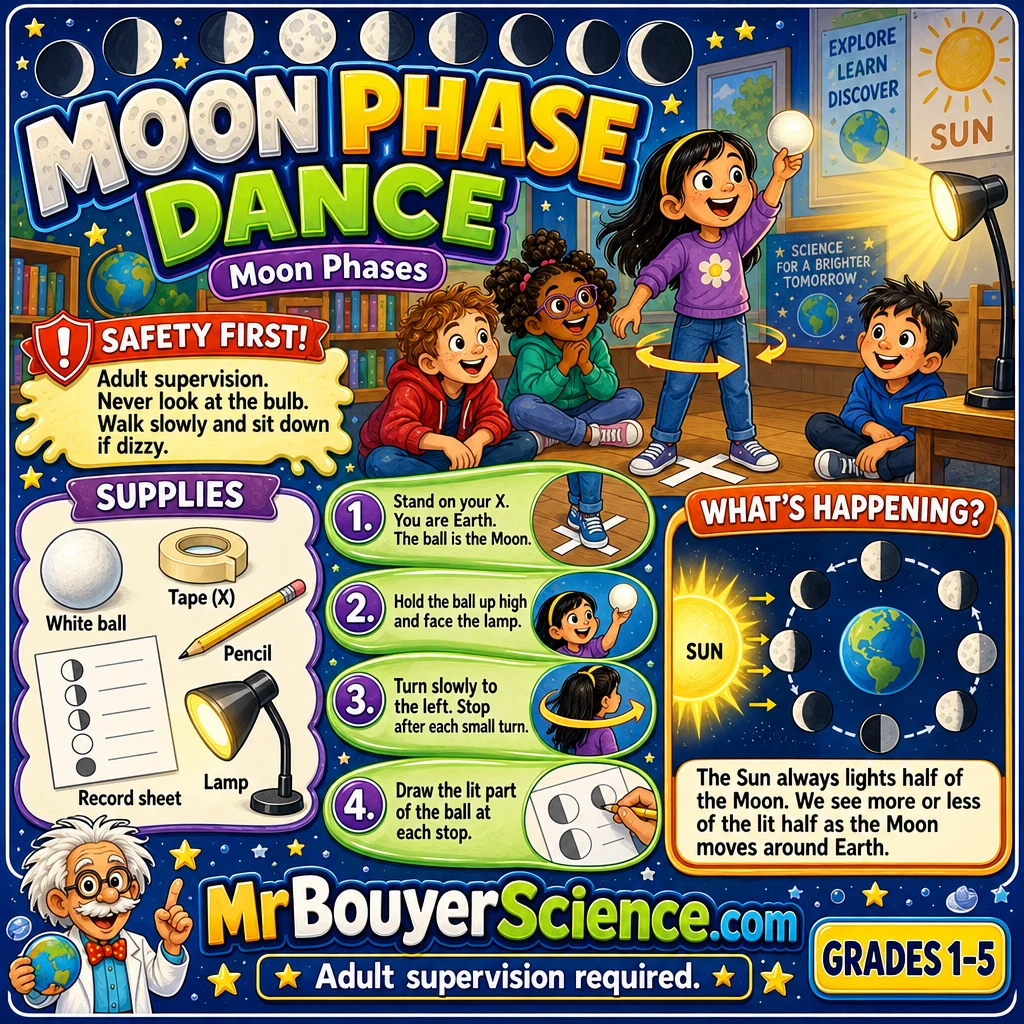
Put this card on the board for the class, or print it. Save the card
1Before class
The day before
- Test the lamp and the bulb. Use a steady LED bulb. No flashing and no flicker. Ask the K to 5 teacher about children who are sensitive to light.
- Practice the dance yourself. Stand on a tape X, face the lamp, hold a ball up and turn slowly to the left. It takes three minutes.
- Give your helpers the helper guide on this page. Let them try the dance once.
- Photocopy the record sheet. It needs eight circles in a row, one for each stop in the turn.
- Check that the plug and cord are safe and that the outlet is close enough to the lamp table.
Ten minutes before kids arrive
- Move the room furniture to the walls. Clear a circle about six meters across.
- Set a steady table in the center with the lamp on it. The bulb should be about as high as a child's shoulder.
- Run the cord along the floor to the wall outlet. Tape it flat with wide tape from end to end. Use a cord cover if you have one.
- Place five groups of three tape X marks in a ring about two meters from the lamp. Keep each X at least one and a half meters from its neighbor.
- Leave a clear walkway around the ring. No stray bags or chairs.
- Dim the room by turning off other lights and closing blinds. Keep one light on or the door open so the floor stays visible.
- Hand each child a white ball, a pencil and a record sheet. Put chairs along the wall for resting.
- Put this card up on the board.
Safety and care
- The K to 5 teacher is the responsible adult. Helpers are teenagers and lead the activity only. An adult stays in the room the whole time.
- Never look at the bulb. Look at the ball. The lamp stays at shoulder height and its bulb stays facing the room, not a child's face.
- Only an adult plugs in, moves or unplugs the lamp. The cord is taped flat. Keep children away from it.
- Do not touch the lamp. Even a cool LED lamp can have a warm base.
- Walk only. No running. No throwing the balls. Keep the ball in your hand.
- Turning in place can cause dizziness. Turn slowly. Stop and sit down if anyone feels dizzy.
- Do not turn the room fully dark. Dim it only.
- Balls must be too big to swallow. Use balls at least six centimeters across.
- Wash hands after the activity because the balls are shared.
2Materials for 15 students
| Item | Per group | Whole class | Notes |
|---|---|---|---|
| LED lamp with a steady bulb | 1 | A work light or desk lamp. Frosted bulbs are gentler on the eyes. | |
| Steady table for the lamp | 1 | Heavy and not wobbly. | |
| White balls, 6 to 8 centimeters across | 3 | 15 | Foam, plastic or paper wrapped. Bring two spares. |
| Masking tape strips for X marks | 6 strips | 1 roll | Two strips make an X. One X per child. |
| Wide tape to cover the cord | 1 roll | Use cord cover if you have it. | |
| Pencils | 3 | 15 | |
| Record sheets with eight circles | 3 | 15 | One circle per stop in the turn. |
| Chairs along the wall | 1 | 5 | For a rest if anyone is dizzy. |
| Timer or clock | 1 | Keep the time on the board. |
How to set up the room
- Put the lamp table in the center of the room.
- Make a ring of tape X marks about two meters from the lamp. Each group of three has three X marks side by side.
- Place the five groups evenly around the ring so each group has a clear view of its own X marks.
- Keep the cord taped and away from the ring. Keep the walkway around the ring clear.
3Run it in 30 minutes
Children stand on their X marks. Show the board. Ask what shape the Moon is tonight. Ask why it changes.
Helpers show the steps. Hold the ball up high at arm's length. Turn slowly to the left, one eighth turn at a time. Say what you see after each stop.
Do one full slow turn. Stop at each of eight stops. Look at the lit part of your ball and draw it on your sheet. Then repeat with the ball held lower to compare.
Sit together. Compare drawings. Name the shapes. Ask why the lit part changed.
Lights back on. Collect balls and sheets. Count the balls in.
4What the kids do
- Stand on your tape X with your ball in your hand. You are Earth. The ball is the Moon. The lamp is the Sun.
- Face the lamp. Hold the ball up high at arm's length. Keep your eyes on the ball. Never on the bulb.
- Predict. What will the lit part of your ball look like when the lamp is behind you? Draw your guess.
- Turn slowly to the left, one small step at a time. Stop after each eighth of a turn.
- At each stop, look at the lit part of your ball. Draw it on your sheet.
- Finish the full turn. Which stop had no lit part you could see? Which stop had a fully lit ball?
- Change one thing. Hold the ball at head height and turn again. What happens to the lit part at the full stop?
- Compare your drawings with your group.
Match it to the grade
Dance the turn and say what you see. Name three shapes. Say round, half or thin. Draw the ball with a lit part.
Draw all eight stops. Name new, crescent, half and full. Say what the lamp is and what the ball is.
Label the eight stops with the phase names. Explain why half of the Moon is always lit. Explain why Earth's shadow is not what makes the phases.
5Helper guide for older students
Your job
- Lead one group of three. Do the dance yourself the day before.
- Keep the group on its X marks.
- Check that every child holds the ball up and looks at the ball.
- Ask questions and let the children try before you explain.
- Count the eight stops aloud so the group stays together.
Say things like this
- Which part of your ball is lit now?
- Turn a little more to the left.
- Let us change one thing and try again.
- That is a good guess. How could we test it?
Please do not
- Do not let anyone look at the bulb.
- Do not let children spin fast.
- Do not say the Moon makes its own light.
- Do not take the ball out of a child's hands. Help with your hands over theirs.
- Do not say a guess is wrong. Say let us test it.
6Talk it over
Questions to ask
- Which part of your ball was lit? Which part was dark?
- What changed at each stop? What stayed the same?
- Where was the lamp when the ball looked fully lit? Where was it when the ball looked dark?
- What happened when we held the ball lower? Why do you think so?
- Where have you seen the Moon change shape in the night sky?
- Grades 4 and 5. Is the Moon making its own light? How do you know?
The science, in plain words
The Moon does not make its own light. It reflects sunlight. The Sun always lights half of the Moon, just as it lights half of Earth. As the Moon travels around Earth in about a month, we see it from different angles. When the lit half faces away from us, we see a new Moon. When we see a small slice of the lit half, we see a crescent. When we see half of it, we see a half Moon. When we see all of the lit half, we see a full Moon. The phases are not caused by Earth's shadow. Earth's shadow only falls on the Moon in a rare event called a lunar eclipse. In the dance, holding the ball too low lets your head block the lamp. That is like a lunar eclipse. Real eclipses are rarer because the Moon's path is tilted a little.
Where you see it
- Farmers and sailors once used Moon phases as a calendar.
- The ocean tides follow the Moon as it travels around Earth.
- People look up at a thin crescent Moon in the early evening sky and a full Moon rising at sunset.
7If it goes wrong
| What you see | What to do |
|---|---|
| The whole ball looks lit all the time | The room is too bright. Turn off another light or close a blind. |
| The ball goes dark at the full stop | The child's head is blocking the lamp. Raise the ball higher or tilt it up a little. |
| Children bump into each other | Space the X marks wider. Stop the dance and reset. |
| Children feel dizzy | Sit down along the wall and rest. Turn more slowly next time. |
| The lamp tips | Stop the dance. An adult steadies the lamp. Move it to a heavier table. |
| Children look at the bulb | Stop and remind them to look only at the ball. Raise the lamp higher or turn it slightly away. |
Clean up
- Collect every ball and count them in
- Collect pencils and sheets
- An adult unplugs the lamp
- Peel up the cord tape and tape X marks
- Chairs back to the room
- Wash hands
Go further
- Draw the Moon every night for a week and compare it with the dance.
- Name each stop with the phase name and add a new row.
- Stand twice as far from the lamp. Does the lit part still change in the same way?
- Hold the ball low on purpose to see the head shadow, a model of a lunar eclipse.
Built by Science Fenns for teachers and student helpers. Keep supervising every group the whole time.