

Teacher cards / Activity 07
For teachers and helpers. Adult supervised. Not for student screens.Marker Color Climb
How can water pull the colors out of a marker?

★The card
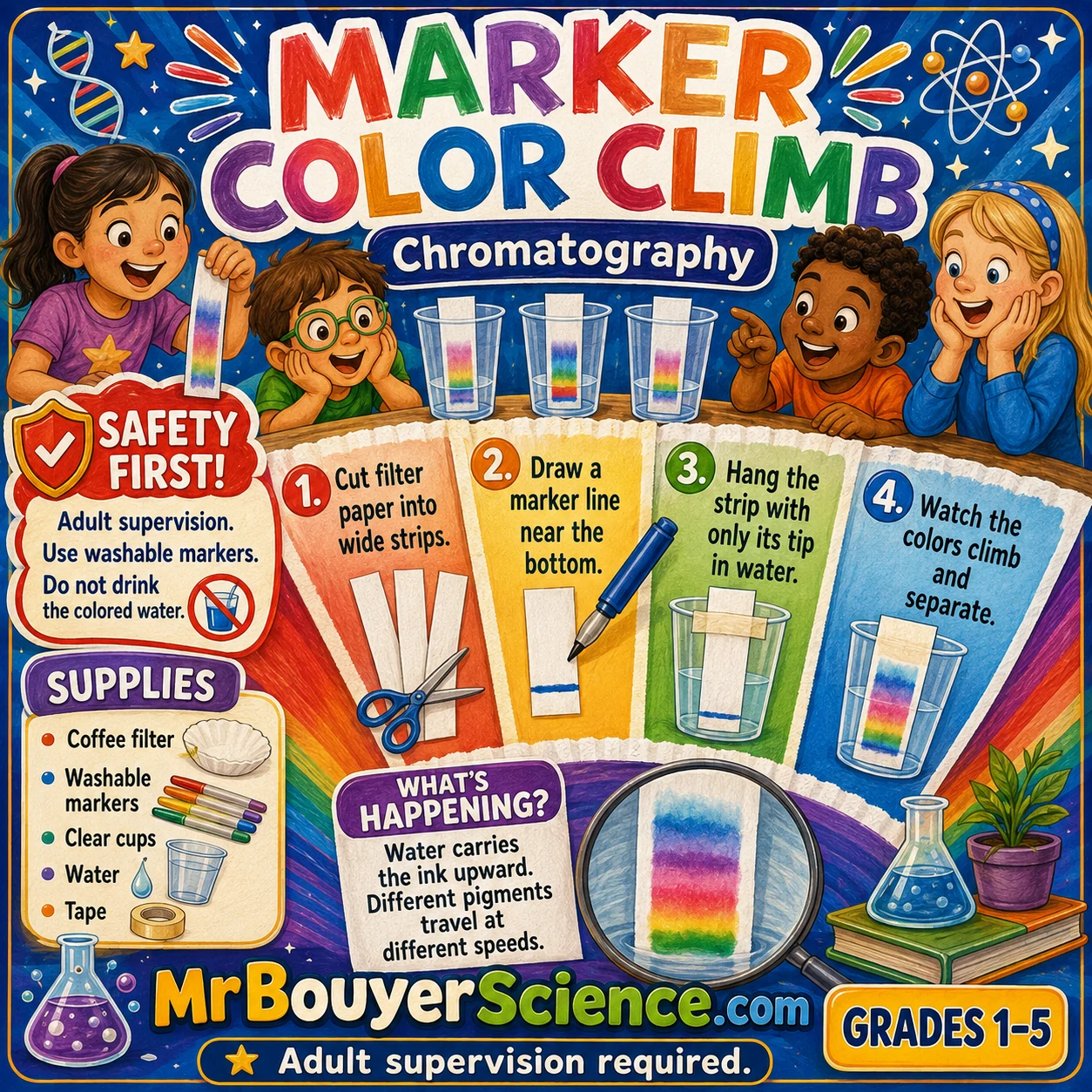
Put this card on the board for the class, or print it. Save the card
1Before class
The day before
- Test the markers first. Draw a line on a strip, hang it in water and watch. Black, brown, green and purple usually split the best.
- Use only washable, water based, low odor markers. Permanent markers do not work in water and have strong fumes.
- Use a well ventilated room. Open windows or doors even though the markers are low odor.
- Ask whether any child is bothered by marker smell. Seat that child near the door.
- Cut the coffee filters into strips before class. Use flat bottom filters. Make each strip about 3 centimeters wide and 10 centimeters long. Scissors are for the K to 5 teacher only. Children and helpers do not cut.
- Put old shirts or aprons on the children. Washable ink still marks some clothes.
- Give your helpers the helper guide on this page. Let them make one strip first.
Ten minutes before kids arrive
- Set five trays, one for each group. Put three clear plastic cups on each tray.
- Stick a strip of tape one centimeter up the outside of each cup as a water mark.
- Helpers fill each cup with room temperature water to the mark before the children sit down.
- At each group set four strips, four markers, three small tape pieces, three sheets of paper and three pencils.
- Put six paper towels at every group.
- Open the windows or doors and check the floor is dry.
- Put this card up on the board.
Safety and care
- An adult stays with every group for the whole activity. The K to 5 teacher is the responsible adult in the room.
- Use washable, water based, low odor markers only. No permanent markers.
- Work in a well ventilated room with windows or doors open.
- Scissors are used only by the K to 5 teacher before class. Children and helpers never cut.
- Nothing is tasted or drunk. The colored water is not for drinking. Cups never go to a mouth.
- Marker caps are a choking risk for young children. Caps go in the tray the moment they come off and back on the marker when finished.
- Markers stay on paper. Not on faces, skin or clothes.
- Spilled water makes a slip hazard. Cups stay on the tray. Wipe the floor at once.
- Check for children who are bothered by marker smell.
- Wash hands before and after.
2Materials for 15 students
| Item | Per group | Whole class | Notes |
|---|---|---|---|
| Coffee filter strips, about 3 centimeters by 10 centimeters | 4 | 20 | Flat bottom filters. Cut before class by an adult. One is a spare. |
| Washable markers in black, brown, green and purple | 4 | 20 | Water based and low odor. Not permanent. |
| Clear plastic cups | 3 | 15 | About 9 ounce. One cup for each child. |
| Water, room temperature | 1 cup | 5 cups | One centimeter deep in each cup. Extra for refills. |
| Small pitcher or jug | 1 | 5 | Helpers fill the cups before the children sit. |
| Masking tape | 6 pieces | 1 roll | Three hold the strips. Three mark the water level. |
| Trays | 1 | 5 | Catch spills and hold the cups. |
| Paper towels | 6 sheets | 30 sheets | For drying strips and wiping. |
| Pencils | 3 | 15 | |
| Plain paper, folded in half | 3 | 15 | Each child draws their strip. |
| Old shirts or aprons | 3 | 15 | Optional. |
| Scissors, adult use only | 1 | Used before class to cut strips. | |
| Trash bag | 1 | For wet towels at clean up. |
How to set up the room
- Seat each group of three around its tray. Cups sit on the tray, never on the floor.
- Keep the trays on tables or on cleared floor away from walkways.
- Open windows or doors so fresh air moves through the room.
- Keep walking space clear so helpers can move between trays.
3Run it in 30 minutes
Groups sit at their trays. Show the board. Ask for a guess. Is a black marker only black?
Each child chooses a marker and draws a thick line near the bottom of a strip. Tape the strip over the cup rim so only the tip touches the water. Keep the line above the water.
Check each strip at two, five and eight minutes. Draw what you see each time. Talk about which colors move fast and which move slow.
Lift the strips out and lay them on paper towels. Compare black, brown and green. Ask why one color became many.
Caps on. Count the markers. Empty the cups. Dry the trays.
4What the kids do
- Pick a marker. Your helper gives each child in your group a different color.
- Draw a thick line across your strip about two fingers from the bottom.
- Tape the top of the strip over the cup rim. The bottom edge just touches the water. The marker line stays above the water.
- Do not move the cup. Watch what the water does.
- Look again at two, five and eight minutes. Draw what you see each time.
- When the water has climbed most of the way up, your helper lifts the strip out and lays it on a paper towel.
- Compare the strips. Which color split into the most colors? Which color climbed fastest?
Match it to the grade
Watch the colors climb. Name the colors you see. Draw the strip.
Compare black, brown and green. Draw each strip and count how many colors you see in each.
Measure how far each color climbed in centimeters. Time it. Make a table. Explain why different dyes move at different speeds.
5Helper guide for older students
Your job
- Lead one group of three. Make a strip the day before so you know the steps.
- Fill the cups to the mark and check the marker line stays above the water.
- Give each child a job. One draws. One tapes. One watches the clock.
- Ask questions and let the children guess before you explain.
- Keep caps in the tray and cups on the tray.
Say things like this
- What do you think will happen? Why?
- Look closely. What colors do you see now?
- Which color is climbing fastest?
- That is a good guess. How could we test it?
Please do not
- Do not use scissors. The adult cut the strips.
- Do not let a cup go near a mouth.
- Do not move the cups once the strips are hanging.
- Do not let caps roll off the tray.
- Do not say a guess is wrong. Say let us test it.
6Talk it over
Questions to ask
- What did the water do on the strip?
- What colors did you see in the black marker?
- Did every marker split into the same colors? Why do you think so?
- Which color climbed fastest? Which stayed lowest?
- Where have you seen water soak up into paper before?
- Grades 4 and 5. Why might one color travel faster than another?
The science, in plain words
Washable marker ink is a mix of several dyes. Water soaks into the paper and rises through the tiny gaps between the paper fibers. This is called capillary action. As the water climbs it dissolves the ink and carries the dyes along. Each dye dissolves differently and clings to the paper differently, so they travel at different speeds. Some race up. Others stay low. The mix spreads into bands. This method is called paper chromatography. Some colors are only one dye and will not split. Permanent markers will not move in water.
Where you see it
- Labs use chromatography to separate and identify the parts of a mixture.
- Investigators can compare the inks of two pens this way.
- A paper towel soaks up a spill the same way water climbs the strip.
7If it goes wrong
| What you see | What to do |
|---|---|
| The colors do not climb | The strip may not touch the water. Slide it down a little or add water to the mark. |
| The marker line dissolves into the water | The line was too low or the water was too deep. Make a new strip with the line two fingers up. |
| Only one color shows | Some markers are a single dye. Try black or brown. |
| The water climbs unevenly | The strip may be touching the cup wall. Hang it straight and tape it flat. |
| The strip falls into the cup | Tape it more firmly over the rim. Use a new piece of tape. |
| The colors blur together | The line was too thick or the strip stayed too long. Lift it out when the water is near the top. |
Clean up
- Put the caps on every marker and count them back in. There should be 20
- Lift out the strips and lay them flat on paper towels to dry
- Pour the cups into the sink and stack them
- Wipe the trays and tables and check the floor
- Put wet paper towels in the trash bag
- Wash hands
Go further
- Try other washable colors such as pink, orange and blue. Which one splits the most?
- Time how long the water takes to climb five centimeters.
- Try a strip of paper towel instead of a coffee filter. Does it climb faster?
- Try a taller strip in a taller cup. Does the water climb all the way up?
Built by Science Fenns for teachers and student helpers. Keep supervising every group the whole time.