

Teacher cards / Activity 04
For teachers and helpers. Adult supervised. Not for student screens.Ice Fishing with Salt
How can a pinch of salt help a string pick up an ice cube?

★The card
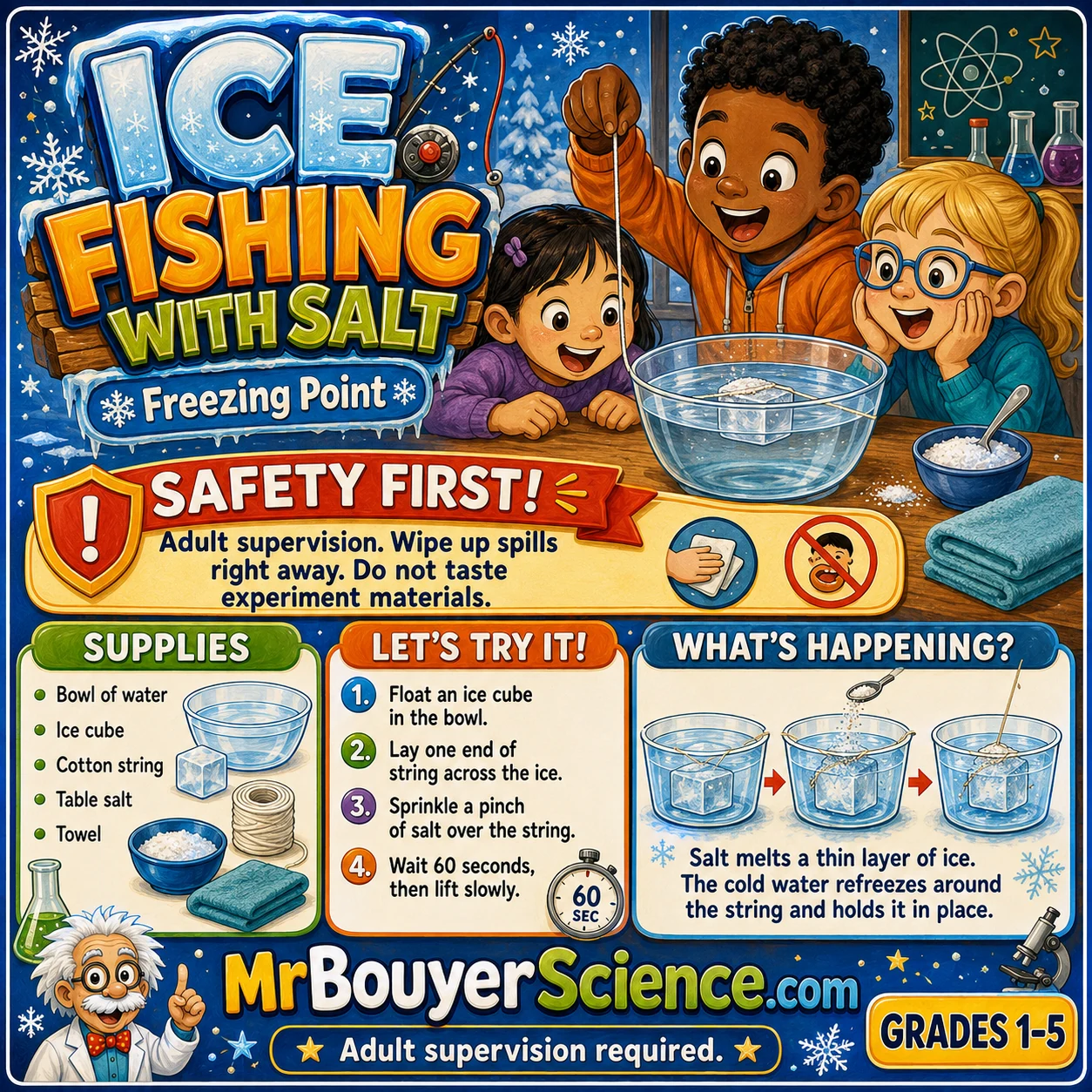
Put this card on the board for the class, or print it. Save the card
1Before class
The day before
- Make the ice cubes the day before. Fill ice cube trays with cold tap water and freeze them overnight. Make about 25 cubes so every group has spares.
- Carry the cubes to class in a cooler. Cubes melt fast in a warm room and stick together.
- Try it yourself first. Try it once without salt and once with salt. It takes five minutes.
- Ask the K to 5 teacher about allergies and skin concerns. Table salt is a plain food product. Check the label for added ingredients. Salt can sting a cut, so a child with a cut on a hand wears a bandage or watches.
- Tell the K to 5 teacher that ice makes hands cold. Children can warm their hands in their pockets between turns.
- Give your helpers the helper guide on this page. Let them try the trick first.
Ten minutes before kids arrive
- Put one tray at each of five stations. Set a hand towel beside every tray.
- Set one clear bowl on each tray. Fill it about three quarters full with cold tap water.
- Put about two tablespoons of table salt in a small cup at each station.
- An adult cuts twenty pieces of cotton string, thirty centimeters each. Put four pieces at each station.
- Keep the ice cubes in the cooler until the activity starts. Helpers bring cubes to each bowl.
- Spread the floor towels near the doorway and between stations to catch drips.
- Put this card up on the board.
Safety and care
- The K to 5 teacher is the responsible adult in the room. An adult stays with every group for the whole activity. Helpers are teenagers and lead under that adult.
- Nothing is tasted. Not the salt. Not the ice. Not the water. Nothing goes in mouths.
- Water and salt on the floor make a slip risk. Wipe up every spill at once. Keep the bowls on the trays and children seated.
- Ice is cold. Warm your hands in your pockets between turns. Do not throw ice. Do not put ice on anyone's skin.
- Salt can sting eyes and cuts. Keep hands away from faces. Wash hands after.
- Only an adult cuts the string. Use clear plastic bowls and no glass.
- Check for allergies before you start. Wash hands with soap and water before and after.
2Materials for 15 students
| Item | Per group | Whole class | Notes |
|---|---|---|---|
| Clear plastic bowls, 1 to 2 liters | 1 | 5 | Plastic only. Wide enough to float a cube. |
| Ice cubes, made the day before | 4 | 20 | Three tries plus a spare. Keep extra in the cooler. |
| Cotton string, 30 centimeters | 4 | 20 | Cotton holds on better than smooth plastic string. |
| Table salt | 2 tablespoons | 1 canister | Never tasted. Plain salt works best. |
| Small cups for the salt | 1 | 5 | Kids take only a pinch. |
| Cold tap water | 1 small pitcher | 5 | Not warm. Cold keeps the cubes frozen. |
| Trays with a rim | 1 | 5 | They catch spills. |
| Hand towels | 1 | 5 | For wet hands and small spills. |
| Floor towels | 2 | Keep by the stations for spills. | |
| Timer or watch for 60 seconds | 1 | 5 | The helper keeps time. |
| Cooler with a lid | 1 | Holds the ice cubes until they are needed. | |
| Pencils | 3 | 15 | |
| Plain paper, folded in half | 3 | 15 | Each child draws what they see. |
How to set up the room
- Set the five stations around the room. Leave room to walk between them.
- Seat the three children of each group around one tray. Keep the bowl in the middle.
- Put the cooler where only helpers and the adult reach it.
- Keep the floor clear and lay towels where drips are likely.
3Run it in 30 minutes
Groups sit at their stations. Show the board. Ask for a guess. Can a string pick up an ice cube with no knot and no tape?
Helpers float one cube in each bowl. Show how to lay the string and how big a pinch is.
Try the string with no salt first. Then add a pinch, count to 60 and lift slowly. Each child takes a turn. Use a fresh cube each round.
Bring the class together. Compare the no salt try with the salt try. Ask why the string stuck.
Pour out the water. Wipe the trays and the floor. Return the kit. Wash hands.
4What the kids do
- Your helper floats one ice cube in the bowl of cold water.
- Lay one end of the string across the top of the ice. Gently lift the string. Does the ice come along?
- Lay the string across the ice again.
- Sprinkle one pinch of salt over the string and the ice. Only one pinch.
- Wait 60 seconds. Count together. Do not touch the string.
- Lift the string slowly. Hold the ice over the bowl. Did the ice come along?
- Switch jobs. Try again with a fresh cube. Draw what you saw.
Match it to the grade
Lay the string, add a pinch and lift. Say what happened. Draw the ice cube with the string stuck to it.
Try with no salt and with salt. Use a timer to wait 60 seconds. Say what was the same and what was different.
Test 30 seconds, 60 seconds and 90 seconds. Record whether the ice lifted each time. Name what you changed and what you kept the same. Explain the result.
5Helper guide for older students
Your job
- Lead one group of three. Try the trick the day before so you know the timing.
- Float the cube and hold the cooler. Children do not take ice by themselves.
- Give each child a job. One lays the string. One adds the pinch. One counts.
- Ask questions and let the children try before you explain.
- Wipe up any water or salt on the floor at once.
Say things like this
- What do you think will happen? Why?
- What do you notice about the string?
- Let us change one thing and try again.
- That is a good guess. How could we test it?
Please do not
- Do not give away the answer before they try it.
- Do not let anyone taste the salt or the ice.
- Do not let anyone throw ice or put it on skin.
- Do not let a child pour salt. They take a pinch.
- Do not say a guess is wrong. Say let us test it.
6Talk it over
Questions to ask
- What happened when we lifted the string with no salt?
- What changed when we added the salt?
- Why do you think the string stuck to the ice?
- What happened to the cube if we added too much salt?
- Where have you seen salt used on ice?
- Grades 4 and 5. Salt makes ice melt. So why did the water freeze again around the string?
The science, in plain words
Ice sits in a thin film of liquid water. Salt dissolves in that film and lowers the temperature at which the water can freeze. So the surface of the ice melts a little where the salt lands. Melting takes heat from the ice and the water nearby, so a small, very cold patch forms. The salt spreads out in the cold water and gets weaker. As it does, the water around the string freezes again and locks the string in. The string is now frozen to the cube and you can lift it. If you use too much salt, the melting wins and the string never freezes in. A pinch is the right amount.
Where you see it
- Road crews spread salt on icy roads to melt the ice.
- Seawater freezes at a lower temperature than fresh water.
- Some ice cream makers use salted ice to get colder than plain ice.
7If it goes wrong
| What you see | What to do |
|---|---|
| The ice will not lift | Wait a little longer. Use less salt. Make sure the string touches the ice the whole way across. Try a fresh cube. |
| The string slips off | Lay the string flat across the top of the cube and make sure it is wet. Use a bit less salt. |
| The cube melts too fast | Use colder water. Keep the cubes in the cooler until needed. Use larger cubes. |
| Too much salt went on | A big pile melts the ice and the string cannot freeze in. Start over with a fresh cube and one pinch. |
| Hands are too cold | Warm hands in pockets. Take turns. Wipe hands on the towel. |
| Water or salt is on the floor | Stop and wipe it up at once with a floor towel. Salty water leaves slick spots. |
Clean up
- Pour out the water and tip the bowl into a sink
- Throw away used string
- Wipe the trays, the tables and the floor
- Return bowls, cups and towels to the kit
- Wash hands with soap and water
Go further
- Try waiting 30 seconds, 60 seconds and 90 seconds. Which works best?
- Try cotton string, yarn and smooth plastic string. Which holds best?
- Lay one string across two cubes that touch. Add a pinch. Can you lift both?
- Try a bigger pinch. What happens to the cube?
Built by Science Fenns for teachers and student helpers. Keep supervising every group the whole time.