

Teacher cards / Activity 30
For teachers and helpers. Adult supervised. Not for student screens.Ice Cube Insulation Race
Which wrap keeps an ice cube frozen the longest?

★The card
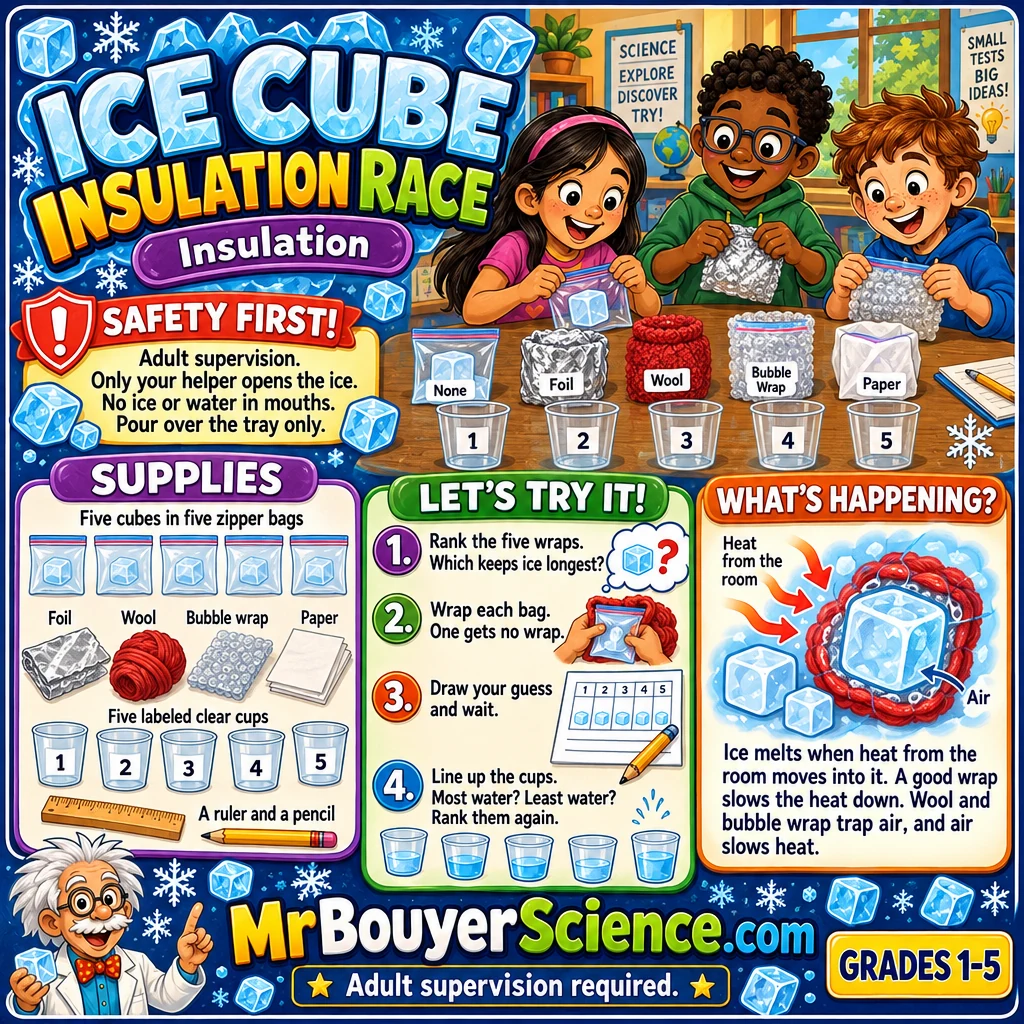
Put this card on the board for the class, or print it. Save the card
1Before class
The day before
- Freeze the ice the day before. Use one tray so every cube is the same size. Pop the cubes into a zipper bag and keep them in a cooler until class.
- Test the race once yourself. Note how much melts in 12 minutes in your room so you know what to expect.
- The differences can be small in 12 minutes. Plan to compare carefully. Run 15 minutes if the class can wait.
- Ask the K to 5 teacher about skin sensitivity to wool. Use a fleece scrap if any child needs it.
- An adult cuts all the foil, bubble wrap, paper and wool pieces ahead. Children never use scissors.
- Give your helpers the helper guide on this page. Let them wrap one cube first.
Ten minutes before kids arrive
- Set one tray on each table. Five tables, five trays.
- At each tray set five clear cups in a row. Put a strip of masking tape on each cup. Write the names No wrap, Foil, Wool sock, Bubble wrap and Paper.
- Set the wraps beside each tray. One foil square, one bubble wrap piece, one wool sock or wool scrap and two sheets of paper.
- Set five zipper bags, a plastic spoon, a ruler, a marker and four tape strips at every tray.
- Lay paper towels under every tray. Set a mop or towel near the door for floor spills.
- Keep the cooler of ice closed and away from the tables. An adult hands out ice only when every group is ready.
- Put the timer on the projector or board where every child can see it. Put this card up on the board.
Safety and care
- The K to 5 teacher is the responsible adult in the room. The high school helpers lead the activity but they are not adults.
- Nothing is tasted or put in mouths. That includes the ice and the melted water.
- Ice is cold. Children hold the bagged bundles, not loose ice. Take a break if hands get cold. Gloves are optional.
- Melted water on the floor is a slip risk. Keep trays in the middle of the table. Pour only over the tray. Wipe at once.
- Plastic bags stay away from faces and heads. Bags go in the trash bag at the end.
- Foil edges can be sharp. An adult cuts and folds the edges ahead. Wool and fleece are checked for skin sensitivity.
- Wash hands after handling the wraps and ice. No scissors are used by children.
2Materials for 15 students
| Item | Per group | Whole class | Notes |
|---|---|---|---|
| Ice cubes, frozen the day before, all the same size | 5 | 25 plus spares | Use one tray. Keep cold in a cooler. |
| Cooler with a lid | 1 | Bring extra ice. Ice stays solid until class starts. | |
| Zipper bags, sandwich size | 5 | 25 | Each cube goes in its own bag before any wrap. |
| Aluminum foil squares, about 20 centimeters | 1 | 5 | Cut ahead by an adult. Fold the edges. |
| Wool sock or wool scrap | 1 | 5 | A clean sock or a fleece scrap works. Check for skin sensitivity. |
| Bubble wrap pieces, about 20 centimeters | 1 | 5 | Cut ahead by an adult. |
| Plain paper sheets | 2 | 10 | Copy paper or newspaper. |
| Masking tape strips | 4 wrap strips and 5 labels | 1 roll | Holds each wrap closed. Labels go on the cups. |
| Small clear plastic cups, 3 to 5 ounce | 5 | 25 | One for the melt water from each bundle. |
| Trays with a rim | 1 | 5 | They catch drips. |
| Rulers in millimeters | 1 | 5 | A kitchen scale in grams is a nice extra if you have one. |
| Washable markers | 1 | 5 | For labeling the cups. |
| Plastic spoons | 1 | 5 | Hold the ice back while the water is poured. |
| Pencils | 3 | 15 | |
| Plain paper record sheets | 3 | 15 | Each child records their own ranking. |
| Paper towels | 6 sheets | 1 roll | For spills. |
| Timer visible to the class | 1 | A phone on the projector works. | |
| Trash bag | 1 | For used bags and wraps. |
How to set up the room
- Use five tables with one tray in the middle of each. Seat three children around each tray with one helper.
- Keep all five trays in the same part of the room. Same temperature. Not in sunlight. Not next to a heater or a window.
- Keep the cooler near the front with the lid closed.
- Leave clear walking space. Keep a towel or mop ready for the floor.
3Run it in 33 minutes
Show the board. Ask for a guess. Rank the five wraps from keeps ice longest to keeps ice shortest.
Helpers show one wrap. An adult hands out the ice. Each cube goes in a bag first. Children wrap each bag in its material and label the cups.
Start the timer when every bundle is wrapped. Children do not open the bundles. They draw their prediction and talk. The K to 5 teacher can read a short story.
Open each bundle over the tray. Pour the melt water into its labeled cup. Compare the cups. Rank them. Measure if you can.
Compare the ranking to the guess. Ask why.
Bag everything. Wipe the tables and floor. Wash hands.
4What the kids do
- Look at your five wraps. Rank them from keeps ice longest to keeps ice shortest.
- Your helper hands you five ice cubes in five bags. Never touch a loose cube.
- Wrap each bagged cube in its own material. Hold the wrap closed with a strip of tape. One bag gets no wrap.
- Set all five bundles on the tray. Do not touch them. Start the timer together.
- Draw your guess and wait. When the timer rings, unwrap each bundle over the tray.
- Pour the melt water from each bag into its labeled cup. The helper holds the ice back with a spoon.
- Line up the five cups. Which has the most water? Which has the least? Measure it if you can. Rank them again.
Match it to the grade
Wrap the cubes and watch. Say cold, melting and water. Look at the cups and say which has the most water. Say which wrap you think wins.
Rank the five wraps before and after. Look at the five cups side by side. Measure the water in each cup with a ruler in millimeters.
Record the water in each cup in millimeters or weigh it in grams. Make a bar graph. Name what you changed and what you kept the same. Explain why fair tests need the same ice and the same time.
5Helper guide for older students
Your job
- Lead one group of three. Wrap and test one cube the day before so you know the steps.
- Hand out the ice only when every child is ready. Keep the cooler lid closed.
- Give each child a job. One wraps. One labels. One pours and measures.
- Ask questions and let the children try before you explain.
- Keep trays in the middle of the table and wipe spills at once.
Say things like this
- What do you think will happen? Why?
- Which wrap do you think wins?
- Let us change one thing and try again.
- That is a good guess. How could we test it?
Please do not
- Do not give away the answer before they test it.
- Do not let anyone unwrap early. It changes the test.
- Do not let anyone put ice in their mouth.
- Do not let ice or water get on the floor.
- Do not say a guess is wrong. Say let us test it.
6Talk it over
Questions to ask
- Which wrap kept the ice from melting the best? Which was worst?
- Did the winner surprise you? Why or why not?
- What did we change? What stayed the same on every cube?
- Why did we use the same ice, the same bag and the same timer?
- Where do people use a wrap to keep something cold or warm?
- Grades 4 and 5. Ice melts when heat moves into it. How does a wrap change the way heat moves?
The science, in plain words
Heat always moves from warmer things to cooler things. The room and your hands are warmer than the ice, so heat moves into the ice and melts it. Insulators slow that movement. Wool and bubble wrap trap pockets of air, and air is a poor conductor of heat. Foil is a metal that conducts heat very well, so a thin layer alone may not help much. Paper does a little. The bag with no wrap is the baseline. Nothing in the wrap makes cold. Cold does not flow in. Heat flows in, and the wrap slows it. In 12 minutes the differences can be small, so compare the cups carefully and measure if you can. Results can surprise. A surprise is a good reason to test again.
Where you see it
- A winter coat traps warm air around your body.
- A cooler with thick walls keeps food cold on a hot day.
- A thermos keeps a drink hot or cold with a layer of nothing between its walls.
7If it goes wrong
| What you see | What to do |
|---|---|
| All the cups look about the same | The differences can be small in 12 minutes. Measure the water with a ruler. Next time run 15 minutes. |
| A bag leaks onto the table | Dab it up with a paper towel. Check the zipper seam. Use a fresh bag. |
| The cubes are different sizes | Use one tray for all the ice. Check cubes before class and swap any that look off. |
| The ice is slushy at the start | The cubes were frozen too late. Freeze them the day before and keep them cold in the cooler. |
| The wrap fell off | Hold it closed with a strip of tape. Do not wrap it so tight that it squeezes the bag open. |
| Water spills on the floor | Stop and wipe it at once. Keep the trays in the middle of the table. Pour over the tray only. |
Clean up
- Pour any extra melt water down the sink
- Put used bags in the trash bag
- Return foil, wool, bubble wrap and paper to the kit
- Wipe every table and tray and check the floor
- Wash hands with soap and water
Go further
- Try two layers of the same wrap. Does one layer or two work better?
- Try putting a cube in a paper cup or a foam cup. Hold the rest the same.
- Wrap a cube and set it in the sun and another in the shade. What changes?
- Try wrapping a cube in a mitten, a hat or a scarf. Which keeps the ice best?
Built by Science Fenns for teachers and student helpers. Keep supervising every group the whole time.