

Teacher cards / Activity 36
For teachers and helpers. Adult supervised. Not for student screens.Heartbeat Listener
What happens to your heartbeat when your body moves?

★The card
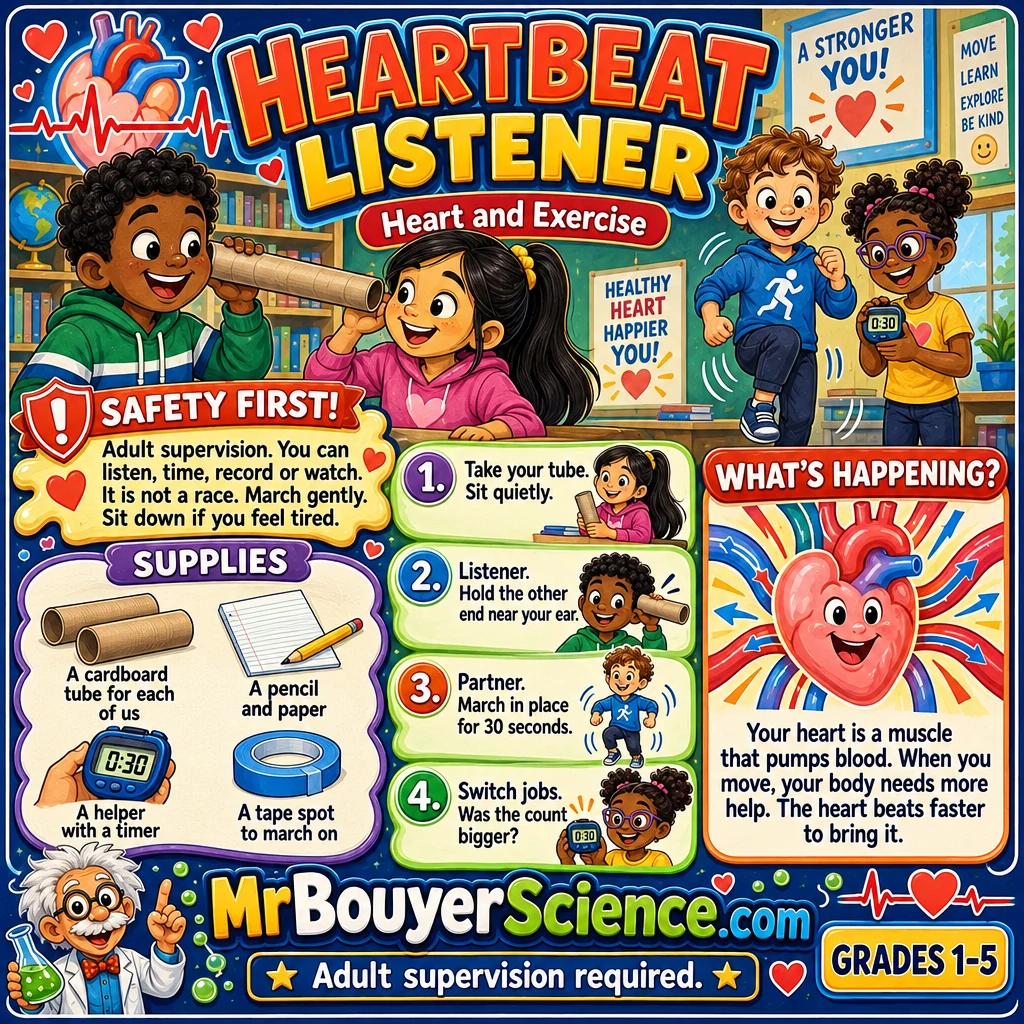
Put this card on the board for the class, or print it. Save the card
1Before class
The day before
- Make one tube yourself and listen to your own heartbeat. Press the tube lightly against your chest over your clothes. Hold it still. It can take a few tries.
- Cut the paper towel tubes in half ahead of time. You or another adult uses the scissors. Children never do. Each half makes one listening tube.
- Quiet matters most. Pick a calm room and ask other classes to keep the hall quiet if you can.
- Tell the K to 5 teacher that every child may choose how much to take part. A child may listen, time, record or watch. No child needs to explain why.
- Give your helpers the helper guide on this page. Let them try a tube on each other first.
- Plan to collect no numbers. Papers go home with the child or into recycling. Nothing is posted.
Ten minutes before kids arrive
- Cut about eight paper towel tubes in half so you have sixteen listening tubes. Run a strip of masking tape around each cut end if the edge is rough.
- Put three tubes, three pencils and three half sheets of paper at every group.
- Put a strip of tape on the floor for each child as a marching spot. Leave a long step between spots and between groups.
- Clear the floor of bags and cords. Children should march on a dry, flat surface in shoes.
- Set a stopwatch or kitchen timer for each helper. A watch with a second hand also works.
- Draw the sitting and marching table on the board. Leave the numbers off.
- Put this card up on the board.
Safety and care
- An adult stays with every group for the whole activity.
- The K to 5 teacher is the responsible adult in the room. Helpers are teenagers and work with the teacher.
- Only the child's own comfort matters. Any child may sit out, take the recorder job or watch. Never press a child to join.
- This is never a competition. Do not compare children. Do not say whose heart is fast or slow.
- No personal health data is kept or posted. Papers go home with the child or into recycling. Do not collect papers. Do not write numbers on the board.
- The partner holds the tube against their own chest over clothes. Nobody touches another child's body.
- Marching is gentle and only for 30 seconds. A child who feels dizzy, short of breath or tired sits down at once and tells an adult.
- This is not a medical test. Never tell a child their heartbeat is wrong. If a child cannot hear a beat, say that is okay and try again or switch jobs.
- Each child keeps one tube. Tubes are not shared and not put in mouths. Wash hands at the end.
- Children wear shoes. Keep spacing so nobody bumps a neighbor.
2Materials for 15 students
| Item | Per group | Whole class | Notes |
|---|---|---|---|
| Cardboard tubes, paper towel tube cut in half | 3 | 15 | About eight paper towel tubes make sixteen halves. Toilet paper tubes also work. |
| Stopwatches or timers | 1 | 5 | A watch with a second hand or a kitchen timer. The helper keeps time. |
| Masking tape marching spots | 3 | 1 roll | A strip of tape on the floor for each child. |
| Pencils | 3 | 15 | |
| Plain paper, half sheets | 3 | 15 | For tally marks. Goes home with the child. |
| Scissors, adult only | 1 | Used before class to cut the tubes. | |
| Recycling bin | 1 | For tubes and papers the children do not take home. |
How to set up the room
- Seat each group of three in a small triangle with a long step between groups.
- Put each child's marching spot beside the seats. Keep the floor clear.
- Keep the room quiet. Soft voices only. No music.
- Put the helper's timer where the children can see it, or let the helper call start and stop.
3Run it in 30 minutes
Groups sit quietly. Show the board. Ask what will happen to a heartbeat when we march. Pass out the tubes.
Each child tries the tube. The partner holds the tube on their own chest over their clothes. The listener holds the other end near an ear. Stay still. Just listen. No counting.
Three rounds. Each child gets one turn as partner, listener and recorder. Listen for 15 seconds sitting. The partner marches in place for 30 seconds. Listen again for 15 seconds. The recorder makes tally marks.
Bring the class together. Ask who heard a faster beat after marching. Raise hands only. Do not call out any numbers.
Papers go home or into recycling. Tubes go in the bin. Wash hands.
4What the kids do
- Take your tube. Sit quietly with your group.
- Partner. Hold one end of the tube on your chest over your clothes.
- Listener. Put the other end near your ear. Listen for the beat.
- Listener. Tap a finger softly on your knee for every beat. Recorder. Make a mark for every tap. Do this for 15 seconds.
- Partner. March in place for 30 seconds. Gentle steps.
- Listen again for 15 seconds. Mark the beats.
- Switch jobs. Ask which count was bigger and what that means.
Match it to the grade
Listen with the tube. Tap a hand softly with each beat. Say fast or slow after marching. No counting is needed.
Count the beats in 15 seconds. Compare sitting and marching. Say which count is bigger. Draw a picture of the heart.
Count and record sitting and marching. Multiply the 15 second count by four for beats in a minute. Explain why the count changes.
5Helper guide for older students
Your job
- Lead one group of three. Practice with a tube first.
- Keep time with your watch. Call start and stop in a soft voice.
- Keep the room quiet. Use a whisper.
- Offer every child a job. Let any child choose to watch.
- Ask questions and let the children try before you explain.
Say things like this
- What do you think will happen?
- Take your time. Listen quietly.
- You can sit this one out if you like.
- That is a good guess. How could we test it?
Please do not
- Do not touch a child or press a tube against anyone.
- Do not compare one child's heartbeat to another.
- Do not collect, write down or post anyone's numbers.
- Do not push a child to march or take part.
- Do not say a guess is wrong. Say let us listen again.
6Talk it over
Questions to ask
- What did you hear when you listened with the tube?
- Was the beat faster, slower or the same after marching?
- What did we change and what stayed the same?
- Why do you think the heart did that?
- When have you felt your heart beat fast? What were you doing?
- Grades 4 and 5. If the 15 second count is 20, how many beats would that be in a minute?
The science, in plain words
The heart is a muscle that pumps blood through the body. Blood carries oxygen to every part. Active muscles use more oxygen, so the heart pumps faster to deliver it. When the body rests, the heart slows again. The tube does not make the sound louder. It blocks outside noise and carries the quiet sound of the beat to the ear. In a quiet room, most children can hear a soft thump. Heart rates differ from person to person. A different count does not mean anything is wrong. This lesson compares the same child sitting and marching, and nothing more. There is no right number to aim for.
Where you see it
- An athlete's heart beats faster during a race and slows down after.
- A doctor uses a stethoscope to listen to the heart. It carries sound to the ear.
- A dog pants and its heart beats faster after it runs.
7If it goes wrong
| What you see | What to do |
|---|---|
| The listener cannot hear a beat | Press the tube a little firmer on the chest. Move it a little to the left. Ask the room to be quieter. Try again. |
| Too much noise | Count down from five and stay silent. Try again. A quiet room matters most. |
| The counts look the same | That is fine. Heartbeats can be hard to count. Try marching a little longer next time. |
| A child feels dizzy or tired | Sit down right away. Tell the K to 5 teacher. Offer water and a rest. |
| A child does not want to take part | That is fine. The child can listen, time, record or watch. Do not ask why. |
| Children want to compare numbers | Say this is not a race. Everyone's heart is different. Look at each child's own sitting and marching only. |
Clean up
- Papers go home with the child or into recycling
- Tubes go in the recycling bin
- Pull up the tape spots
- Return timers to the kit
- Wash hands
Go further
- Try marching for a longer time. Does the beat change more?
- Listen after lying down quietly for one minute. What do you hear?
- Try a cardboard tube and a paper cup. Which carries the sound better?
- Draw a picture of a heart as a pump with blood moving to the arms and legs.
Built by Science Fenns for teachers and student helpers. Keep supervising every group the whole time.