

Teacher cards / Activity 22
For teachers and helpers. Adult supervised. Not for student screens.Foil Boat Challenge
How many washers can a foil boat hold before it sinks?

★The card
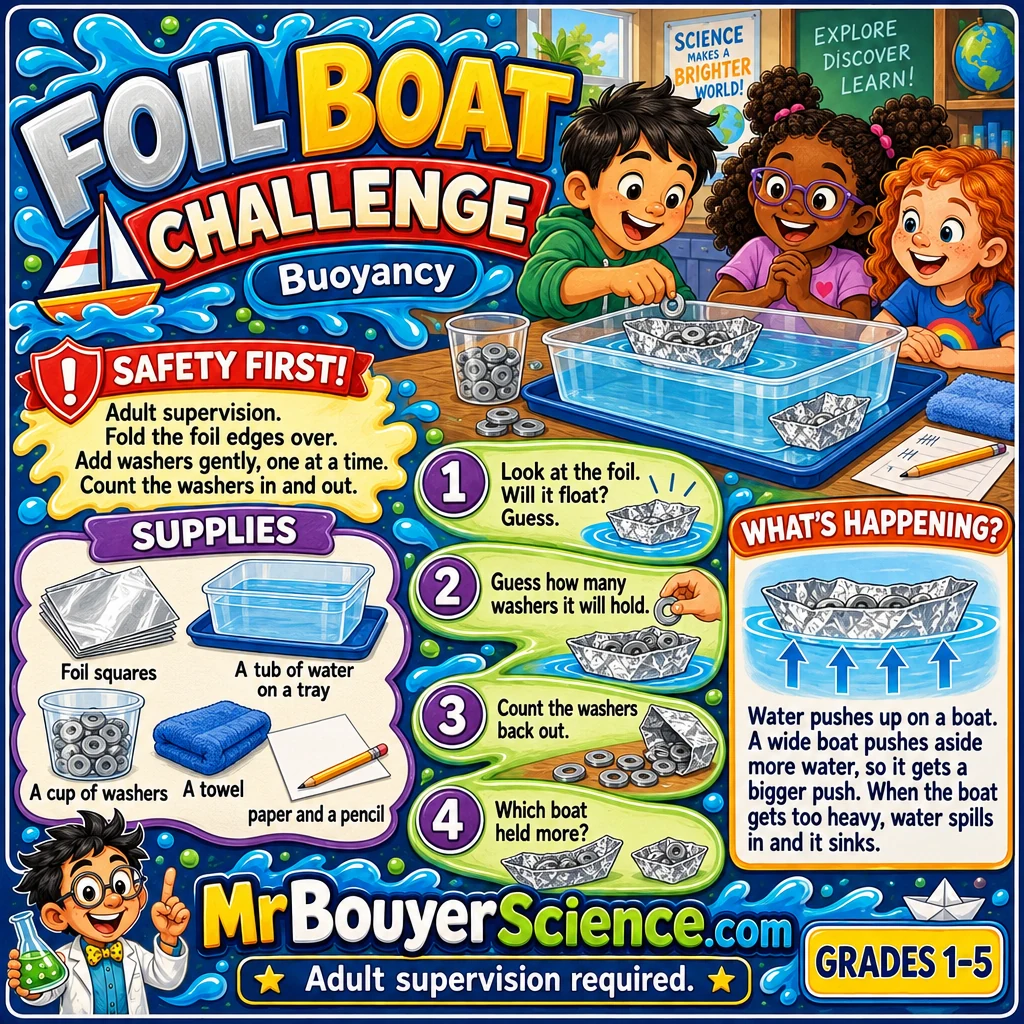
Put this card on the board for the class, or print it. Save the card
1Before class
The day before
- Test one boat yourself. Build it, float it and load it until it sinks. It takes five minutes and shows you what to expect.
- Cut the foil squares ahead of time. An adult does the cutting. Fold the cut edges over so no edge is rough.
- Count the washers into five cups of 30. Count them again. You will count them back at the end of class.
- Tell the K to 5 teacher the floor may get wet. Children should wear shoes with a good grip.
- Give your helpers the helper guide on this page. Let them build one boat first.
Ten minutes before kids arrive
- Put one tray on each group table or on a clear patch of floor. Set a clear plastic tub on each tray.
- Fill each tub with about 5 cm of room temperature water. Check the depth with a ruler.
- Lay one towel flat beside each tray and keep a second towel folded nearby.
- At each station set three foil squares, one cup of 30 washers, a ruler, pencils and paper.
- Keep a mop or large towel by the door for spills.
- Put this card up on the board.
Safety and care
- An adult stays with every group for the whole activity. The K to 5 teacher is the responsible adult. Helpers are teenagers and lead the activity.
- Cut foil edges can be sharp. An adult cuts the squares. Children and helpers fold every edge over so the rim is smooth and rounded.
- Washers are heavy and small. Count them out and count them back in. None go in mouths or pockets and none are thrown.
- Wet floors are a slip risk. Keep tubs on trays. Wipe up every drip at once with a towel.
- Nothing is tasted or drunk. Do not splash. Room temperature water only.
- Add washers gently, one at a time. Do not drop them from high up.
- Wash hands after the activity.
2Materials for 15 students
| Item | Per group | Whole class | Notes |
|---|---|---|---|
| Aluminum foil squares, 25 cm, cut and edges folded | 3 | 15 | Two boats plus one spare. Cut by an adult before class. |
| Clear plastic tubs | 1 | 5 | About 30 cm long and 10 cm deep. A big plastic food tub works. |
| Large metal washers, all the same size | 30 | 150 | Count out and count in. Wide washers are easiest to stack. |
| Plastic cups for the washers | 1 | 5 | Keeps washers from rolling away. |
| Trays or baking sheets with a rim | 1 | 5 | Catches splashes. |
| Large towels | 2 | 10 | One flat and one to wipe. |
| Rulers | 1 | 5 | To check the water depth. |
| Pencils | 3 | 15 | |
| Plain paper, folded in half | 3 | 15 | Each child records their own counts. |
| Trash bag | 1 | For foil scraps. |
How to set up the room
- Spread the five stations apart so helpers can walk between them.
- Put each tub on its tray with a towel flat beside it.
- Seat each group of three around the tub on the floor or at a table. Keep the floor clear.
- Keep the mop or large towel by the door.
3Run it in 30 minutes
Sit around the tubs. Show the board. Ask for a guess. Will a flat piece of foil float? What if we shape it into a boat?
Show how to fold the edges over. Each group builds a wide flat boat with low sides. The group predicts how many washers it will hold and writes the number down.
Float the boat. Children add washers one at a time and count out loud. Record the number when water comes in over the side or the boat sinks. Then build boat B with the same foil but a different shape. Test it the same way.
Bring the class together. Compare the counts. Which shape held more? Ask why.
Count the washers back in. Dry them and the tubs. Bag the foil scraps. Wipe the floor.
4What the kids do
- Look at your foil square. Will it float? Make a guess.
- Fold the edges of your foil over so they are smooth. Shape it into a boat. This is boat A.
- Guess how many washers your boat will hold. Write your guess.
- Set the boat on the water. Add washers one at a time. Count out loud.
- Stop when water comes in over the side or the boat sinks. Write the number.
- Take out the washers and count them back. Dry them.
- Make boat B with a different shape. Keep the foil the same size. Test it the same way.
- Compare. Which boat held more?
Match it to the grade
Float one boat and add washers while counting out loud. Watch what happens at the end. Talk about heavy and light.
Test two boat shapes. Count the washers for each. Say which held more and by how many.
Test each shape. Record the counts and find the difference. Make a bar graph. Name what you changed and what stayed the same.
5Helper guide for older students
Your job
- Lead one group of three. Build a boat the day before so you know the steps.
- Count the washers out and back with the children.
- Give each child a job. One shapes the boat. One adds washers. One writes the count. Rotate for boat B.
- Ask questions and let the children try before you explain.
- Fold the foil edges over with the children and check for rough edges.
Say things like this
- What do you think will happen? Why?
- Let us add one more. Count with me.
- Where did the water go when the boat got heavy?
- Let us change one thing and try again.
Please do not
- Do not give away the answer before they test it.
- Do not let washers leave the cup unless they are going into the boat.
- Do not let anyone drop washers from high up.
- Do not leave water on the floor.
- Do not say a guess is wrong. Say let us test it.
6Talk it over
Questions to ask
- Why does a flat boat float when a ball of foil sinks?
- What happened to the water when the boat got heavier?
- Which shape held more washers? Why do you think so?
- What did we change? What stayed the same?
- Where have you seen big boats that carry heavy things?
- Grades 4 and 5. Why does a boat with higher sides hold more weight before it sinks?
The science, in plain words
A floating boat pushes water out of its way. The water pushes back up with a force equal to the weight of the water pushed aside. A flat sheet or a ball of foil pushes aside very little water, so it sinks. A boat shape pushes aside much more water, so the upward push is bigger. Each washer adds weight. The boat floats until the weight equals the largest push the water can give. Then water pours over the edge and the boat sinks. The shape you choose changes how much water the boat can push aside before that happens. Results vary from group to group and that is fine.
Where you see it
- Huge cargo ships are made of steel and float because the hull is wide and hollow.
- A canoe floats with a person inside because of its shape.
- A pan of water in a sink floats while a spoon sinks.
7If it goes wrong
| What you see | What to do |
|---|---|
| The boat sinks right away | Make the sides taller and the base wider. Check for tears and pinch every seam closed. |
| The boat tips over | Place washers in the middle, a little at a time. Spread them evenly. |
| The foil tears | Use a fresh square. Fold gently and do not pull the foil tight. |
| The count is different every time | That is normal. Do each test two times and write both numbers. |
| The boat holds all 30 washers | Call it 30 plus. Ask what you could do to make it carry even more. |
| Water splashes out of the tub | Add washers gently. Wipe up the water at once and move the tray if needed. |
Clean up
- Count the washers back in and check against the count
- Dry the washers and set them in a cup
- Pour the tub water into a bucket or sink with a helper
- Put foil scraps in the trash bag
- Wipe the trays, tubs and floor
- Wash hands
Go further
- Try a boat with a flat bottom and a boat with a round bottom. Which holds more?
- Use a smaller square of foil. How does the count change?
- Stack the washers in one corner. What happens to the boat?
- Float a ball of foil of the same size. Does it float? Why not?
Built by Science Fenns for teachers and student helpers. Keep supervising every group the whole time.