

Teacher cards / Activity 25
For teachers and helpers. Adult supervised. Not for student screens.Domino Chain Reaction
How does one small push travel down a whole line of dominoes?

★The card
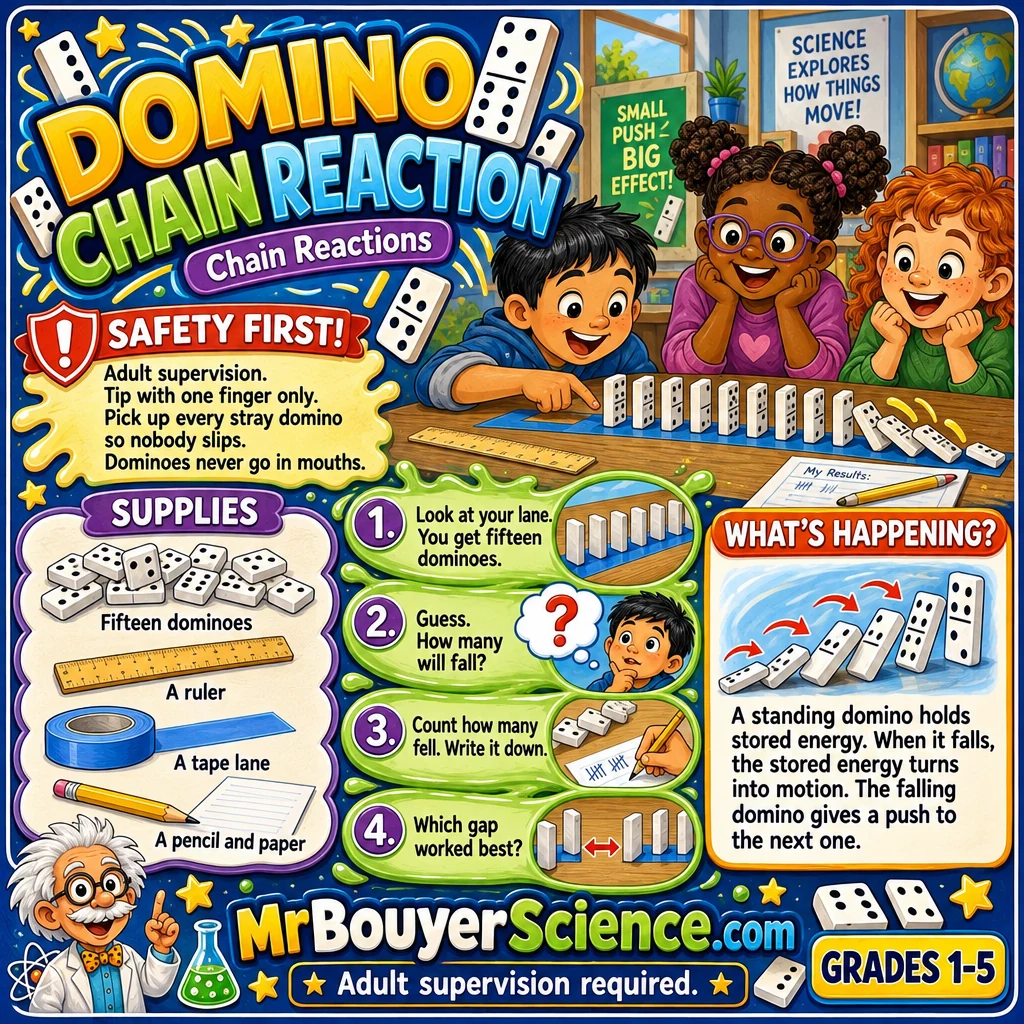
Put this card on the board for the class, or print it. Save the card
1Before class
The day before
- Set up a test lane yourself. Dominoes differ in size, so find out which gaps work for yours.
- Count the dominoes into five bags of twenty. Count them again at the end of class.
- Pick a hard, flat floor. Dominoes do not stand well on carpet. If you only have carpet, lay a long strip of flat cardboard under each lane.
- Give your helpers the helper guide on this page. Let them build one lane first.
- Tell the K to 5 teacher that children will kneel on the floor.
Ten minutes before kids arrive
- Lay five lanes of masking tape on the floor. Make each lane one and a half meters long.
- Keep the lanes at least one and a half meters apart so a falling line never reaches the next lane.
- Put a short cross strip of tape at one end of each lane as the start mark.
- At every lane set a bag of twenty dominoes, a ruler, a box lid and a recording sheet.
- The box lid catches dominoes when the line is picked up.
- Put this card up on the board.
Safety and care
- The K to 5 teacher is the responsible adult in the room. A helper stays with every group the whole time.
- Dominoes on the floor are a slip hazard. Pick up every stray domino at once and drop it in the box lid.
- Dominoes are small. They are never put in mouths, thrown or carried in pockets.
- Count the dominoes out at the start and back in at the end. Do not leave until the count is right.
- Children kneel or sit beside the lane. Nobody walks over the lanes.
- Keep sleeves and feet out of the lane while a line is standing.
- Wash hands after class.
2Materials for 15 students
| Item | Per group | Whole class | Notes |
|---|---|---|---|
| Dominoes, standard size | 20 | 100 | Fifteen are used and five are spares. Index cards cut in half and folded into tent shapes can stand in. Test them first. |
| Masking tape for the lane | 1 strip, 1.5 meters | 1 roll | Tear the strip ahead and stick it down. |
| Ruler, centimeters | 1 | 5 | A meter stick works too. |
| Box lids or small trays | 1 | 5 | To catch dominoes. |
| Pencils | 3 | 15 | |
| Plain paper, folded in half | 3 | 15 | Each child records their own gaps and counts. |
| Stopwatch, optional | 1 | For grades 4 and 5 only. |
How to set up the room
- Run the five lanes side by side. Keep one and a half meters between them.
- Seat each group of three on the floor behind the start mark, kneeling beside the lane.
- Keep a clear walking path so helpers can move between lanes.
- No one stands at the far end of a lane.
3Run it in 30 minutes
Groups kneel at their lanes. Show the board. Ask for a guess. If we tip the first domino, how many will fall?
Helpers show how to stand fifteen dominoes along the tape with a gap of 1 centimeter. Children place them gently.
Test a gap of 1 centimeter, then 3, then 6. Each time the group guesses, one child tips the first domino, one counts the ones that fell, one records.
Bring the class together. Compare the counts. Ask why the wide gap stopped the line.
Pick up every domino. Count them back into the bags.
4What the kids do
- Look at your lane. Your helper gives you fifteen dominoes. Five are spares.
- Stand the dominoes along the tape. Use the ruler to set a gap of 1 centimeter between each one.
- Predict. How many dominoes will fall? Write your guess.
- One child tips the first domino with one finger. Everyone watches the wave.
- Count how many fell. Write the gap and the count on your paper.
- Stand them up again. Make the gap 3 centimeters. Guess and test. Then try 6 centimeters.
- Look at your three counts. Which gap worked best? Which one stopped the line?
Match it to the grade
Stand a short line of ten dominoes with a small gap. Tip the first and say bump, bump, bump together. Count the fallen ones by pointing.
Test the three gaps. Use the ruler in centimeters. Write each count and say which gap gave the most.
Run two trials for each gap. Find the typical count. Make a bar graph. Find the biggest gap that still works. Time the wave with a stopwatch if you have one.
5Helper guide for older students
Your job
- Lead one group of three. Run the activity once before class so you know the steps.
- Count the dominoes out and back in.
- Let the child place the dominoes. You hold the ruler.
- Make sure every domino is picked up so no one slips.
- Give each child a job and rotate the jobs.
- Ask questions and let the children try before you explain.
Say things like this
- What do you think will happen? Why?
- What did the first domino give to the next one?
- Let us change one thing and try again.
- That is a good guess. How could we test it?
Please do not
- Do not tip the first domino for the child.
- Do not give away the answer before they test it.
- Do not let anyone walk across a lane.
- Do not let dominoes be thrown or carried off.
- Do not say a guess is wrong. Say let us test it.
6Talk it over
Questions to ask
- What happened after you tipped the first domino?
- What did the first domino give to the second one?
- What happened when the gap got bigger? Why do you think so?
- What did we change each time? What stayed the same?
- Where have you seen one thing bump the next thing in a line?
- Grades 4 and 5. Why did the wide gap stop the line even though the push was the same?
The science, in plain words
A standing domino has its weight held up high, so it carries stored energy. A small push tips it past its balance point and it falls. As it falls, the stored energy turns into motion. When it hits the next domino it passes on part of that motion as a push, and that domino tips too. The push travels down the line as a wave. Some energy turns into sound at every click and a little into heat. If the gap is wider than the domino is tall, the falling domino cannot reach the next one and the chain stops. A small gap passes the push every time.
Where you see it
- Bowling pins knock into each other after the ball hits the first pin.
- Billiard balls pass a push along when one ball strikes another.
- A desk toy with swinging steel balls passes energy from one end to the other.
7If it goes wrong
| What you see | What to do |
|---|---|
| A domino falls while setting up | Place dominoes slowly with two fingers. Keep hands clear after the last one. Use the spare to finish the line. |
| The line stops at one gap | The gap may be too wide or a domino is leaning. Measure with the ruler and stand the domino straight. |
| Two dominoes fall at once | They are touching. Spread them to the gap on the ruler. |
| The dominoes slide on the floor | Try a flat strip of cardboard under the lane or move to a table. |
| The wave heads for the next lane | Check that lanes are one and a half meters apart. Tip the first domino gently. |
| Children want to push it again right away | Say let us record first. Then reset and try again. |
Clean up
- Pick up every domino and put it in the box lid
- Count the dominoes back into the bags
- Peel up the tape lanes
- Return rulers, lids and pencils to the kit
- Wash hands
Go further
- Make a lane that turns a corner. Does the chain still work?
- Stand dominoes on a slope. Do they fall farther?
- Try index card blocks against dominoes. Which passes the push better?
- Build a lane with a short gap, then a wide gap. Where does it stop?
Built by Science Fenns for teachers and student helpers. Keep supervising every group the whole time.