
Teacher cards / Activity 31
For teachers and helpers. Adult supervised. Not for student screens.Day and Night Globe
Why is it day in one place and night in another?

★The card
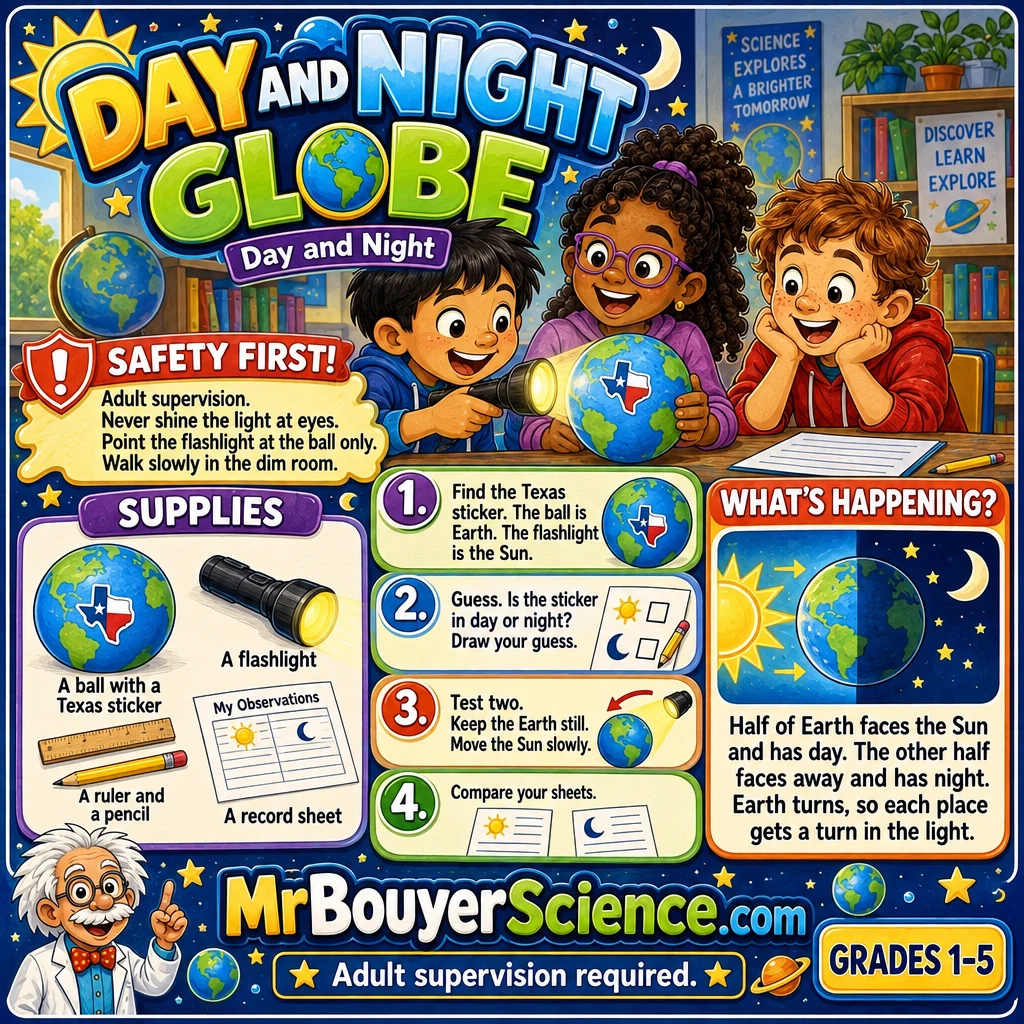
Put this card on the board for the class, or print it. Save the card
1Before class
The day before
- Test every flashlight. Fresh batteries make a steady beam.
- Ask the K to 5 teacher about children who are sensitive to light. Use steady beams only. Never use a flashing or strobe light.
- Do a trial run yourself. Spin the ball slowly and watch the Texas sticker go from dark to light. It takes two minutes.
- Give your helpers the helper guide on this page. Let them practice both tests once.
- Check that a dim room is still safe to walk in. Plan to turn off only the lights nearest the windows.
Ten minutes before kids arrive
- Put a round sticker on each ball for Texas. Place it on the northern half, a little above the middle.
- Set five tables or desk groups with room to walk between them.
- Stand each ball on a masking tape roll stand on its table. Tape the roll down so it cannot slide.
- Stand a folder or box flap upright behind each ball. It catches stray light so no beam crosses the room.
- Mark a spot on each table 40 centimeters from the ball with a strip of tape. The flashlight head sits at this mark.
- At every table set a flashlight, a ruler, three pencils and three record sheets.
- Dim the room by turning off the lights nearest the windows and closing blinds. Keep enough light to see faces and the floor.
- Put this card up on the board.
Safety and care
- The K to 5 teacher is the responsible adult. Helpers are teenagers and lead the activity only. An adult stays in the room the whole time.
- Never aim a flashlight at anyone's eyes. The beam points at the ball and nowhere else. Say it aloud before you start.
- Do not turn the room fully dark. Dim it only. Keep one light on or the door open so everyone can see the floor.
- Only the Sun child switches the flashlight on. The helper switches it off at the end of each test.
- Walk only. No running in a dim room. Keep bags and chairs out of the walkways.
- Batteries stay inside the flashlights. Spare batteries stay with the teacher, never in a child's hands.
- Wash hands after the activity because the balls and flashlights are shared.
2Materials for 15 students
| Item | Per group | Whole class | Notes |
|---|---|---|---|
| LED flashlight | 1 | 5 | Small bright LED. Test the batteries first. |
| Globe or ball, 15 to 20 centimeters across | 1 | 5 | A light colored ball shows light best. Foam or plastic is fine. |
| Round stickers for Texas | 1 | 5 | Or a dot made with a marker. Keep one spare. |
| Masking tape roll for a stand | 1 | 5 | Tape it to the table so the ball does not roll. |
| Folder or box flap for a beam catcher | 1 | 5 | Stands upright behind the ball. |
| Ruler | 1 | 5 | Used to mark 40 centimeters from the ball. |
| Pencils | 3 | 15 | |
| Record sheets | 3 | 15 | Four circles for the four places. A box to tally light counts and dark counts. |
| Masking tape strips | 2 strips | 1 roll | One marks the flashlight spot. One anchors the stand. |
| Spare batteries | 4 | Teacher keeps them. |
How to set up the room
- Spread five tables around the room with a clear walkway between each.
- Each table is one Earth and Sun station. Place the flashlight mark and the folder as set up.
- Seat each group of three beside its table. The helper sits where all three children can be seen.
- Keep the walkway lit just enough that the floor is easy to see.
3Run it in 30 minutes
Groups gather at their tables. Show the board. Ask what makes day and night. Ask each child to guess. Show where Texas is on the ball.
Helpers show the three jobs. One child holds the Sun flashlight. One child turns the Earth. One child counts and records. Check the 40 centimeter mark.
Test one. The Earth turns slowly and the Sun stays still. Test two. The Earth stays still and the Sun moves. Children rotate jobs between tests.
Bring the class together. Ask what the Texas sticker saw in each test. Ask which test looked like real life.
Switch off flashlights. Lights back on. Return everything and count the balls and flashlights.
4What the kids do
- Look at your ball. This is Earth. Find the Texas sticker. Your flashlight is the Sun.
- Set the flashlight head on the 40 centimeter mark. Point it only at the ball. Never at a face.
- Predict. When the sticker is in the light, is it day or night in Texas? Draw your guess on your sheet.
- Test one. Turn the Earth slowly while the Sun stays still. Count to ten for one full turn.
- Each time you say a number, say light or dark for the sticker. Tally it on your sheet.
- Test two. Hold the Earth still. Now the Sun child takes slow steps around the ball.
- Tally again. Does the sticker see light and dark the same way?
- Compare your sheets. Say what you notice.
Match it to the grade
Spin the Earth slowly and say day when the sticker is lit and night when it is dark. Point to where the Sun is. Draw a sun and a moon.
Spin the Earth for a ten count and tally light and dark counts. Say which is bigger. Draw the sticker at morning, noon, evening and night.
Compare the two tests. Explain why spinning Earth and moving Sun look the same from the sticker. Add a second sticker on the far side of the ball and say what time it is there.
5Helper guide for older students
Your job
- Lead one group of three. Practice both tests once the day before.
- Say the light rule at the start. The beam goes on the ball and nowhere else.
- Give each child a job. One holds the Sun. One turns the Earth. One counts and records. Rotate jobs.
- Ask questions and let the children try before you explain.
- Keep the room dim but never dark. Watch the walkways.
Say things like this
- What do you think will happen when the sticker turns away?
- Is the sticker in the light or in the dark right now?
- Let us change one thing and try again.
- That is a good guess. How could we test it?
Please do not
- Do not let the flashlight point at a face.
- Do not say the Sun moves around Earth every day. Say Earth turns.
- Do not turn the room fully dark.
- Do not take the ball out of a child's hands. Help with your hands over theirs.
- Do not say a guess is wrong. Say let us test it.
6Talk it over
Questions to ask
- Which half of the ball was lit? Which half was dark?
- What did the Texas sticker see when it turned into the light?
- What did we change between test one and test two? What stayed the same?
- In test one the Sun stayed still. Why does the real Sun seem to move across the sky?
- What is the same about day and night in Texas and day and night in your own yard?
- Grades 4 and 5. Why is it night in some places while it is day in others at the same time?
The science, in plain words
Earth is a ball that spins once about every 24 hours. At any moment the Sun lights up the half that faces it. That half has day. The half turned away has night. As Earth turns, a place like Texas moves from night into day, which is sunrise, and later from day into night, which is sunset. From the ground, Earth feels still. The Sun seems to climb and cross the sky, but the Sun looks that way because we are the ones turning. A flashlight and a ball show the idea well, but the model is not to scale. The real Sun is far bigger and far farther away than a flashlight 40 centimeters from a ball.
Where you see it
- An astronaut on the space station sees about 16 sunrises and 16 sunsets every day.
- When it is afternoon in Texas, it is night in parts of Asia.
- A sundial shadow moves across the ground as Earth turns.
7If it goes wrong
| What you see | What to do |
|---|---|
| The whole ball looks lit | The room is too bright. Turn off another light or close a blind. Also check that the flashlight is not too close. |
| The light spreads and looks weak | Move the flashlight a little closer or use fresh batteries. Hold it steady with an elbow on the table. |
| The ball rolls off its stand | Tape the roll to the table. Press the ball into the ring of tape. |
| The sticker falls off | Press it down firmly or tape over the edges. Do this before the lesson if you can. |
| The beam keeps wandering | Rest the Sun child's elbow on the table. Move the folder closer behind the ball. |
| The Earth turns too fast to see the sticker | Slow down. Count to ten for one full turn. Show a helper turn first. |
Clean up
- Switch off every flashlight
- Lights back on
- Peel off the folder and return it
- Return rulers, pencils and tape to the kit
- Count balls, stickers and flashlights back in
- Wash hands
Go further
- Add a second sticker on the far side of the ball. When one sticker is in day, what is the other in?
- Move the flashlight farther away. Is the lit half bigger or smaller?
- Stick a tiny paper flag on the Texas sticker. Watch its shadow as the Earth turns.
- Turn the Earth the other way. Does the sticker go from dark to light in the same place?
Built by Science Fenns for teachers and student helpers. Keep supervising every group the whole time.