

Teacher cards / Activity 03
For teachers and helpers. Adult supervised. Not for student screens.Celery Color Climb
How does colored water climb up a celery stalk?

★The card
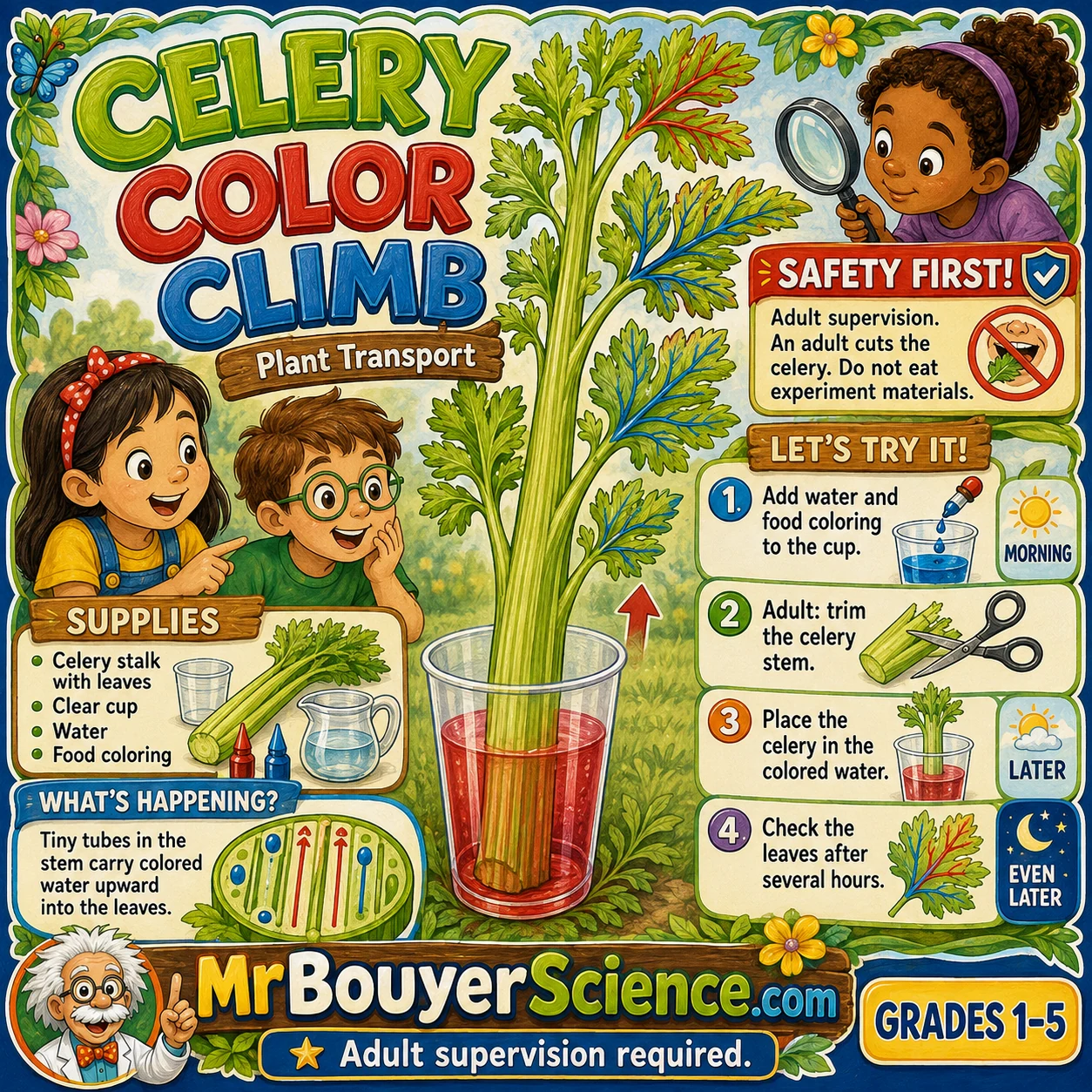
Put this card on the board for the class, or print it. Save the card
1Before class
The day before
- Ask the K to 5 teacher about allergies to celery and to food coloring. A child with either allergy watches and draws and does not touch the celery or the dye.
- Buy fresh, crisp celery with the leaves still on. Limp celery moves water slowly.
- Do a trial the afternoon before class. Set one stalk in dark colored water. By the next morning you have a finished stalk to show the class.
- This lesson takes hours to finish. The class sets it up at the start and checks at the end. The K to 5 teacher can also check the cups the next morning. Decide now whether the cups stay in the science room or go back to the K to 5 room on their trays.
- Food coloring stains skin, clothes and tables. Ask the K to 5 teacher to send the class in clothes that can get a little stained. Old shirts work well as aprons.
- Give your helpers the helper guide on this page. Let them set up one cup first.
Ten minutes before kids arrive
- Put one tray at each of five stations. Lay a towel under every tray.
- An adult, not a helper, cuts the celery on a cutting board. Slice about two centimeters off the bottom of each stalk so the end is fresh. Keep the leaves on.
- Keep the cut stalks in a tub of cold water until the activity starts. Dry the ends just before use.
- Fill five small pitchers with cold tap water. Put one at each tray.
- Put one clear cup, one strip of masking tape and a pencil at each station. Write the group number on the tape.
- Plan the colors. Three groups get red. Two groups get blue. Keep the food coloring with the helpers, not on the tables.
- Set the demo stalk from yesterday and a paper towel roll on the front table.
- Put this card up on the board.
Safety and care
- The K to 5 teacher is the responsible adult in the room. An adult stays with every group for the whole activity. Helpers are teenagers and lead under that adult.
- Only an adult cuts the celery or slices the stalk. Knives and scissors stay with that adult and out of the children's reach.
- Check for allergies to celery and to food coloring before you start. A child with either allergy does not touch the materials.
- Nothing is tasted or eaten. The celery and the colored water are science materials.
- Food coloring stains. Only the helper handles the bottle. Wipe drips at once. Blot a spill. Do not rub.
- Water on the floor is a slip risk. Keep cups on trays. Wipe floor drips at once.
- Wash hands with soap and water before and after.
2Materials for 15 students
| Item | Per group | Whole class | Notes |
|---|---|---|---|
| Celery stalks with leaves | 1 | 5 | One bunch gives plenty. Choose crisp stalks of about the same size. |
| Celery stalk for the demo, colored the day before | 1 | Set it in dark colored water the afternoon before. | |
| Tall clear plastic cups | 1 | 5 | Plastic only. Tall cups hold the stalk upright. |
| Food coloring, red and blue | about 20 drops | 1 bottle each | Dark colors show best. Yellow is hard to see. |
| Small pitchers of cold tap water | 1 | 5 | |
| Trays with a rim | 1 | 5 | They catch drips and stains. |
| Old towels for under the trays | 1 | 5 | Dye stains. A towel protects the table. |
| Paper towels | 1 roll | For wiping drips. | |
| Cutting board | 1 | Adult only. Keep it away from the children. | |
| Knife or scissors | 1 | Adult only. Keep it away from the children. | |
| Hand lenses | 1 | 5 | Optional. For the cut slice at the end. |
| Masking tape strips | 1 strip | 1 roll | For group labels on the cups. |
| Pencils | 3 | 15 | |
| Plain paper, folded in half | 3 | 15 | Each child draws the celery now and later. |
| Old shirts or aprons | as needed | Food coloring stains clothes. |
How to set up the room
- Set the five stations around the room. Leave room to walk between them.
- Seat the three children of each group around one tray. Keep the cups in the middle of the tray.
- Keep the food coloring and the knife with the adult and helpers, not on the tables.
- Choose a spot where the cups can stay for hours and not be knocked over. A windowsill with sun speeds things up.
3Run it in 30 minutes
Show the board and the demo stalk from yesterday. Ask for a guess. Where will the color go?
The helper pours water and adds the drops. Each group stands its celery in the cup and draws it. This starts the clock.
An adult slices a thin piece off the demo stalk. Use the hand lenses. Look for the colored dots. Children draw them.
Look at the cups again. Compare to the first drawing. Color may show at the cut end and up the stem. Leaves take hours. Say when you will check again.
Leave the cups on their trays. Wipe the tables and trays. Count tools back in. Wash hands.
4What the kids do
- Your helper pours cold water into the cup until it is half full.
- Your helper adds about twenty drops of food coloring. Do not touch the bottle.
- Look at your celery. An adult has already cut the bottom. Look at the green leaves.
- Stand the celery in the colored water. The cut end goes down.
- Draw your celery now. Color in the water. Write the time.
- Look again at the end of class. Look at the cut end, the stem and the leaves.
- Look again later today or tomorrow morning. Draw what changed.
Match it to the grade
Watch the color and say which parts turned color. Draw the celery before and after. Use crayons for the colors.
Draw the celery at three times. Show how high the color climbed each time. Say what you notice about the leaves.
Measure how far the color climbed in centimeters at each check. Make a line graph over time. Compare red and blue cups. Predict how far it will climb by tomorrow.
5Helper guide for older students
Your job
- Lead one group of three. Set up a cup the day before so you know how it looks.
- Pour the water and add the drops. The children do not handle the bottle.
- Give each child a job. One stands the celery. One draws. One writes the time.
- Ask questions and let the children look before you explain.
- Check the cups again at the end and point to what changed.
Say things like this
- Where do you think the color will go?
- What do you see in the stem?
- What stayed green? Why do you think so?
- That is a good guess. Let us look again later.
Please do not
- Do not cut the celery. Only an adult cuts it.
- Do not let children squeeze the food coloring.
- Do not tell them where the color goes before they look.
- Do not let anyone taste or eat the celery.
- Do not say a guess is wrong. Say let us check later.
6Talk it over
Questions to ask
- What did you see in the stem after a short time?
- Where did the color go? What parts of the celery stayed green?
- Why do you think the color moved up and not down?
- How could we make the color climb faster?
- Where does a tree get its water?
- Grades 4 and 5. What do you think pulls the water up? Think about the leaves.
The science, in plain words
A celery stalk is a stem. Inside it run narrow tubes called xylem. They carry water from the roots up to the leaves. Water evaporates from tiny pores in the leaves, and that pulls more water up the tubes. Water molecules also stick to each other and to the tube walls, so the water climbs as one thread. Food coloring dissolves in the water and travels with it. The color marks the tubes as lines in the stem and dots in a cut slice. In a 30 minute class you may see color at the cut end and a little way up the stem. Color in the leaves usually takes several hours or overnight. A fresh cut, a warm room and a bright spot help.
Where you see it
- A tree lifts water from its roots to leaves high above the ground.
- A white flower in colored water slowly takes on that color.
- A wilted plant perks up after it is watered.
7If it goes wrong
| What you see | What to do |
|---|---|
| There is no color after class | Celery takes hours. Check again later today or tomorrow morning. Make sure the cut end is fresh and the celery is crisp. |
| Color only at the bottom | Give it more time. Keep the leaves on. Put the cup in a warm bright spot. |
| The color looks pale | Add more drops. Dark red and blue show best. Yellow is hard to see. |
| The celery tips over | Use a taller cup. Lean the stalk on the rim. Keep the cup in the middle of the tray. |
| Food coloring spills | Blot with paper towels. Do not rub. Tell the K to 5 teacher about any stain on clothes. |
| A child has dye on a hand | Wash with soap and water. It fades in a day or so. Do not let the child touch the face. |
Clean up
- Leave the cups on their trays with the celery in them
- Wipe every drip and wipe the trays
- Check the floor for wet spots
- Return pencils, tape and lenses to the kit
- Wash hands with soap and water
Go further
- Stand one stalk in plain water beside the colored ones. What is different?
- Put one cup in a sunny window and one in a dim spot. Which climbs faster?
- An adult splits a stalk bottom into two halves. Set each half in a different color.
- Measure how far the color climbs every hour for a day.
Built by Science Fenns for teachers and student helpers. Keep supervising every group the whole time.