

Teacher cards / Activity 01
For teachers and helpers. Adult supervised. Not for student screens.Balloon Rocket
What makes a balloon rocket zoom down a string?

★The card
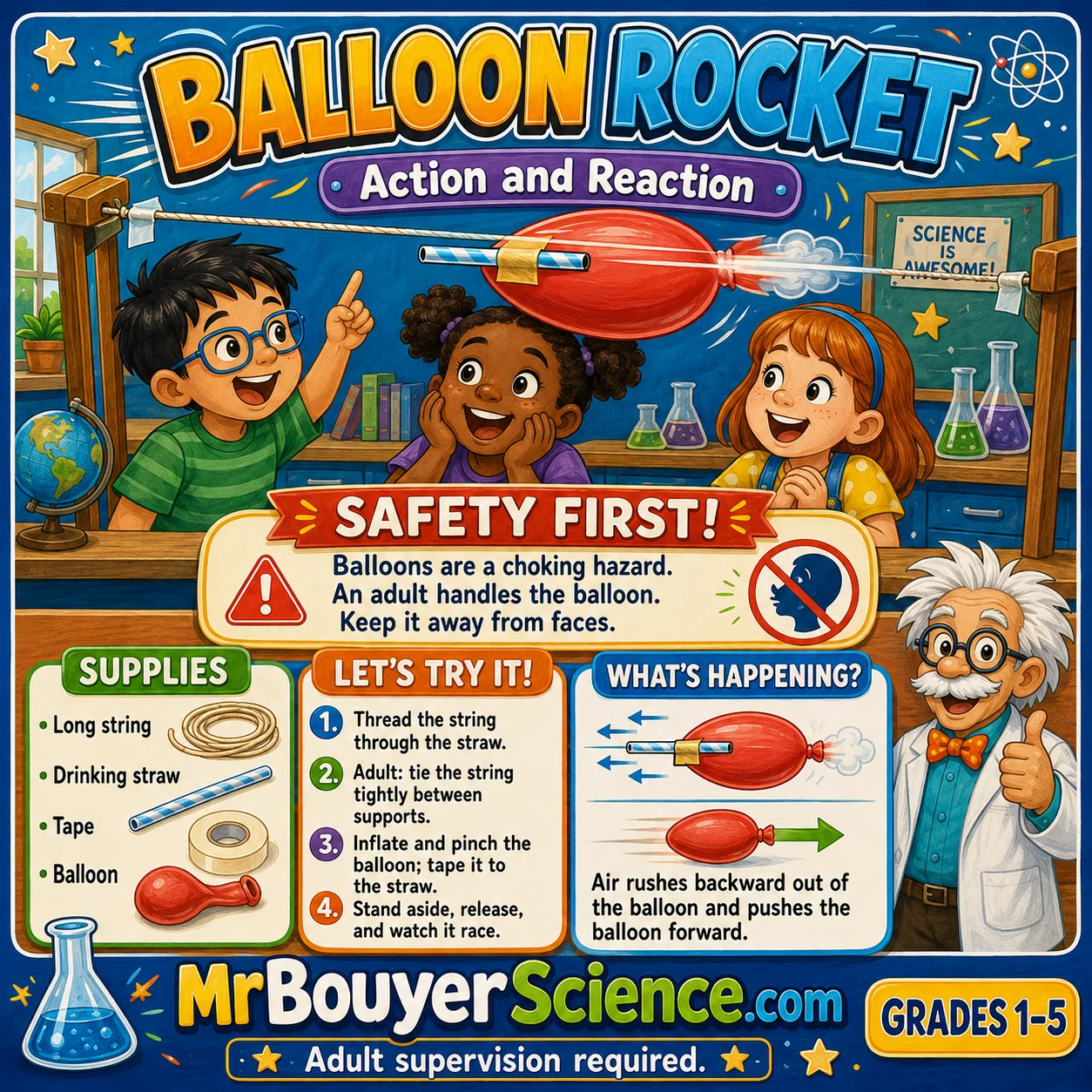
Put this card on the board for the class, or print it. Save the card
1Before class
The day before
- Test one rocket yourself. It takes three minutes and saves ten in class.
- Ask about latex allergies. Buy latex free balloons if any child needs them.
- Blow up one balloon of each kind and check for leaks.
- Give your helpers the helper guide on this page. Let them build one rocket first.
- Tell the K to 5 teacher to bring the class dressed to sit on the floor if needed.
Ten minutes before kids arrive
- Cut five pieces of string, four meters each.
- Slide one straw onto each string before you tie anything.
- Tie one end of each string to a chair or tape it to the wall at the height of a seated child's shoulder.
- Pull each string tight and anchor the far end. Lines should be one and a half meters apart.
- Put a strip of tape on the floor at each start mark.
- Set a tape measure, six strips of tape, four balloons and a trash bag at every line.
- Put this card up on the board.
Safety and care
- An adult stays with every group for the whole activity.
- The older student blows up every balloon. Children never inflate balloons alone.
- Uninflated balloons and broken pieces are a choking risk for young children. Pick up every popped piece at once and drop it in the trash bag.
- No balloons in mouths. No chewing the neck. No wearing balloons on faces.
- Check for latex allergies before you open the bag.
- Strings across the room are a trip risk. Keep lines at shoulder height of a seated child and have children stay beside the line, not in front of the balloon.
- Popping balloons are loud. Tell the class before you start.
2Materials for 15 students
| Item | Per group | Whole class | Notes |
|---|---|---|---|
| String or fishing line, 4 meters | 1 | 5 | Smooth line slides best. Thin is better than thick. |
| Plastic straws | 2 | 10 | Wide straws slide better. One is a spare. |
| Balloons, 9 inch round | 4 | 20 | Three launches plus a spare. Test blow a few. |
| Masking tape | 6 strips | 1 roll | Tear the strips ahead and stick them on a table edge. |
| Tape measure or meter stick | 1 | 5 | Two can be shared if you are short. |
| Chairs or table legs | 2 | 10 | Or tape the string to the wall. |
| Pencils | 3 | 15 | |
| Plain paper, folded in half | 3 | 15 | Each child records their own launches. |
| Trash bag | 1 | For broken balloon pieces. |
How to set up the room
- Run the five lines side by side across the room. Leave one and a half meters between lines.
- Put the start mark at the chair end and the measuring tape on the floor beside the string.
- Seat each group of three on the floor or on chairs behind its start mark.
- Keep walking space clear so helpers can move between lines.
3Run it in 30 minutes
Groups sit behind their lines. Show the board. Ask for a guess. How far will a balloon rocket go with one big breath?
Helpers show one rocket. Each group tapes a balloon to its straw with the neck pointing back. The string stays tight.
Three launches. Small breath, medium breath, big breath. The helper inflates and pinches. A child lets go on the count. Another marks where the straw stops. The third measures.
Bring the class together. Compare which breath went farthest. Ask why.
Pick up every piece. Untie the lines. Count the balloons and straws back in.
4What the kids do
- Look at your string and straw. This is your rocket track.
- Your helper blows up a balloon a little. The helper pinches the neck shut. Do not tie it.
- Tape the balloon under the straw. The neck points back toward the start mark.
- Count down together. Three, two, one. Let go.
- Watch where the air goes. Watch where the balloon goes.
- Mark where the straw stopped. Measure from the start.
- Try again with a bigger breath. Which one went farther?
Match it to the grade
Launch the rocket and watch it go. Say whoosh together. Measure with big steps or a long string of yarn. Talk about the push of the air.
Do three launches with a small, medium and big breath. Measure with a tape measure in centimeters. Say which went farthest.
Record three trials for each breath size. Find the typical distance for each. Make a bar graph. Name what you changed and what you kept the same.
5Helper guide for older students
Your job
- Lead one group of three. Build a rocket the day before so you know the steps.
- Blow up every balloon and pinch the neck before a child holds it.
- Give each child a job. One lets go. One marks the spot. One measures.
- Ask questions and let the children try before you explain.
- Keep the group behind the start mark and beside the line.
Say things like this
- What do you think will happen? Why?
- Where did the air go?
- Let us change one thing and try again.
- That is a good guess. How could we test it?
Please do not
- Do not give away the answer before they test it.
- Do not let a child blow up a balloon alone.
- Do not let anyone stand in front of a launching balloon.
- Do not take the tape or balloon out of a child's hands. Help with your hands over theirs.
- Do not say a guess is wrong. Say let us test it.
6Talk it over
Questions to ask
- Which way did the air go and which way did the balloon go?
- What happened when the breath got bigger? Why do you think so?
- What did we change each time? What stayed the same?
- What could make the rocket go even farther?
- Where have you seen something shoot out the back to push forward?
- Grades 4 and 5. Why did the rocket still stop after the balloon was empty?
The science, in plain words
When the balloon lets air out the back, the air pushes the balloon forward. Push one way and the balloon moves the other way. A bigger breath holds more air and pushes for longer, so the rocket usually goes farther. Friction with the string and the weight of the balloon slow it down.
Where you see it
- A real rocket pushes hot gas out the bottom to climb.
- A squid squirts water out one way and zips the other way.
- A garden hose can jerk back when the water rushes out.
7If it goes wrong
| What you see | What to do |
|---|---|
| The straw will not slide | Check that the tape is only on the straw and not wrapped round the string. Use a thinner string if needed. |
| The balloon barely moves | Pull the string tighter. Pinch the neck harder. Try a bigger breath. |
| The balloon spins and does not travel | Tape the balloon along the straw so the neck points straight back. |
| The rocket stops halfway | The balloon may be dragging on the string. Tape it a little lower and keep it clear of the line. |
| A balloon pops | Pick up every piece. Put it in the trash bag. Use a spare. |
| The air leaks out too soon | Show how to pinch the neck with two fingers. Press the neck flat, not twisted. |
Clean up
- Pick up every balloon piece and bag it
- Untie and coil the string
- Return straws, tape and tape measures to the kit
- Count balloons and straws back in
- Wash hands
Go further
- Try a longer string. Does the rocket go farther?
- Try a long skinny balloon against a round one.
- Tape a paper cup to the straw as a cargo bay. Does it still go as far?
- Slant the string uphill. What happens?
Built by Science Fenns for teachers and student helpers. Keep supervising every group the whole time.