

Science Fenns K-5Grades K to 5
A creek bank cut open to show layered bands of sand, mud and small pebbles with a fossil shell in one layer.

Science / All lessons / Water, Rock and Landforms

Sedimentary Rocks

Layers pressed into stone.

Lesson 28 of 41

Try this first

Before we start

Today’s story

Sedimentary Rocks

Rain and wind wear rock into bits. Sand, mud and small pebbles are called sediment. Rivers carry sediment away, and this is erosion. When the water slows, the sediment drops, and this is deposition.

Sediment settles in layers at the bottom of lakes, rivers and seas. New layers pile on top. The weight squeezes the layers below. Water seeps through and leaves minerals that glue the grains. This is compaction and cementation.

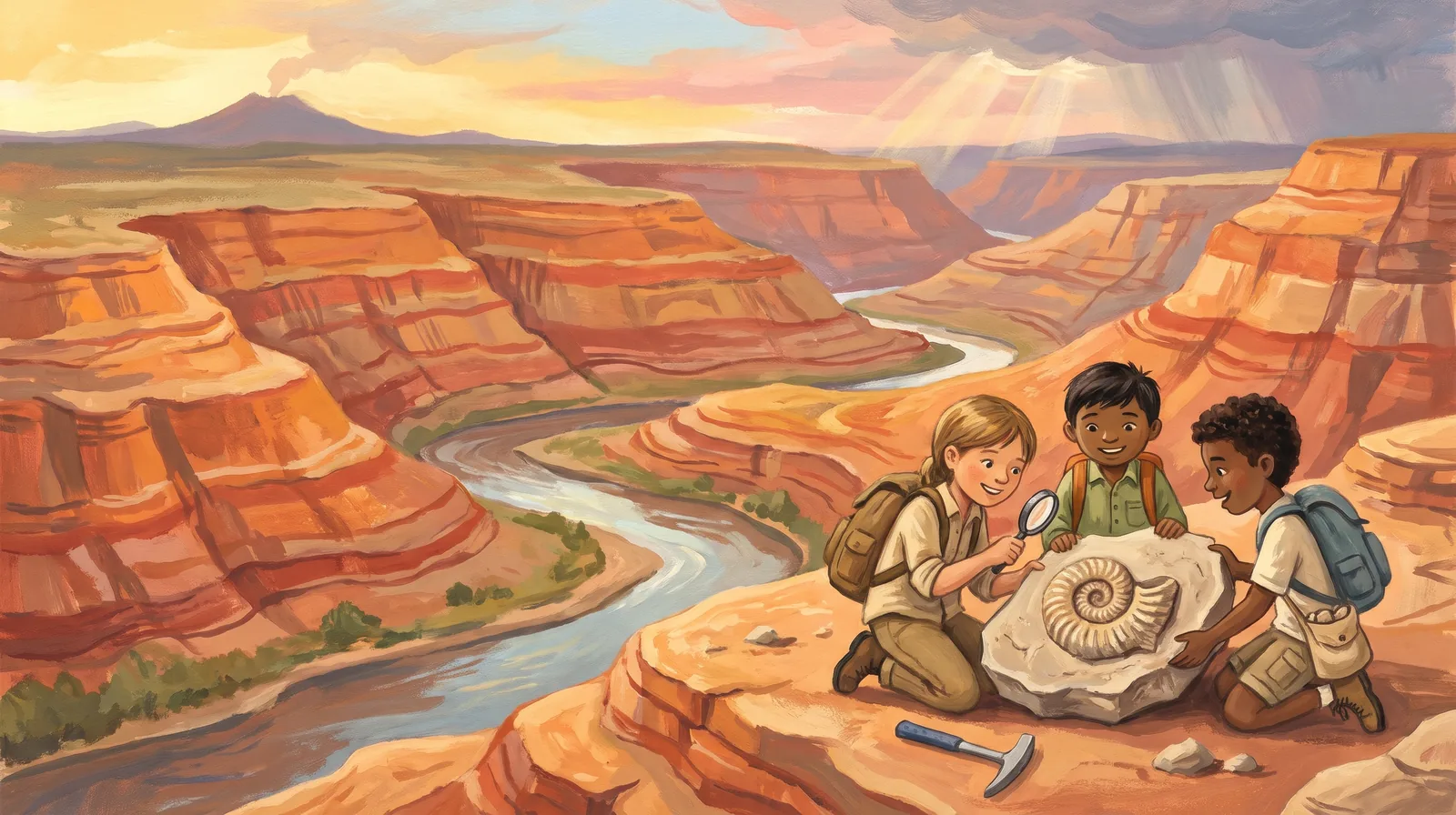
After a very long time the loose sediment is rock. It is called sedimentary rock. Sandstone, shale and limestone are examples. Often fossils are found inside. Here are the steps.

See it

Five steps. Every time.

    Hands on

    Layers in a Jar

    25 minutes plus waiting · Do this with a grown-up nearby

    You need

    • a clear jar with a lid
    • a handful of soil
    • sand
    • small gravel
    • water
    • a ruler

    Do this

    1. Put a scoop each of gravel, sand and soil into the jar.
    2. Fill the jar nearly full of water.
    3. Put on the lid and shake well.
    4. Set the jar down and do not touch it.
    5. Watch the layers settle for a few minutes.
    6. Look again after a day.
    Write or draw: Draw the jar and label each layer with its material. Note which settled first.

    Watch for: The heaviest pieces settle first. The finest stay cloudy longest. Real sedimentary rock forms in the same order.

    Safety: Keep the lid on and wash your hands. Do not drink the water.

    Same every time

    Three rules

    Rule 1Sediment settles in layers.

    Heavy bits drop first.

    Rule 2Pressure and cement make the rock.

    It takes a long time.

    Rule 3Fossils live in sedimentary rock.

    Soft layers can bury living things gently.

    Grandpa Fenn’s notebook

    Say it like a scientist

    sediment
    Small pieces of rock, sand, mud or shell that settle.
    erosion
    Wind or water moving bits of rock from place to place.
    deposition
    When moving water or wind drops the sediment it carries.
    sedimentary rock
    Rock formed when layers of sediment are pressed and cemented.

    Poppy’s quiz

    Six questions

    Tap an answer. Green means right. You will see why.

    Talk about it

    Say it out loud

    • What evidence in a rock tells you it began as sediment?
    • Have you seen layered rock in a road cut or creek bank near you? What did it look like?
    Did you know

    Much of Texas sits on sedimentary rock that formed under shallow seas long ago, which is why limestone and seashell fossils turn up so far from the coast.

    Someone who does this

    A geologist studies rocks and layers to learn the history of the land.